In this guide 17 sections ▾
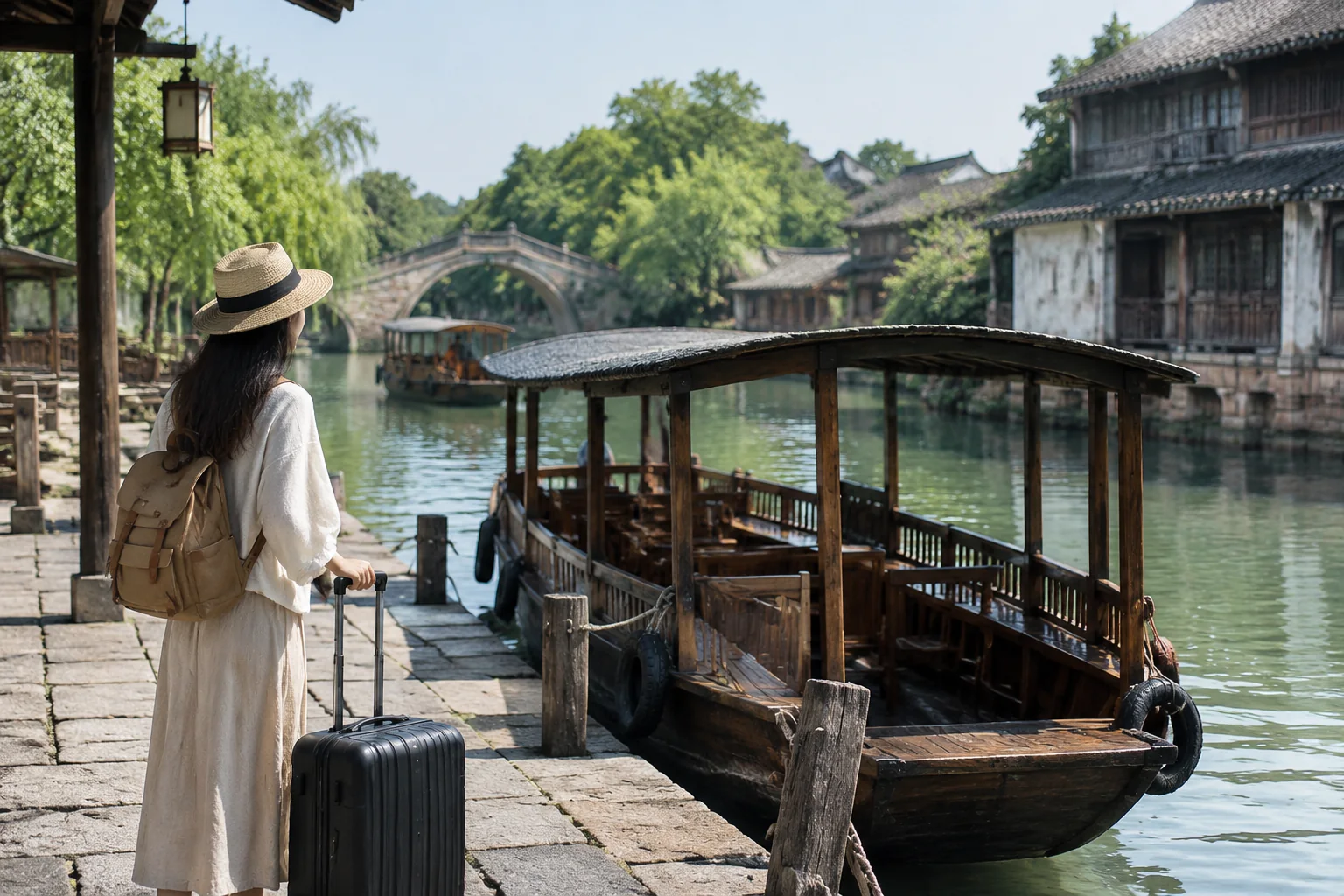
Wuzhen’s East and West scenic areas look close on a map, but they are not one continuous pedestrian zone. The practical plan is usually to use the East–West shuttle for the main transfer, walk the lanes for atmosphere, and add a boat only when it improves the day. The real question is not which transport is best, but which transport fits your ticket, your energy and the time you have before services stop. This guide covers the categories and the decisions behind them. Because transport details can change, confirm current operations on the scenic area’s official channel and at the visitor centre or ticket desk before you rely on them.
Wuzhen Internal Transport at a Glance
Use this section to choose the right tool, not to assume a timetable. The stable planning point is that East and West are separate scenic areas with separate entrances and transport arrangements. The details that change are operating hours, frequency, boarding points, ticketing, ticket validity and whether a particular service is running at all. Check the scenic area’s official website or official social account linked from your ticket, booking confirmation or the scenic area’s own material, then confirm again at the visitor centre on arrival. If you cannot find a current notice online, ask staff before you build your day around a service.
| Mode | Best for | Strength | Main limitation | What to check on the official channel and on site |
|---|---|---|---|---|
| Walking the lanes | Seeing alleys, bridges, museums and waterside details | Flexible; you choose the pace and can stop often | Does not solve the East–West transfer; stone lanes and bridges can be tiring | Which entrance you are using, and whether your ticket allows re-entry |
| East–West shuttle | Moving between the two scenic areas | Saves a long transfer and is useful for short stays | A daytime link is the safe planning assumption, not an all-hours service; frequency can vary | Operating status, boarding point, frequency, first and last departures, whether a ticket check or booking is needed, luggage policy |
| West entrance ferry | Arriving at the West Scenic Area | Makes the entrance part of the water-town experience | It is a transfer, not a private cruise; queues are possible | Whether it is running, whether it is included or separately charged, boarding point, late-arrival arrangements, weather adjustments |
| Hop-on water bus | Resting while moving between riverside stops | More flexible than a continuous tour; useful for short hops | Stops and boarding points may not match your sightseeing plan | Route, stops, payment method, last boarding time, capacity |
| Per-boat tour | A continuous scenic ride, especially for a group | Fixed seating and a set route; the boat is yours for the trip | Capacity is limited, and the rate basis needs checking before you commit | Rate basis, capacity, duration, departure point, day and evening differences |
If you remember one thing, remember this: the shuttle is transfer infrastructure, the West entrance ferry is arrival infrastructure, and the boats are experiences in their own right. Do not treat all three as the same kind of transport.
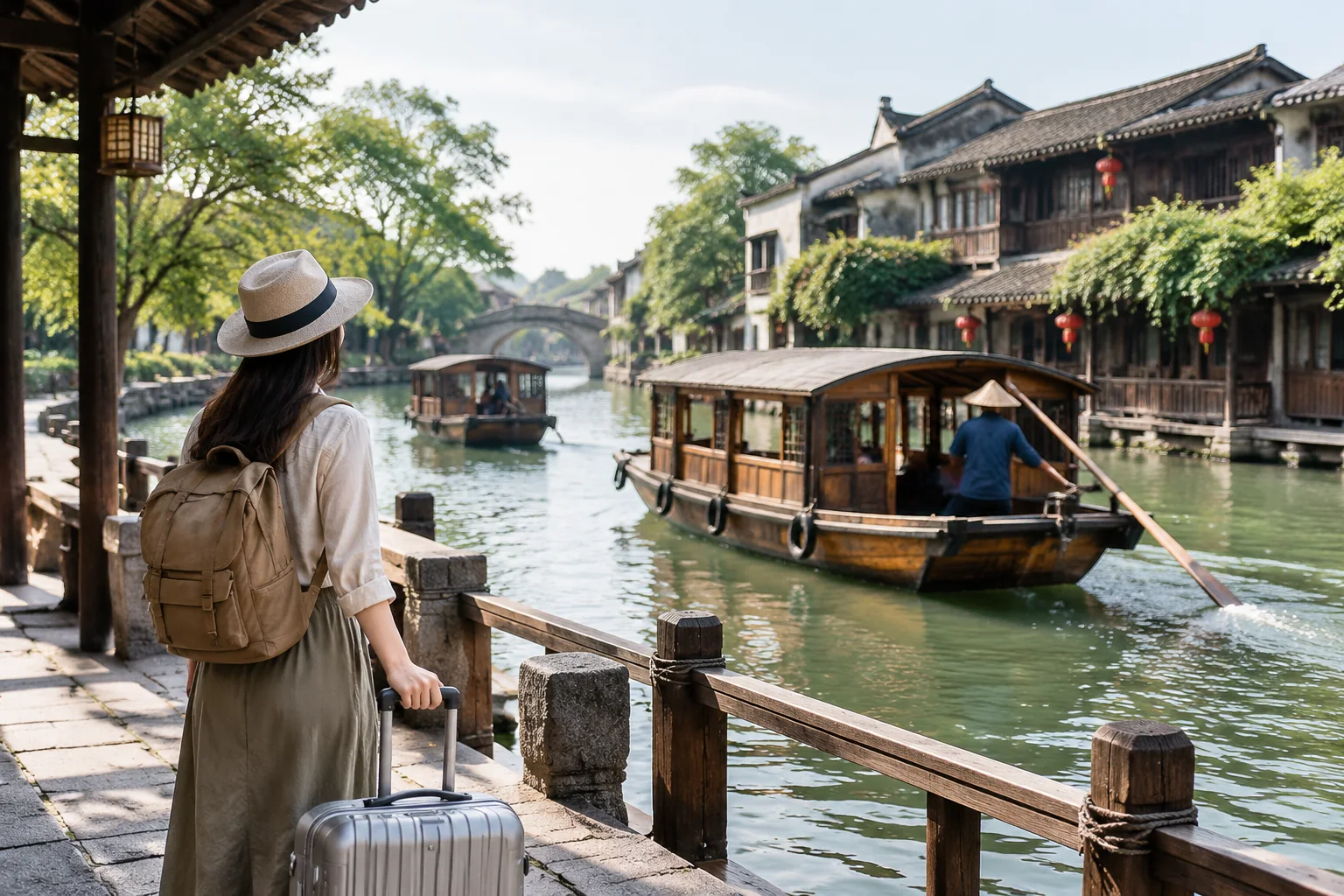
The East–West Shuttle: When It Helps and When It Does Not
When it is running, the shuttle is the most useful piece of planning for a one-day visit. It is the tool for changing base: seeing East in the morning and West in the afternoon, staying near one area and visiting the other, travelling with limited time or light shopping, or keeping a group from improvising a cross-area transfer. It is less useful if you plan to bounce back and forth. Each transfer costs waiting time, and a single-entry ticket may make an unnecessary return impossible. Check your ticket rules before you leave one area for the other.
On arrival, ask four questions at the visitor centre or ticket desk: Where exactly does the shuttle board? What are the first and last departures today? Does it require a ticket check or a booking? How often is it actually running at this hour? Note the answer or photograph the notice. Then keep a fallback: if the queue is long or the service has stopped, ask staff for the current alternative rather than relying on an old guide.
Do not assume the shuttle carries large luggage, and do not assume it runs after dark. A daytime link is the safe planning assumption unless staff confirm otherwise. If you are staying inside West and visiting East, make the transfer once in each direction and leave a generous buffer before the last departure. If you are visiting for one day, do the cross-area move once and spend your time in the areas rather than on the link between them.
Before departure, use the scenic area’s official website or official social account to look for transport or service notices. Look specifically for whether the shuttle is operating, where it boards, whether it is included with your ticket or separately ticketed, and whether the timetable changes at weekends, holidays or in bad weather. If the official channel has no current notice, treat the visitor centre as your source of truth on the day.
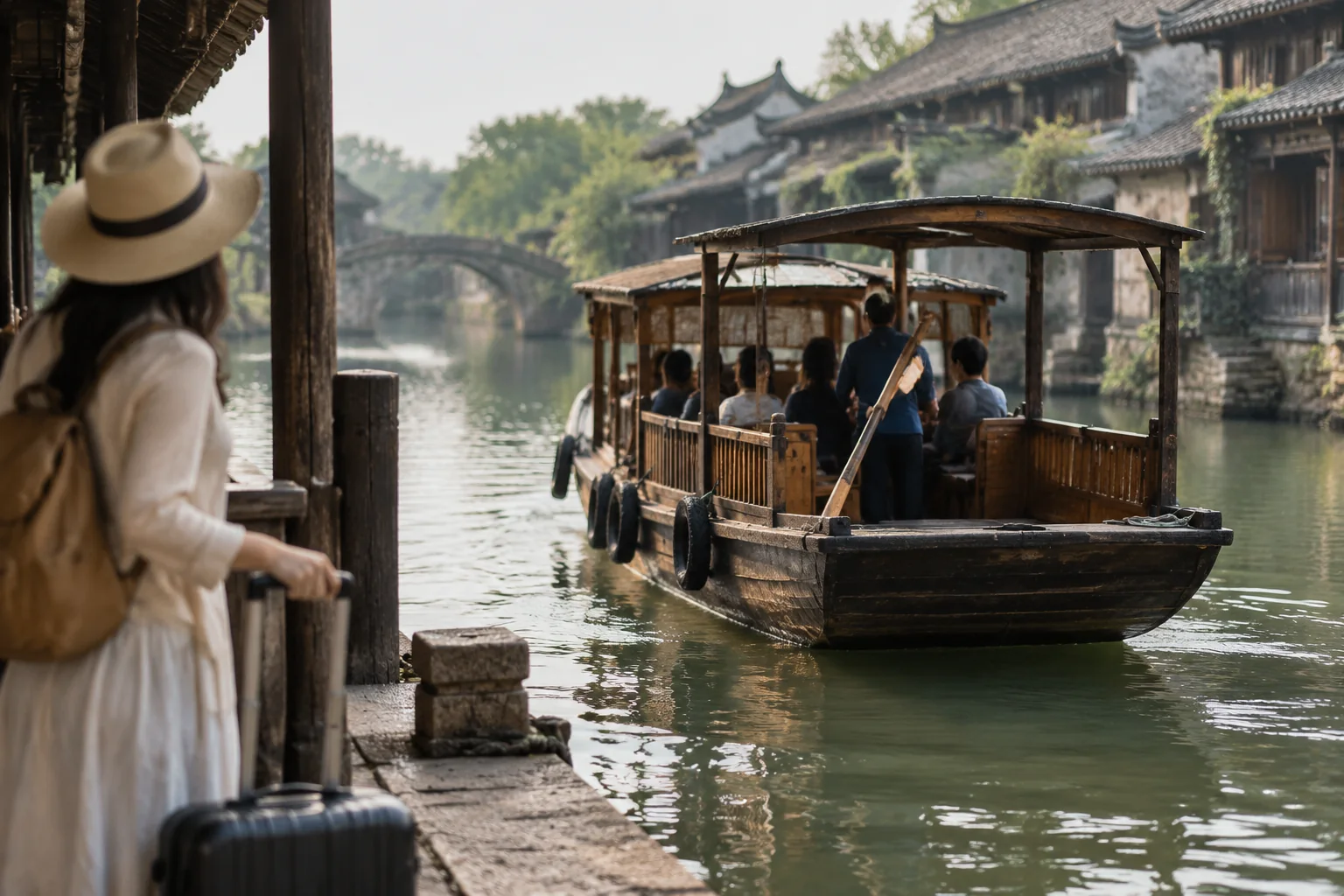
Water Buses and Boat Taxis: What You Are Actually Buying
Wuzhen’s water transport is easier to understand if you separate the shared water bus from the tour boat. The phrase boat taxi can mislead if you imagine hailing a metered craft to any address. The services described for Wuzhen are closer to a shared water bus or a tour boat with a set route. If you need point-to-point transport, ask staff which service, if any, does that; do not assume a boat will take you directly to your hotel or to the other scenic area.
A shared water bus is the hop-on option. It suits travellers who want to rest their legs, cross a stretch of water, or reach a waterside stop without committing to a full tour. It is not a comprehensive sightseeing circuit, and it will not replace walking through the lanes. Boarding points can be small, queues can form, and the last boat may matter more than the first. Ask at the dock or ticket desk whether the water bus is ticketed per segment, per ride or in another way, and do not assume one payment covers all hops.
A tour boat is a different purchase. It is a continuous ride with fixed seating and a set route. Before buying, ask whether the rate is per boat or per person, how many people the boat holds, how long the ride lasts, where it departs from and whether day and evening trips differ. That structure matters for groups: compare the total only after you know the rate basis. A solo traveller should ask whether a shared boat or a shorter hop is better value. Confirm capacity before assuming everyone in your party fits in one boat.
Children, strollers and luggage all affect the decision. Ask whether children count toward the boat’s capacity, whether a stroller can be taken aboard, and whether bags can be carried. Do not buy a tour boat before checking its departure point; the entrance ferry and the tour boats are not the same service. In wet or windy weather, ask whether boats are running normally rather than assuming they are.
The West Scenic Area Ferry and First Arrival
Ask whether the West entrance water crossing is operating. If it is, treat it as part of arrival rather than as a paid tour. The distinction matters: if you have already booked a tour boat, do not assume the entrance ferry is the same experience or that it departs from the same place. Confirm at the ticket desk whether the entrance crossing is included with access to the West area or separately charged, and where passengers board.
Keep your ticket accessible, follow the signs for the entrance ferry rather than for the tour boats, and allow a buffer on first arrival. The crossing itself may be short, but queues, ticket checks and finding the correct entrance can take longer than expected. If you are staying inside the West Scenic Area, ask your accommodation about arrival arrangements and luggage before you reach the gate. Porter service and luggage rules vary, so get the answer before you arrive with bags.
Do not schedule a tight connection immediately after the ferry. If you arrive late in the day, confirm that the entrance crossing is still operating and that your ticket is valid for the access you need. The same caution applies in wet or windy weather: ask staff whether the ferry is running normally. If it is not, ask for the current alternative rather than walking to a different pier on an old assumption.
Sequencing East and West Around Ticket Rules
East and West have different characters. East is the more compact heritage area, with old lanes, cultural houses, workshops and sights such as Fengyuan Twin Bridge, Jiangnan Hundred Beds Museum and Mao Dun’s Former Residence. West is larger and more oriented towards waterways, shops, evening atmosphere and a slower wander. A useful starting point is to treat East as a half-day visit and West as somewhere to linger into the evening, but that is a planning pattern, not a rule.
The ticket rule is the part that can break a plan. Do not leave East for lunch in West and expect to re-enter East later without checking. Ask at the ticket desk whether your ticket is single-entry or allows re-entry, what areas it covers, and whether a combined East–West ticket exists. Read the current ticket terms on the official channel or at the desk; do not rely on old descriptions of how admission worked.
A sensible one-day sequence is East in the morning, lunch, the shuttle to West, then West through the afternoon and evening. Keep the boat optional. Trying to fit an East loop, a shuttle, a West walking route and a night boat into one day can leave you queuing rather than looking. For two days, give East its own slower morning and West a separate afternoon and evening, using the shuttle once rather than treating it as a personal taxi.
If you are staying in West and visiting East, confirm two things before you go: whether your ticket permits the return you are planning, and when the last shuttle actually leaves. If the shuttle is not running, ask at the visitor centre for the current fallback. Do not improvise a route from an old map that does not show today’s closures or service changes.
Boat, Bridge or Walking: Choosing Your Mode
Walking is still the main way to see Wuzhen. The lanes, bridges, doorways and waterside details are the destination; a boat moves you past them rather than through them. Use walking for the compact sightseeing circuit, the shuttle for the East–West transfer, and a boat when you want a different perspective or a rest.
A useful decision rule is to choose the boat that matches the job. If you want flexibility, take the hop-on water bus for a short segment. If you want a continuous ride and are travelling as a group, compare a tour boat with the cost of several individual seats only after confirming the rate basis. If you have half a day in East, a short loop may be enough; confirm the departure point and timing before you buy. If you are staying overnight in West, an evening boat may suit the atmosphere better, but confirm the departure point and last trip.
Families should ask about capacity and whether children count towards the boat’s fixed seating. Travellers with limited mobility or a stroller should not assume step-free access to boats or between lanes; boarding often involves steps or uneven edges. Ask staff before buying a ticket. Accessibility details are not uniform, so explain what you need and ask which entrance and which boat, if any, are most practical. In wet weather, stone surfaces and boat boarding can be less comfortable, and services may be adjusted; check rather than assume.
Common Planning Mistakes and a Pre-Trip Checklist
The most common mistake is treating East and West as one continuous scenic zone. They are separate areas with their own entrances and ticket rules, linked by a transfer that needs checking. The second mistake is relying on an old shuttle timetable, especially in the evening. The third is leaving East on a single-entry ticket and assuming re-entry is automatic. If your ticket is single-entry, plan East and West as two separate visits rather than a casual back-and-forth.
Other easy errors include expecting a metered boat taxi, buying a tour boat before checking its departure point, assuming the entrance ferry and the tour boats are the same service, and carrying large luggage onto a shuttle or boat without asking. Build in waiting time, and do not make a boat your only way of reaching a fixed appointment.
A practical pre-trip checklist:
- Confirm your ticket type and whether it covers one area or both, and whether it is single-entry or allows re-entry.
- Check the scenic area’s official website or official social account for transport and service notices before departure.
- Ask for the shuttle’s boarding point, frequency and first and last departures, then confirm again on the day.
- Ask whether the West entrance ferry is operating and whether it is included with your ticket or separately charged.
- Check water-bus stops, payment method and last boarding time.
- For a tour boat, confirm rate basis, capacity, duration and departure point.
- Ask about luggage rules and accessibility before committing.
- Check weather and ask whether boats are running normally.
- Keep a flexible buffer between the shuttle, the ferry and any booked boat.
FAQ: Wuzhen Transport Questions Travellers Actually Ask
Can I walk from Wuzhen East Scenic Area to West Scenic Area?
Do not assume the two areas are connected by one continuous pedestrian route. They are separate scenic areas, and the intended link is the shuttle or another transfer confirmed locally. Ask at the visitor centre for the current route, then allow a generous buffer rather than planning a tight walking connection.
Is the East–West shuttle free, and does it run at night?
Do not rely on old descriptions of a free daytime shuttle. Ask at the visitor centre or check the scenic area’s official channel for the current ticketing, operating hours and last departure. Do not plan an evening shuttle unless staff confirm that one is running.
Do I need to pay extra for the water bus and tour boats?
Treat them as separate products unless your ticket says otherwise. Ask at the ticket desk whether the water bus is ticketed per segment or per ride, whether the tour boat rate is per boat or per person, and whether the entrance ferry is included with access to West. Get the answer before boarding.
Which is better for a first visit: the shuttle or a boat?
They do different jobs. The shuttle is transfer infrastructure; the boat is an experience. If you have one day, use the shuttle to move from East to West and add only one boat ride if it fits your schedule. If you have more time, walk first, then take a boat when you want to slow down.
How should I plan a one-day visit around the transport?
Start with East in the morning, when the lanes and cultural houses suit a walking pace. Check ticket validity before leaving East. Move to West after lunch by shuttle, then spend the afternoon and evening there. Keep the boat optional so that queues do not take over the day, and confirm the last shuttle, ferry and boat before you commit to a late plan.
Is Wuzhen easy to visit with limited mobility?
Do not assume a step-free route or accessible boat boarding. The lanes, bridges and boat edges may present difficulties, so ask staff at the ticket desk before buying transport. Explain what you need and ask which entrance and which boat, if any, are most practical. Check the official channel for published accessibility information; if none is available, ask on site.
Sources and Verification
This guide is a planning aid, not a live timetable or fare sheet. Before departure, check the scenic area’s official website or official social account and the visitor centre or ticket desk for: shuttle operating status, boarding point, frequency, first and last departures, ticket checks and luggage rules; West entrance ferry operation and ticketing; water-bus stops, payment method and last boarding; tour-boat rate basis, capacity, duration and departure point; ticket validity and re-entry; weather adjustments; and accessibility. No official URL is printed here. Use the official channel listed on your ticket, booking confirmation or the scenic area’s own material, and confirm the details again when you arrive.
Find places & plan your visit
These links open external search results. Confirm the exact place, entrance and current arrangements.
Need help planning your trip?
Tell us about your travel plans and send an inquiry.