In this guide 17 sections ▾
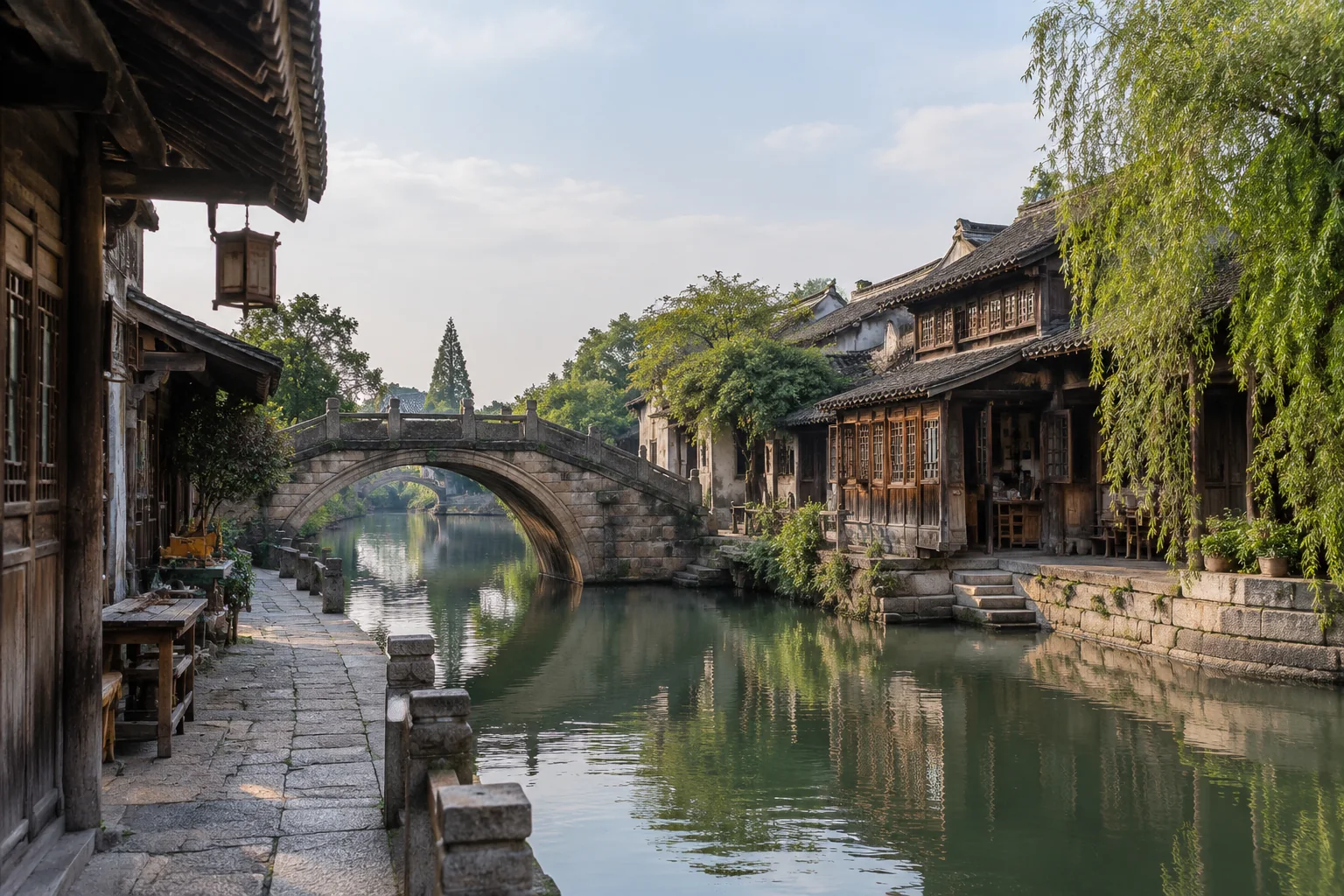
Short answer: build this literary walk around Dongzha, the older east scenic area, where Mao Dun’s Former Residence stands on Guanqian Street. Treat the house as the anchor, add one or two nearby cultural stops, and leave Xizha for a separate evening or another day. The evidence supports a compact cultural route, not a house-by-house map of Mao Dun’s fiction.
This guide is for travelers who want a slower literary layer in Wuzhen rather than a checklist of photo stops. It assumes you can set aside roughly half a day for the East Scenic Area, with the option of extending if museums and performances interest you. The main limitation is verification: the available references are older guidebook material, so current opening hours, ticket inclusions, room access, performance schedules and transport links must be checked before you go.
Why This Walk Works Best in Dongzha
Dongzha is the natural setting for a Mao Dun walk because the residence is part of its historic street fabric. The reference material describes East Scenic Area as the part of Wuzhen with more traditional residents, old-street workshops and cultural relics, while West Scenic Area is larger and more associated with shops and evening scenery. That does not make one area better than the other; it means they serve different purposes.
For a literary visit, Dongzha gives you a compact sequence: a bridge, a lane, a house, a stage and a workshop street. You do not need to “cover” every museum. The useful approach is to choose a small number of stops that help you read the town as a place of rivers, timber houses, family education, local opera and commercial life. If you try to connect every sight to a novel, the walk becomes a forced treasure hunt rather than an encounter with a writer’s world.
Mao Dun’s Former Residence: The Biographical Anchor
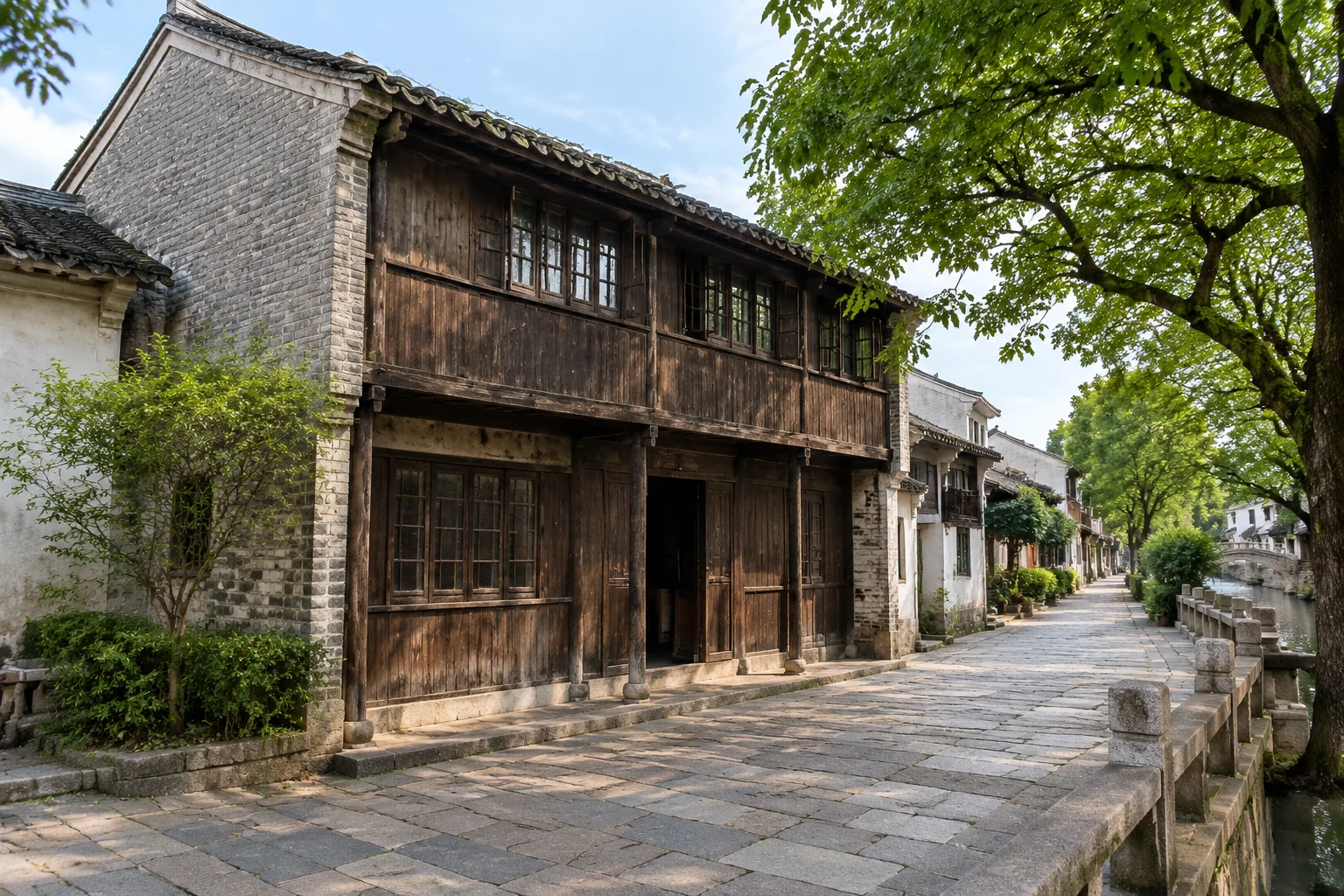
Mao Dun (茅盾), born Shen Yanbing, is one of modern China’s major writers and served as the first culture minister after the founding of the People’s Republic. The reference guide places his former residence on Guanqian Street (观前街), on the east side of the East River, and gives the address as No. 17 Guanqian Street. It describes a south-facing, brick-and-timber Jiangnan house, with four generations of the family living there from Mao Dun’s grandfather onward.
The building is modest rather than monumental: a two-storey timber-framed house with four bays and two depths, according to the guide. One street-facing room on the west side is identified as the family schoolroom where Mao Dun studied. That detail is more revealing than any grand display. It connects the future novelist to a domestic routine of books, discipline and a street-level view of town life.
The residence is also the best place to separate biography from fiction. It tells you where Mao Dun came from; it does not turn every nearby bridge or shop into a scene from a novel. The guide notes that works such as Spring Silkworms, Autumn Harvest and The Lin Family Shop recreate fragments of 1930s Jiangnan water-town life, and that some works directly describe Wuzhen and nearby rural areas. Read that as regional grounding, not as a promise that each literary location has an identifiable address.
Reading the House and the Novels Together
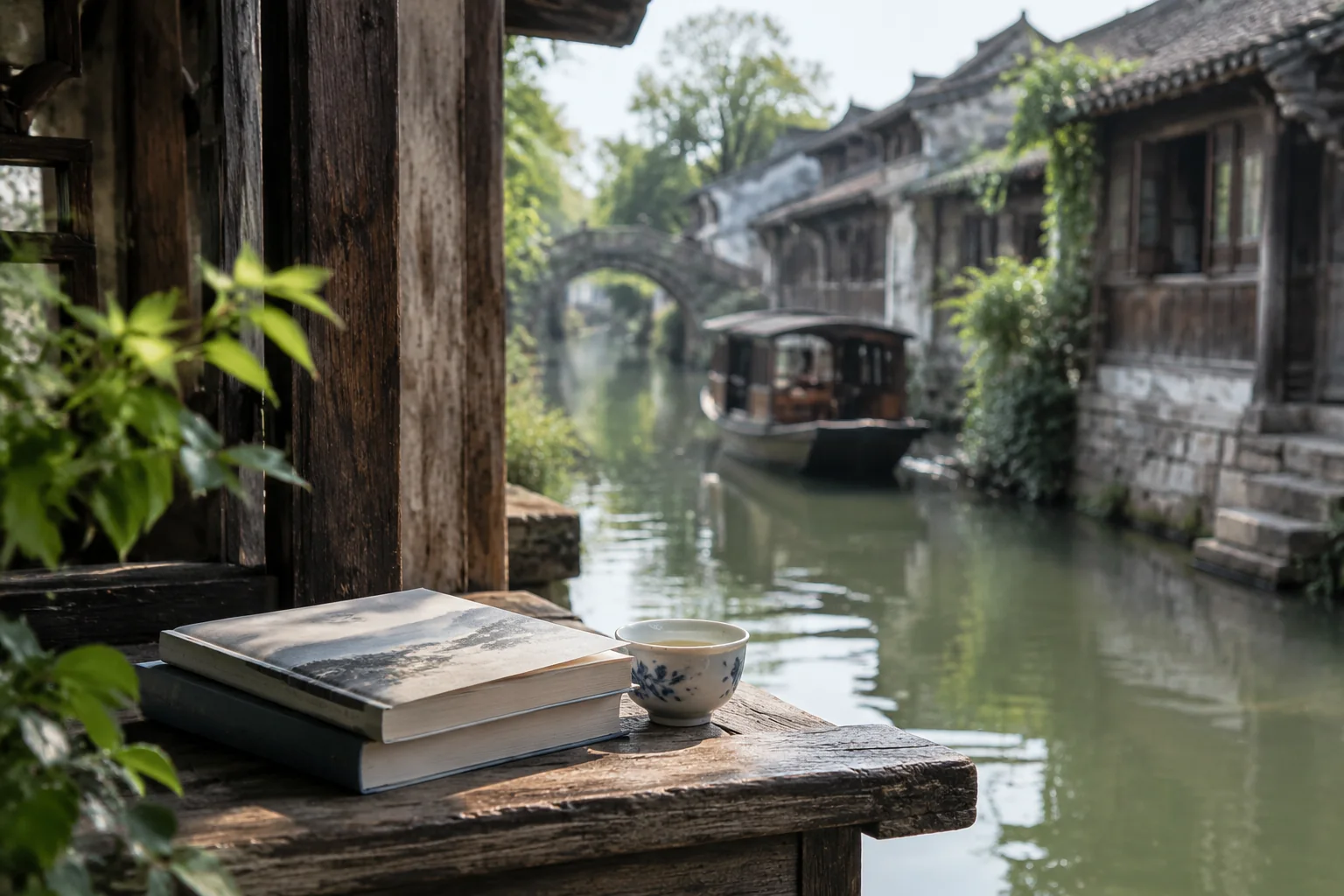
A useful way to approach the residence is to look for the material world that made the fiction possible: narrow street frontage, timber construction, family rooms, the proximity of river and lane, and the mixture of residence and trade in the old town. The guide describes the interior as simply furnished, with an atmosphere associated with the Shen family. Current furnishings and room access may change, so treat the house as a historic setting rather than a fixed exhibition.
Before visiting, read one short work rather than trying to prepare a whole bibliography. Spring Silkworms or The Lin Family Shop is enough to attune you to the guide’s themes of rural livelihood, small-town commerce and social pressure. Midnight is also mentioned as one of his major novels, but its urban scope is less directly connected to a walk through Wuzhen’s lanes. The point is not to match plot points to buildings; it is to notice how a water town’s physical scale shapes the human stories told about it.
A Gentle Literary Route Through Dongzha
Start at the entrance to Dongzha and cross Fengyuan Double Bridge, the paired bridge arrangement named in the guide’s route. Use the first part of the walk to settle into the old street rather than rushing to the residence. If you want context, choose one museum only: the Jiangnan Folk Museum for late Qing and Republican-era customs, or the Jiangnan Hundred Beds Museum for domestic craft and furnishing. Doing both plus the wood-carving museum is likely to exhaust your attention before you reach the literary core.
Move on to Guanqian Street and give Mao Dun’s Former Residence the largest single block of your time. Look at the house from the street before entering; the relationship between the facade, the lane and the river is part of the experience. Inside, focus on the family schoolroom and the domestic scale rather than trying to read every label. If rooms are closed or the display has changed, accept that the house is a historic building with conservation needs, not a guaranteed full reconstruction.
After the residence, continue to the Ancient Opera Stage, which the guide describes as an attachment to Xiuzhen Temple with a two-level stage and detailed timber carvings. It is a good architectural stop even without a performance. The old route then links shadow puppetry at Hanlin Di and the traditional workshop street, ending optionally at Huiyuan Pawnshop. Performances and opening arrangements must be checked on the day; do not build the entire walk around an unverified performance time.
End along the water or in the workshop lanes, where the old guide’s route returns by boat or by the stone-paved south bank. This is the moment to let the literary framing recede and simply notice the town’s working texture: dye workshops, food workshops, river traffic and street-level commerce. That texture is more valuable to a literary traveler than another plaque.
Beyond Mao Dun: Wuzhen’s Older Scholarly Layer
The guide places Wuzhen within a much longer scholarly tradition. It names Shen Ping as a compiler of an early Wuzhen town gazetteer, Zhang Yangyuan as a philosopher, Bao Tingbo as a bibliophile, and late-Qing figures such as Yan Chen and Xia Tongshan. These names are useful as background, not as a second must-see checklist. They explain why a small water town could present itself as a place of books, collecting, examination success and local history.
The most striking older figure in the guide is Crown Prince Zhaoming, Xiao Tong of the Liang dynasty. Local tradition summarized in the reference places him in Wuzhen, where he is said to have built a study hall and read for years, and associates him with the compilation of the Zhaoming Wenxuan (Selections of Refined Literature), an anthology described as highly influential in Chinese literary culture. This is deeper historical background rather than a clearly mapped modern visitor stop in the supplied material. Treat it as a layer of the town’s self-image, not as a site you can confidently locate without current local information.
Dongzha or Xizha? A Literary Comparison
For a Mao Dun walk, Dongzha is the clear starting point. Xizha can be added for evening atmosphere or a second day, but it is a separate scenic area rather than a continuation of the same lane walk. The old guide suggests East Scenic Area first and West Scenic Area later, including its night views; use that as a sequence idea, not as a current crowd forecast.
| Choice | Why it matters for a literary visit | Planning tradeoff | What to verify |
|---|---|---|---|
| Mao Dun’s Former Residence | The biographical anchor, with the family schoolroom and domestic scale of the house | Give it priority over a long museum circuit | Current room access, opening status and ticket inclusion |
| Guanqian Street | The street address helps place the house within the old town | Use it as orientation, not as a separate ticketed sight | Current visitor entrance and any crowd controls |
| Ancient Opera Stage | Architectural and performance context attached to Xiuzhen Temple | Add it if the timing fits; do not plan the day around unverified performances | Same-day performance listings and access |
| Jiangnan Folk Museum or Hundred Beds Museum | Social history and domestic craft that help you read the water-town world | Choose one rather than trying to see every museum | Opening status and whether included in the current ticket |
| Dongzha versus Xizha | Dongzha is the more compact cultural core; Xizha is a separate area with stronger evening associations in the guide | Keep them as alternatives or separate blocks, with a transfer buffer if doing both | Current ticket combinations and local transport between areas |
Practical Planning: Tickets, Transport, Weather and Access
The reference guide records an old Dongzha ticket price and a long list of sites it covered, including Mao Dun’s Former Residence, the Ancient Opera Stage, the dye workshop and several museums. Do not use those figures as today’s prices. Ticket types, combination tickets and the list of included buildings need confirmation through current official channels, especially if the residence is your main reason for visiting.
For arrival, the Zhejiang guide describes Tongxiang railway station as the rail gateway and mentions a local bus connection onward to Wuzhen. It also refers to trains from Hangzhou and Shanghai. These are older planning details, not a current timetable. Check present rail services, station-to-town bus routes and the return journey before setting out. Wuzhen itself is described as lying in northern Tongxiang, roughly 17 kilometres from the city, so allow a realistic transfer buffer rather than assuming a seamless station-to-scenic-area connection.
Wuzhen has a wet subtropical climate, and the guide notes rain as well as the possibility of typhoons in late summer and autumn. Carry rain protection and check the forecast. The guide’s aesthetic preference is for spring and autumn and for early morning or evening light; that is not a guarantee of good weather, quiet lanes or ideal photography. Historic lanes, bridges and old buildings may be slippery in rain.
The supplied material does not provide a verified step-free route through Dongzha or the residence. If you have limited mobility, ask the scenic area directly about entrances, bridges, thresholds and indoor access before relying on any general claim that the walk is easy. Families may find the visual performances and workshop displays more engaging than long label reading, but content, language and timing should be checked for children.
Common Mistakes and a Pre-Trip Checklist
The first common mistake is treating fiction as a map. Mao Dun’s novels draw on the region, but the guide does not support a precise novel-scene trail through Wuzhen. The second is trying to combine Dongzha and Xizha as one continuous literary walk. They are separate areas with different characters; if you visit both, state the transfer explicitly in your plan and keep the literary core in Dongzha. The third is overloading the day with museums. One context museum is usually enough before the residence.
A practical checklist:
- Confirm current opening hours, ticket types and whether Mao Dun’s Former Residence is included.
- Check whether the residence’s rooms or displays are fully or partly open.
- Look up same-day performance listings for the Ancient Opera Stage and shadow puppetry.
- Verify the current rail and bus route from Tongxiang, including the last return connection.
- Check the weather and bring footwear suitable for wet stone lanes.
- Ask directly about accessibility if anyone in your group has limited mobility.
- Read one short Mao Dun work before arrival, but do not expect a one-to-one literary map.
- If you want planning help around pacing, family needs or a short stay, use the inquiry form at the end of this guide.
FAQ
Is Mao Dun’s Former Residence in Dongzha or Xizha?
The reference material places it in Dongzha, on Guanqian Street, on the east side of the East River. It is part of the older east scenic area rather than the West Scenic Area. Verify the current visitor entrance and ticket arrangements before you go, because scenic-area management can change.
Do I need to read Mao Dun before visiting the house?
No, but one short work helps. Spring Silkworms or The Lin Family Shop gives you a sense of the rural and small-town world the guide connects with his writing. The residence is a historic family house, not a literary theme park, so reading is a way to deepen attention rather than decode a fixed set of exhibits.
How long should I allow for the literary walk?
The old guide treats East Scenic Area as a half-day visit, and that is a reasonable planning starting point for the literary core. Add more time only if you want a museum and a performance as well. Do not treat any published estimate as a guarantee, since queues, closures and your own pace will affect the visit.
Can I combine Dongzha and Xizha in one day?
It is possible, but it is not a single gentle walk. The two areas are separate, and the old guide treats East Scenic Area as the cultural and residential core and West Scenic Area as larger, with stronger evening associations. If you do both, keep an explicit transfer buffer and decide in advance which one will be shortened.
Is this walk suitable for children or visitors with limited mobility?
Children may respond to the visual stops, especially performances and workshop displays, but check timings and content. For limited mobility, the supplied sources do not verify a step-free route. Historic bridges, thresholds and narrow lanes may be difficult; ask the scenic area for current access information rather than relying on general assurances.
Sources and Verification
This article draws on two internal reference documents: Wuzhen Guide (乌镇攻略), especially pages 3, 4, 5, 6, 9 and 17, and Zhejiang Guide (浙江攻略), page 18. These are internal reference PDFs, not public web pages or current official notices. Page numbers refer to the original PDFs. They are older guidebook-style materials, and no independent publication or fact-check date is asserted here.
The Mao Dun biography, residence layout, Guanqian Street address, nearby cultural stops and the Zhaoming Crown Prince background are source-backed background. They should not be read as a current audit of opening hours, room access, ticket prices, performance schedules, transport routes or accessibility. Those details need confirmation through official scenic-area and transport channels before publication or travel.
Find places & plan your visit
These links open external search results. Confirm the exact place, entrance and current arrangements.
Need help planning your trip?
Tell us about your travel plans and send an inquiry.