In this guide 21 sections ▾

Quick answer: which water town should you sleep in?
If your priority is the water town after dark with the least logistical friction, stay inside or immediately outside Wuzhen’s West Scenic Area (西栅). If your priority is old architecture, low-key lanes and a family-run room beside the canal, base yourself in the Bai Jian Lou (百间楼) area of Nanxun Ancient Town (南浔古镇).
That is the short version. The longer version is that these two places offer different kinds of stay rather than different price points, and the choice is shaped by three things: whether you want to be inside a ticketed scenic area at night, how much variation in room quality you are willing to accept, and how much transfer time you want to spend between towns.
This guide is for independent travelers coming from Hangzhou or elsewhere in the region who are choosing an area first and a specific property second. The reference material behind it is older guidebook text: it describes area character, building types and room categories, but it does not give verified current rates, opening hours or booking conditions. Treat everything time-sensitive here as something to confirm directly with the scenic area or the property before you commit.
Two decisions: which town, and which side of the gate
The area decision and the property decision are separate, and most planning mistakes come from mixing them up.
- Choose the town first. Wuzhen is the more staged, more amenity-rich water town; Nanxun is smaller in tourist footprint and leans on its old residences and canal-side lanes.
- Then choose your side of the gate. In Wuzhen this matters a lot: sleeping inside the West Scenic Area, sleeping just outside its gates, and sleeping in Tongxiang town are three genuinely different experiences.
- Then choose the room type. Riverside family inns vary from purpose-built guest rooms to converted rooms in old houses. Bed configuration, bathroom, heating and breakfast are property-by-property questions, not area-level facts.
Background descriptions in the reference guides support the first two steps well. The third step can only be resolved by asking the property.
Staying inside Wuzhen’s West Scenic Area
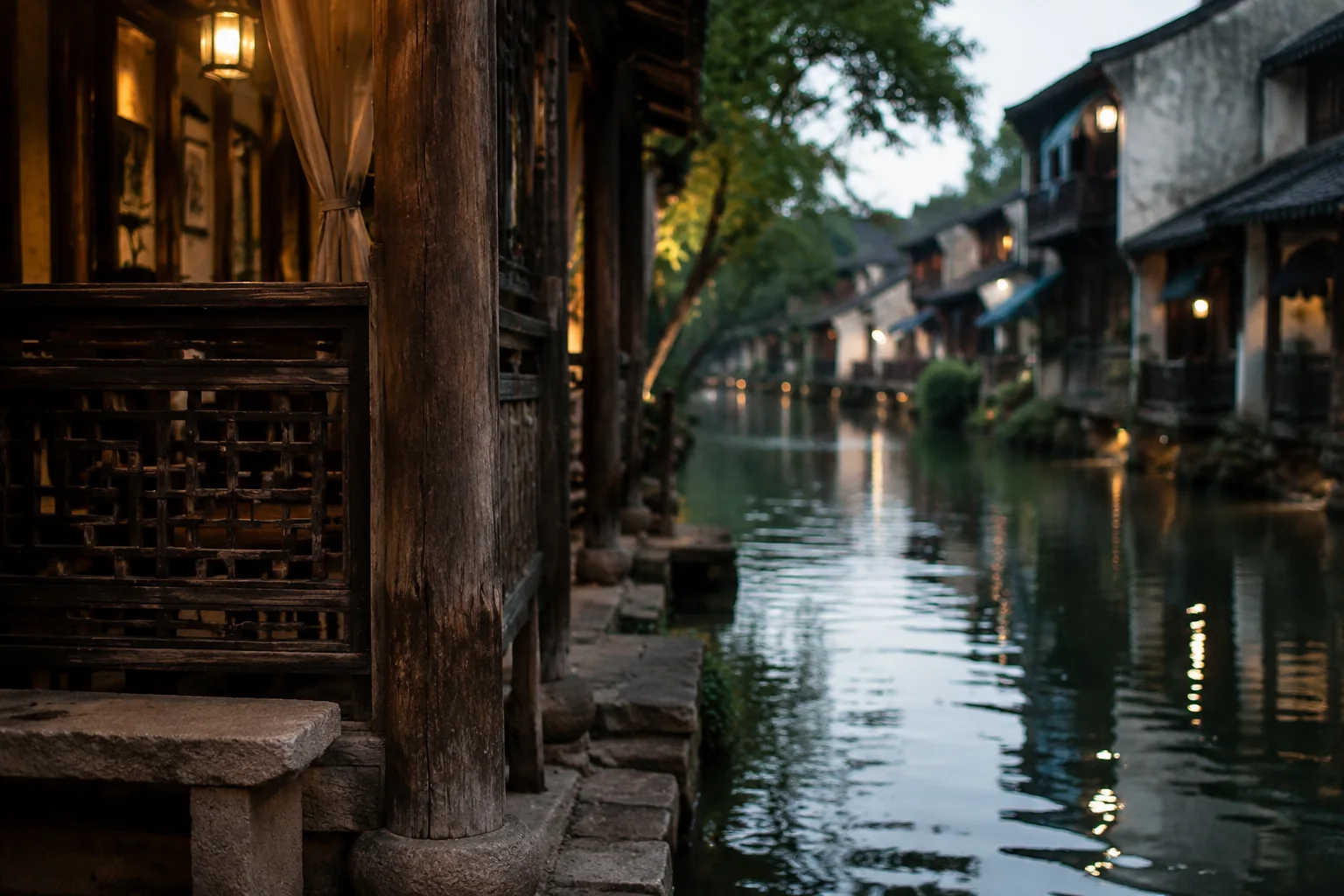
The West Scenic Area is described as the resort-oriented half of Wuzhen — a cluster of islands ringed by water, with workshops, exhibition halls, guesthouses, shops and evening lighting, in contrast to the Dongzha (东栅) area’s daytime focus on original lanes and craft workshops. The historical guide text also describes arriving by ferry, which is the kind of detail that changes with operational decisions and should be checked rather than assumed.
What you gain by sleeping inside is simple: the lit canals and stone lanes are on your doorstep once day visitors thin out, and you do not have to organize a departure around a gate closing. The reference material stresses evening atmosphere in the West Scenic Area — boats, tea, opera and old-style outdoor film screenings — as the reason to be there at night rather than at midday.
What you give up is consistency. The old guide describes the in-area guesthouse stock as large and varied: standard doubles, multi-bed rooms and family rooms, some in converted residential buildings, some with antique carved beds, and conditions ranging from characterful-but-basic to more hotel-like. It explicitly contrasts these with hotels near the scenic area that offer more standardized hardware and service. In practice, that means the area name tells you about atmosphere, not about what your bathroom will look like.
One structural point deserves attention before booking: according to the reference text, guests staying inside the West Scenic Area still need a ticket for first entry, and a deposit-based temporary re-entry pass was described as the mechanism for coming and going during the stay. Whether that is still how it works, what it costs, and whether it applies to all in-area properties are questions for the scenic area’s own channels — not something to plan around on the basis of an old guidebook.
Staying outside Wuzhen’s gates: the practical alternative
The lanes around the West Scenic Area’s gates hold a second tier of small guesthouses that behave more like ordinary rural guesthouses than resort accommodation. The reference material describes rooms with wireless internet, private bathrooms, showers, a standard set of toiletries, and a mix of bed types including family and Japanese-style tatami rooms. It also mentions owners meeting guests at the bus station — a courtesy that should be requested in advance and never assumed.
The trade-off is straightforward. You get easier luggage handling, no dependency on a scenic-area ticket for your comings and goings, and often a more modern room for the same night. You lose the thing you came for: at the end of the evening you walk out of the illuminated lanes and back to a normal street.
If you are choosing this option, pick the property by walking distance to the specific gate you will use, not by the phrase "near West Scenic Area," which can cover a spread of locations. Ask the property to describe the route on foot from the gate and whether the road is lit at night.
Nanxun’s Bai Jian Lou and the riverside family inns
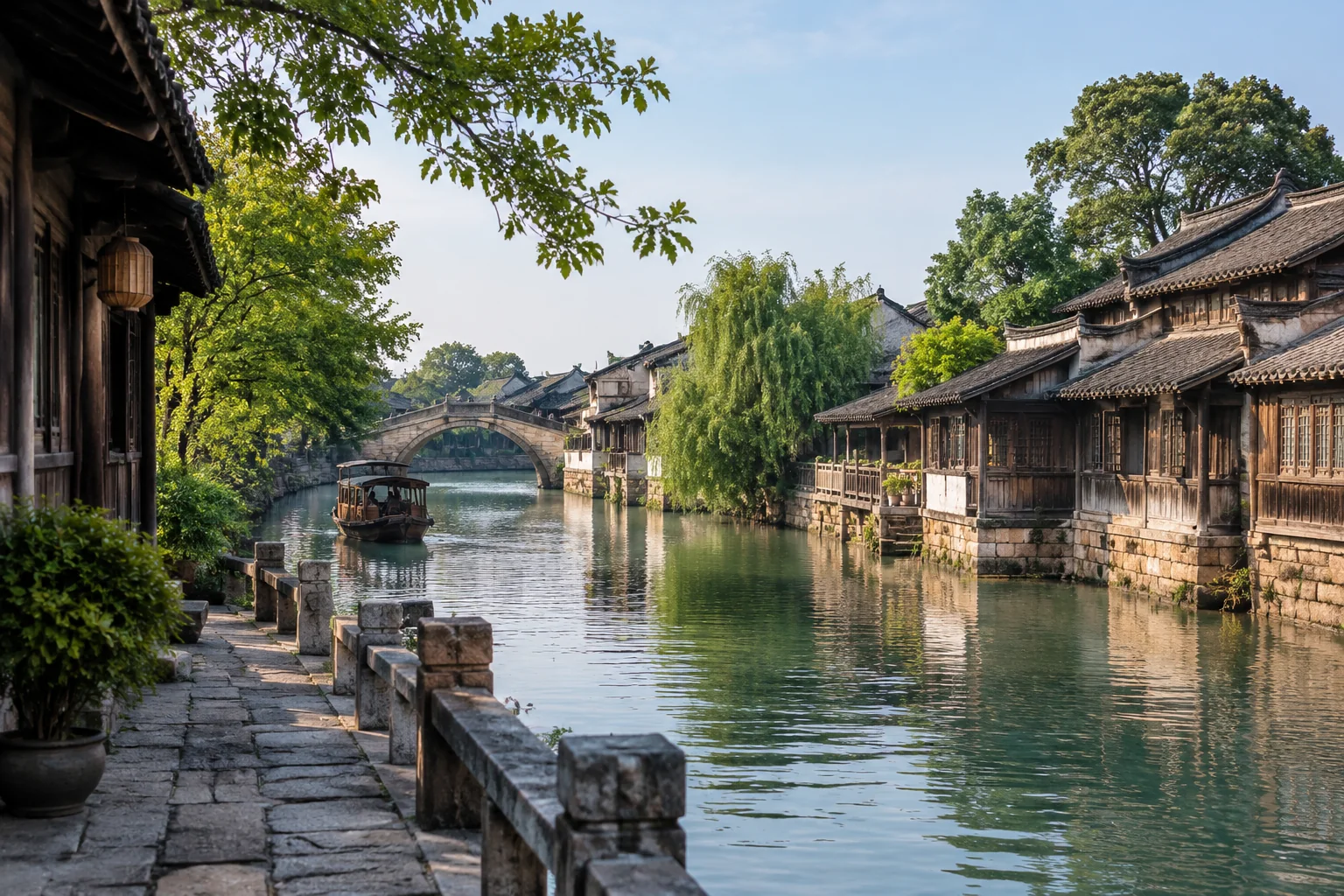
Nanxun’s appeal in the reference guides is different in kind. The lodging recommendation there is not a resort cluster but family inns, chosen because they let you live inside an old town rather than visit it. Within that, two settings are singled out as most characteristic: the old houses of Bai Jian Lou, described as the Ming-dynasty building group that best conveys Nanxun’s antique atmosphere, and the "pillow-the-river" (枕河人家) family inns — small riverside houses scattered around the town’s sights.
The reference text is explicit about who the riverside rooms suit: travelers who want Jiangnan water-town scenery and a somewhat economical stay. That is a fair summary of the trade. You are paying for position and character rather than facilities, and the practical details — bathroom arrangement, moisture in summer, heating in winter, sound insulation between old timber walls, breakfast — will vary from house to house.
Nanxun’s sightseeing also rewards staying overnight in a way that suits a slow morning. The classic circuit runs Xiaolianzhuang (小莲庄) — its lotus pond and green courtyards early in the day — then the Jiaye Tang Library (嘉业堂藏书楼), Zhang Shiming’s Former Residence (张石铭旧宅) with its mix of Chinese and Western detailing, Liu’s Tihao (刘氏梯号), Zhang Jingjiang’s Former Residence (张静江故居) and finally Bai Jian Lou on the water. Doing that from a room five minutes away is a different experience from doing it off a coach timetable.
Local food is part of the case for staying: the guides describe Nanxun’s river fish and spring bamboo shoots as the things to eat, cooked plainly in local kitchens. Which kitchens currently serve visitors, and at what price, needs a current check on arrival.
Comparing the areas side by side
| Option | Atmosphere | Evening | Practical convenience | Best suited to |
|---|---|---|---|---|
| Inside Wuzhen’s West Scenic Area (西栅) | Lit canals, resort-style lanes, craft workshops and exhibitions on the doorstep | Strongest of the four: the area is described as an evening destination in its own right | Ticket and re-entry procedures apply; in-area rooms vary from characterful to basic; luggage movement inside a pedestrian area needs planning | Travelers who want the water town at night and accept variable room quality |
| Just outside Wuzhen’s gates | Ordinary street outside, scenic area a short walk away | You leave the lights behind at the end of the evening | Easiest for luggage, late arrivals and modern room fittings; no ticket dependency | Short stays, families with bags, travelers arriving late |
| Nanxun, Bai Jian Lou riverside inns | Ming-era buildings, canal-side lanes, family houses | Quiet; the town is not pitched as a nightlife destination | Simple rooms, variable facilities, but sights within walking distance | Couples and independent travelers prioritizing architecture and calm |
| Nanxun, standard hotels | Modern and unremarkable | No old-town atmosphere | Predictable rooms, easier for drivers and heavy luggage | Travelers who want Nanxun by day but conventional comfort at night |
Room types, amenities and questions to ask before booking
Because the reference material shows real spread in room quality within the same area, the booking conversation matters more than the listing photos. Ask these before paying a deposit:
- Bed configuration and capacity. In Wuzhen’s in-area stock, doubles, multi-bed rooms and family rooms are all described; confirm exactly how many people the room sleeps and whether an extra bed is possible.
- Does the window actually face the canal? "Riverside" can mean the building is on the water, not that your room is.
- Bathroom arrangement. Private or shared, shower or tub, and whether hot water is continuous.
- Heating and air-conditioning. Old timber buildings can be cold and damp depending on season; ask what is installed, not whether it is "comfortable."
- Breakfast. Whether it is included, what it consists of, and what time it starts — relevant if you plan an early start.
- Access. Stairs, thresholds, narrow lanes, and how far a vehicle can come. Ask for a plain description of the final approach with luggage.
- Ticket and entry rules. If you are inside Wuzhen’s West Scenic Area, ask the property to explain current first-entry and re-entry procedures in writing.
- Payment, cancellation and deposit terms, plus which languages the property can handle by message.
Getting there from Hangzhou and handling the transfer
The reference guides treat Tongxiang Railway Station as the usual rail gateway for Wuzhen, with local buses continuing to the town’s bus station and onward services to the scenic area; they also list direct coach services from Hangzhou bus stations and airport shuttle options. These are exactly the details that change: routes get rerouted, timetables get revised, and station-to-town connections are the first thing to break on a holiday weekend. Check current schedules on official transport channels a few days before travel, and again on the day.
For Nanxun, the historical material describes arriving via Nanxun’s own bus station and long-distance coaches, including services linking the water towns. Rather than treat any single route as fixed, plan the journey as a half-day block: a train or coach leg, a possible change, and a short local transfer at the far end.
The important planning consequence is this: Wuzhen and Nanxun are alternatives, not a pair to be done in one cramped day. If you want both, give the transfer its own generous buffer and treat the second town as a separate stay rather than a stopover. A rushed cross-city move in the middle of a two-night trip costs you the very evening atmosphere you booked for.
Sample stay plans that keep transfers realistic
Two nights, Wuzhen-focused. Sleep near the West Scenic Area. Use the first morning for Dongzha’s lanes, workshops and old residences while it is quiet, return for a rest, then spend the evening inside the West Scenic Area. Keep the second day loose for whichever half you preferred.
One night, Nanxun-focused. Arrive by midday, walk the sights in the order above, and finish at Bai Jian Lou as the day visitors leave. Eat river fish in the evening. The next morning is for the lotus pond end of town before departure.
Three nights, both towns. Two nights in Wuzhen as above, then a transfer day with nothing else scheduled, then one night in Nanxun. If your dates are tight, one night in each with no transfer day is workable but unforgiving.
Families, limited mobility, wet weather and short stays
Families. Wuzhen’s in-area stock is described as including family and multi-bed rooms, which makes it the more flexible of the two for groups. Riverside houses in Nanxun are likelier to have one or two rooms per house, so book early and confirm capacity.
Limited mobility. Old water towns mean bridges, steps and uneven stone. Ask specifically about ground-floor rooms, step-free access from the nearest vehicle drop-off, and bathroom grab rails if needed. No blanket accessibility assurance can be given for converted heritage buildings.
Wet weather. Jiangnan rain is a normal condition rather than an exception. Ask whether there is somewhere covered to sit outside your room, and treat indoor sights — the library, the former residences — as your wet-weather plan rather than a fallback you improvise.
Short stays. With one night, choose one town and one side of the gate. A one-night plan that includes a cross-town transfer gives you almost no time in either place.
Common planning mistakes and a pre-trip checklist
- Booking an in-area Wuzhen room assuming the ticket question resolves itself. Ask first.
- Assuming "riverside" means a canal view from the bed.
- Scheduling Wuzhen and Nanxun on the same day and calling it efficient.
- Trusting an old guidebook’s transport or opening times as current.
- Choosing a room by photo rather than by bed configuration and bathroom.
Before you go: confirm current entry and re-entry rules for Wuzhen’s West Scenic Area; confirm train and bus connections for your dates; confirm the room’s bed setup, bathroom, heating and breakfast in writing; confirm the final approach with luggage; save the property’s contact in a messaging app that works in China; and carry a small amount of flexibility for the transfer day.
If you would like help comparing dates, room types or transfer options, the inquiry form at the end of this guide reaches the planning team directly. It is a request for contact, not a booking or a confirmed quote.
Frequently asked questions
Is it better to stay inside Wuzhen’s West Scenic Area or outside its gates?
Inside, if the evening is the point of the trip and you accept that rooms vary. Outside, if you are arriving late, travelling with heavy luggage, or want a modern room and no ticket-related comings and goings. Neither is better in the abstract; they buy different things.
Do I need a ticket to sleep inside Wuzhen’s West Scenic Area?
The reference material says yes for first entry, with a deposit-based temporary re-entry pass during the stay. Do not rely on that description: confirm the current rule, cost and procedure with the scenic area or your property before booking, because it affects both your budget and how freely you can leave and return.
Are Nanxun’s Bai Jian Lou inns suitable for families or older travellers?
They suit travellers who value setting over facilities. Families should confirm room capacity and bathroom arrangement, and anyone with limited mobility should ask about ground-floor rooms and the final approach, since the buildings are old and the lanes are stone. If predictability matters more than atmosphere, a standard hotel in Nanxun is the safer choice.
Can I visit Wuzhen and Nanxun in one trip without changing hotels twice?
You can, but it is not a time-saver. Each town rewards an overnight. If you only have three nights, sleep two in one town and one in the other, and give the transfer its own half-day rather than squeezing it between sightseeing blocks.
What should I ask a riverside inn before paying a deposit?
Bed configuration and capacity, whether the room itself faces the water, private or shared bathroom, heating and air-conditioning, breakfast content and timing, how far a vehicle can approach with luggage, stairs, payment methods, and cancellation terms. Ask for the answers in writing so there is a record.
Is one night enough for a water-town stay?
One night is enough to see the town in the evening and the following morning, which is exactly the part day-trippers miss. It is not enough for two towns. Pick one, and use the saved transfer time inside it.
Sources and verification
This guide was written from internal reference documents, not from a site visit and not from interviews with properties. The relevant extracts are from the Chinese-language guides 乌镇攻略 (Wuzhen Guide), pages 2, 4, 5, 7, 8, 9, 10, 12, 13, 14 and 15; 浙江攻略 (Zhejiang Guide), pages 16, 17 and 18; 杭州攻略 (Hangzhou Guide), page 15; and 西溪湿地攻略 (Xixi Wetland Guide), page 10. The Nanxun lodging discussion appears in the latter three; the Wuzhen accommodation, ticketing and transport details come from the Wuzhen guide.
These are internal reference documents used for background on area character, building types, room categories and sightseeing sequences. They are not current fact sheets, and no prices, opening hours, transport timetables or entry policies from them have been verified as current for this guide. Specifically, the following need confirmation from official or property channels before you rely on them: Wuzhen West Scenic Area first-entry and re-entry rules for guests; current opening hours; rail and bus connections via Tongxiang and to Nanxun; and every room-level detail such as rate, breakfast and facilities. No property names, rates, contact details or availability are given here by design, and no specific inn is endorsed.
Find places & plan your visit
These links open external search results. Confirm the exact place, entrance and current arrangements.
Need help planning your trip?
Tell us about your travel plans and send an inquiry.