Contents
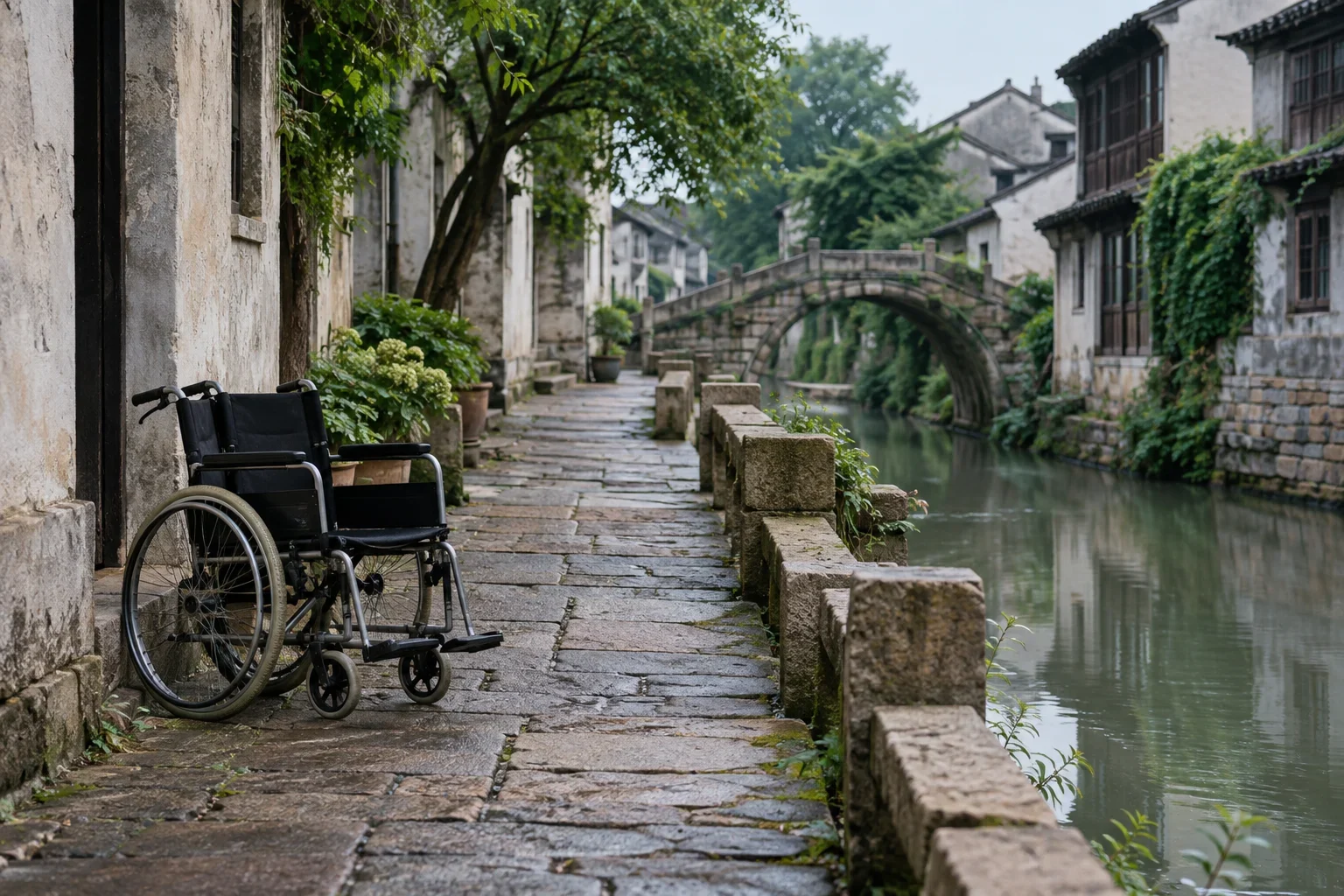
Wuzhen, a historic water town in Tongxiang, a county-level city under Jiaxing in Zhejiang, draws travellers for its canals, stone bridges, and centuries-old lanes. But for anyone using a wheelchair or pushing a stroller, the same heritage surfaces quickly become the deciding factor in how the day unfolds. The conserved paving, arched bridges, and narrow alleyways were laid out long before wheels were part of the equation. That does not mean a visit is impossible—it means you need to plan around the terrain rather than against it. This guide explains what to expect, which areas and routes are more manageable, what alternative transport options might replace walking, and what you must verify directly with the scenic area before you arrive. It does not promise step-free access; instead, it helps you weigh the trade-offs so you can decide how much of Wuzhen you want to take on.
The Surface Is the Whole Question
The single biggest factor in a Wuzhen visit—larger than distance, larger than crowds—is the ground beneath your wheels. What looks like a stroll on a map becomes a series of micro-decisions: whether a stone is level, whether a gap will catch a front caster, whether a threshold can be mounted with help. Wuzhen’s old town is organised as four old streets laid over a double-chessboard pattern of parallel waterways and lanes, so bridges and waterways are the structures to read when planning any route. That layout was shaped by foot traffic and boats, not by accessibility standards. Cobblestones and stone slabs are uneven, with cracks, edges, and drainage covers that can stall a chair. A manual wheelchair can be pushed, but it takes effort, especially with a passenger who cannot assist. A stroller may bounce on the stones, tiring parents and little ones alike. The question is never simply "Is Wuzhen accessible?"—it is "Which parts of Wuzhen work for you?" The answer depends on your strength, your equipment, whether you have assistance, and how willing you are to skip some interiors. Before you book, decide your priorities: step-free access at every attraction, or a flexible day of lanes, riverside views, and a shorter list of sights.
Where Wheels Roll Comfortably
Not every surface in Wuzhen is difficult, but you need to know where the smoother ground is. The scenic-area entrance plazas and the modern approach roads that lead to them are the most reliable places for wheels: they are paved with asphalt or concrete and are generally level. Inside the areas, the main commercial streets—the ones lined with shops and restaurants—tend to be wider and better maintained than the side alleys, and they are a good spine for a day’s route. The plazas in front of major landmarks offer level ground and room to turn around. However, the narrow lanes that branch off these spines are a different story. These alleys are often just wide enough for two pedestrians, with uneven stones and frequent doorsteps. Treat those lanes as optional detours, not as part of your core route. If you want to explore them, bring a helper, allow extra time, and be ready to turn back if the surface worsens.
Cobblestones, Bridges and Thresholds
Three recurring obstacles will define your day in Wuzhen: stone paving, bridges, and door thresholds. Understanding each helps you plan a route that minimises friction.
Cobblestones and paving — The stone paving is the main challenge. It is uneven, with gaps between stones and occasional drainage covers that can catch a wheel. After rain, the stones become slippery, so extra care is needed—especially on any slope. Consider whether the forecast is wet before you commit to a long day. There may be few covered alternatives if the weather turns, so an umbrella or waterproof jacket for the wheelchair user is essential.
Bridges — Many of Wuzhen’s bridges are arched, with steps on both sides, and some may have low or no railings. A wheelchair user cannot cross without assistance, and a step-free alternative may not exist for every bridge. You may need to take a longer route around the waterway to reach your destination. Even in other Jiangnan water towns, some old flat stone bridges are step-free but have no railings—a reminder that a bridge without steps is not automatically safe. When you plan a crossing, always check whether the far side has a ramp or a step-free path, not just the near side.
Thresholds — Museums, folk houses, and workshops often have raised sills at their entrances. A wheelchair user cannot enter without a ramp or help. Some venues may have a portable ramp, but this is not guaranteed. Plan to enjoy many sights from the lane, through open doorways, rather than entering every building. This is not a compromise on atmosphere: the lanes themselves are part of Wuzhen’s appeal.
East Versus West: Choosing Where to Spend the Effort
Wuzhen is divided into East and West Scenic Areas, and each offers a different mobility experience. Choosing where to spend your time can shape whether the day feels like a triumph or a struggle.
East Scenic Area — This is the classic heritage quarter. It is compact, and its main sights form a linked chain: Fengyuan Twin Bridge, the bed, folk-custom and wood-carving museums, Mao Dun’s former residence, and the old opera stage. The distances are short, but the route involves many separate entries, each with its own threshold. The lanes may be narrow in places, and crowds can make them even tighter. For a wheelchair user, attempting every museum may be exhausting. Instead, choose two or three interiors that matter most, and enjoy the rest from the open lane.
West Scenic Area — This area is broader, with wider riverside walks and more open space. It is known for its evening atmosphere, with canals lit after dark. A key choice here is whether to see the canals from a boat or from a bridge viewpoint. For wheelchair users, the bridge viewpoints may be inaccessible due to steps; the boat might be the more realistic option, but you need to confirm boarding feasibility. The wider layout means less time in cramped alleys, but the trade-off is longer distances between points of interest. Plan for a slower pace and consider how you might reduce walking, such as taking a boat segment or returning along the same bank. The evening light and reflected lanterns make West a rewarding choice even if you do not cover every corner.
Routes to Favour
Your route should be designed to minimise obstacles and maximise enjoyment. A little thought before you set off can save a great deal of effort later. The principle is simple: favour longer but smoother paths over shorter but rougher ones.
Out-and-back along one bank — Instead of crossing bridges to make a loop, stay on one side of the canal and walk out to a point, then return the same way. This avoids the steps and congestion of bridge crossings. You may see less variety, but you will spend less time lifting and manoeuvring.
Same gate entry and exit — Enter and exit through the same gate so you do not have to search for an accessible exit elsewhere. This also means you can leave your transport at a spot you know is reachable, avoiding an anxious search at the end of the day.
Main street as your spine — Use the broadest main street as your central route. Treat side alleys as optional detours, and only venture into them if you have help and time. This keeps your day on the smoothest surfaces and reduces the chance of hitting a dead end with steps.
Budget for a shorter list of sights — Do not try to see everything. Choose two or three must-see attractions and allow extra time to reach them. In East, that might be Mao Dun’s former residence and the folk museum; in West, a boat ride and a stroll along the main canal. Saying no to some sights is a way of saying yes to the ones that matter.
Plan rest points — Identify cafes, benches, and open plazas where you can stop. These are not always frequent, so carry snacks and water. A short pause can make the difference between an enjoyable day and an exhausting one.
Boats, Shuttles and the East–West Transfer
Boats and shuttle services can be more than attractions—they might replace walking segments that would otherwise be difficult. Because these services vary by season, time of day, and operator, you must confirm the details directly with the scenic area. What follows are the questions to ask, not promises of what is available.
Boat transfers and tours — In West Scenic Area, there is an explicit choice between viewing the canals from a boat or from a bridge viewpoint, which suggests that boats are available for hire. However, boarding a boat involves stepping down onto a low deck, and you need to know whether staff can assist, whether a folded wheelchair or stroller can be taken aboard, and whether there is room to store it. Ask whether the boat has a ramp or a level boarding point, or whether you must lift yourself across. The same applies to any water bus or scheduled boat service inside the areas: request current routes, stops, boarding procedures, and whether assistance is provided.
East–West shuttle — If you want to see both scenic areas in one day, you will likely need a transfer between them. Ask whether a shuttle exists, what type of vehicle it uses, whether it can take a folded wheelchair or stroller, and whether boarding is level. Some shuttle services use minibuses with steps; others may have a lower floor or a ramp. Do not assume—confirm.
The key question — For every boat or shuttle, ask two things: "Can my equipment come aboard?" and "Will staff help me board?" If the answer is yes, ask for details: how many steps, whether the ramp is wide enough, and whether there is space to secure the equipment during the ride. If the answer is no, factor that into your plan—you may need to choose one side of the town rather than both.
Getting There and Arriving
The journey to Wuzhen is as much part of the accessibility equation as the town itself. Wuzhen does not have its own train station; you will arrive by road, either by car, taxi, or bus from a nearby city. Hangzhou, a major city with accessible taxis, is a common gateway. Understand that Hangzhou’s accessible taxi fleet operates within the city, and it may not be available for a long-distance transfer to Wuzhen. Confirm with local providers before relying on them.
Accessible taxis and transfers — Hangzhou has introduced accessible taxis with wheelchair ramps and restraints, but they are typically intended for city use. For the trip to Wuzhen, you may need to book a private car or a regular taxi that can carry a folded wheelchair. Always state your needs when booking: the size of the chair, whether it folds, and whether the driver can assist with the transfer. Ask about the vehicle’s boot space and whether a ramp is available. If you are travelling with a stroller, the same questions apply, though folding strollers are easier to accommodate.
Choosing your gate and drop-off point — The scenic areas have multiple gates. Some may offer a level approach from the car park; others may have steps or a long walk. Contact the scenic area in advance to ask which gate has the shortest level approach and where the drop-off point is. A vehicle with a ramp is not much help if it cannot pull up close to the gate. If you book a hotel, ask whether they can arrange a pickup from the gate or the nearest accessible drop-off point. The last few hundred metres can be the difference between a smooth start and a frustrating one.
What to Confirm Before You Book
Before you confirm your trip, compile a short checklist to send to the scenic area or your hotel. Do not assume that any feature exists—ask. The answers will let you tailor your day to the reality of the surfaces.
- Paving and bridge conditions — Ask about the specific circuit you plan to walk. Is the main street smooth stone or rough cobble? Are all bridges stepped, or are there step-free crossings at certain points? Request a route description or a map that marks step-free segments.
- Equipment loan — Does the scenic area lend wheelchairs or strollers? Are they available at the entrance or visitor centre? Is there a deposit or ID requirement?
- Accessible toilets — Where are they located? Are they truly step-free, or do they have a small step at the entrance? Which gates are nearest to them?
- Boat boarding — Can a wheelchair user board the tour boats or any water bus? Is staff assistance available? Can a folded chair or stroller be stored aboard?
- Shuttle service — Does the East–West shuttle exist? What type of vehicle does it use? Can it accommodate a folded wheelchair or stroller? Is boarding level?
- Gate access — Which gate offers the shortest level approach, and where is the drop-off point for cars or taxis?
- Current hours, prices, and booking rules — Confirm opening hours, ticket prices, and whether any attractions require advance booking. You do not want to arrive to find that a booking is mandatory.
You can also check official sources for regional accessibility information. For example, Hangzhou has announced barrier-free tourism routes and accessible taxis, but those provisions are within the city, not inside Wuzhen. They are useful for your transfer and any time you spend in Hangzhou, but they do not guarantee accessibility within the scenic areas. The only reliable way to know what Wuzhen offers is to ask the scenic area directly.
Sources
Need help planning your trip?
Tell us about your travel plans and send an inquiry.