In this guide 17 sections ▾
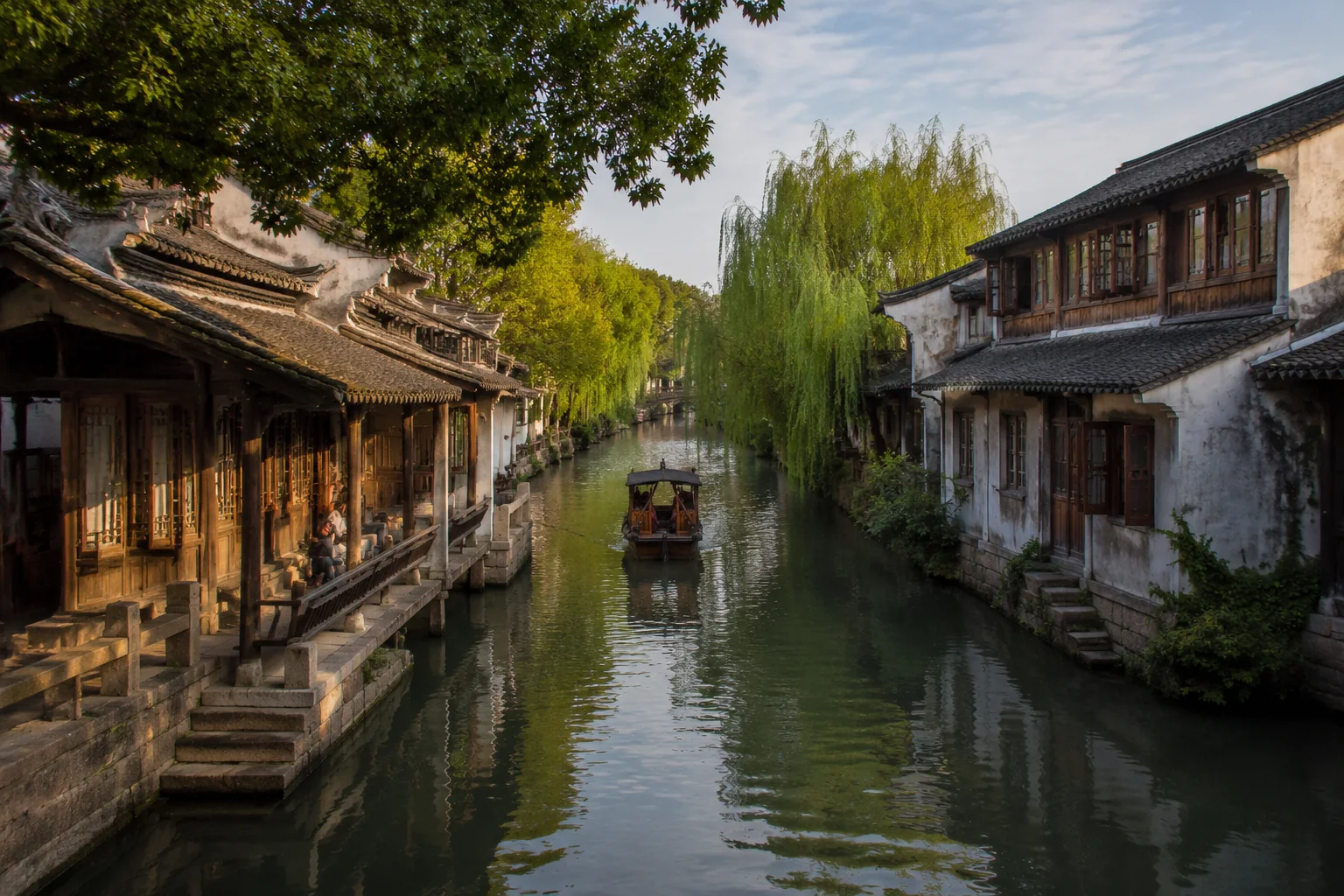
Wuzhen’s craft workshops reward a slower visit than the usual water-town photo circuit. For indigo cloth, wood carving and sanbai jiu, the most useful base is Dongzha, the older east zone where the reference places the workshop quarter, the indigo-cloth dye workshop and the Jiangnan Wood Carving Museum. Xizha is better treated as an atmospheric add-on or evening alternative, not as the main craft classroom.
This guide is for travelers who want to understand how things are made, not just buy souvenirs. The main planning decision is whether to give Dongzha a focused half-day or a full day, and whether to add Xizha separately. The important limitation is that the reference is an older visitor guide. It can explain the crafts and the general layout, but it cannot confirm today’s ticket inclusions, demonstration times, opening arrangements or transport. Those need current checks before you travel.
The short answer: put Dongzha at the centre
For a workshop-focused visit, choose Dongzha first. The reference describes it as the zone with the old residential quarter and the traditional workshop area, and its suggested Dongzha route runs past the indigo-cloth dye workshop, the traditional workshop area and the Jiangnan Wood Carving Museum. The same route also includes other sights such as the Jiangnan Hundred Beds Museum, the folk museum, Mao Dun’s former residence and the old stage. That makes Dongzha a practical craft spine rather than a scatter of unrelated stops.
Xizha is not redundant, but its role is different. The reference presents Xizha as the larger area with shops, evening atmosphere and water-town scenery. If you have only one day, splitting your attention between the two zones can leave both feeling rushed. A better pattern is to keep the craft study in Dongzha and use Xizha for an evening walk, an overnight stay or a separate part of the trip. The two areas are distinct, so plan a transfer rather than assuming you can drift from one craft stop to the next on foot.
Names and transliterations vary in visitor material. Match the Chinese terms on the current map: 蓝印花布 for blue calico, 江南木雕陈列馆 for the wood-carving museum, and 三白酒 for the local liquor. If an English label is unclear, the Chinese characters are the more reliable guide.
What indigo dyeing reveals about local materials
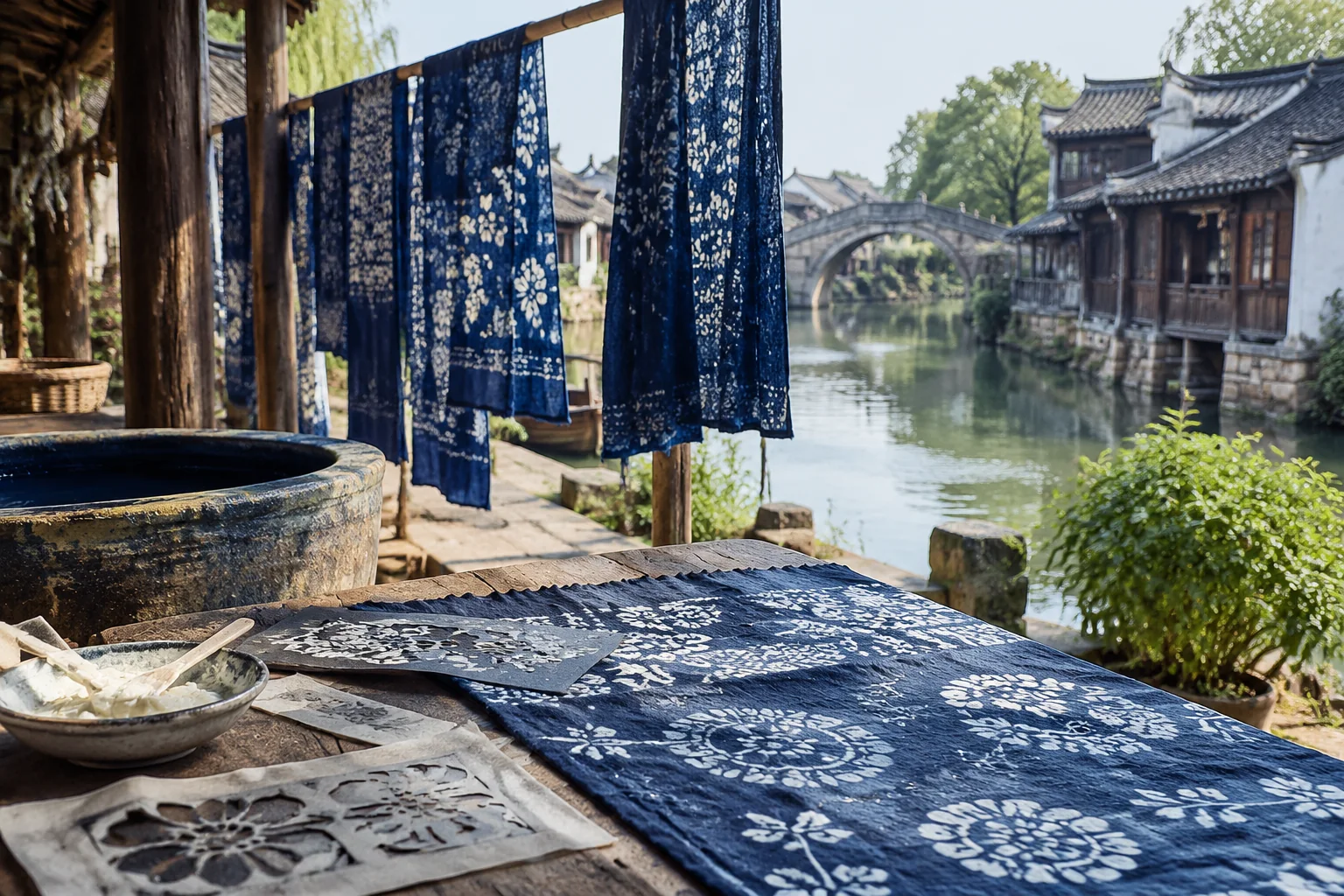
Blue calico, or 蓝印花布, is the clearest process demonstration in Wuzhen’s craft circuit. The reference describes it as a traditional folk textile made with cotton cloth, a soybean-paste resist and dye from blue plants. The production sequence includes pattern design, cutting the stencil, applying the paste, dyeing and drying. That sequence is the reason to visit: it shows how a practical cloth becomes a patterned one through a series of controlled steps rather than through printing alone.
The key idea to watch for is resist. The paste is applied where the maker wants the pattern to remain light, while the exposed cloth takes the blue dye. The reference describes the process as very handmade and the finished cloth as fresh and understated. Visitors do not need to master the chemistry to appreciate it. Look for the point where the pattern is prepared, the moment the paste is spread, and the drying stage where the cloth is stretched out. The reference also notes a shop at the front of the dye workshop, but shopping is not the reason to go. The workshop is most useful when you treat the cloth as evidence of a process.
Practical details matter here. Drying is weather-dependent, and the reference describes outdoor drying rather than a fully indoor display. If it is raining or very humid, some steps may be paused or moved. Ask on arrival which stages are running that day. Also check whether any explanation is available in English; the reference does not confirm language support. If you want to understand the difference between the resist paste, the dye bath and the finished cloth, it is worth slowing down at the demonstration area instead of treating it as a photo stop.
How to read the wood-carving collection
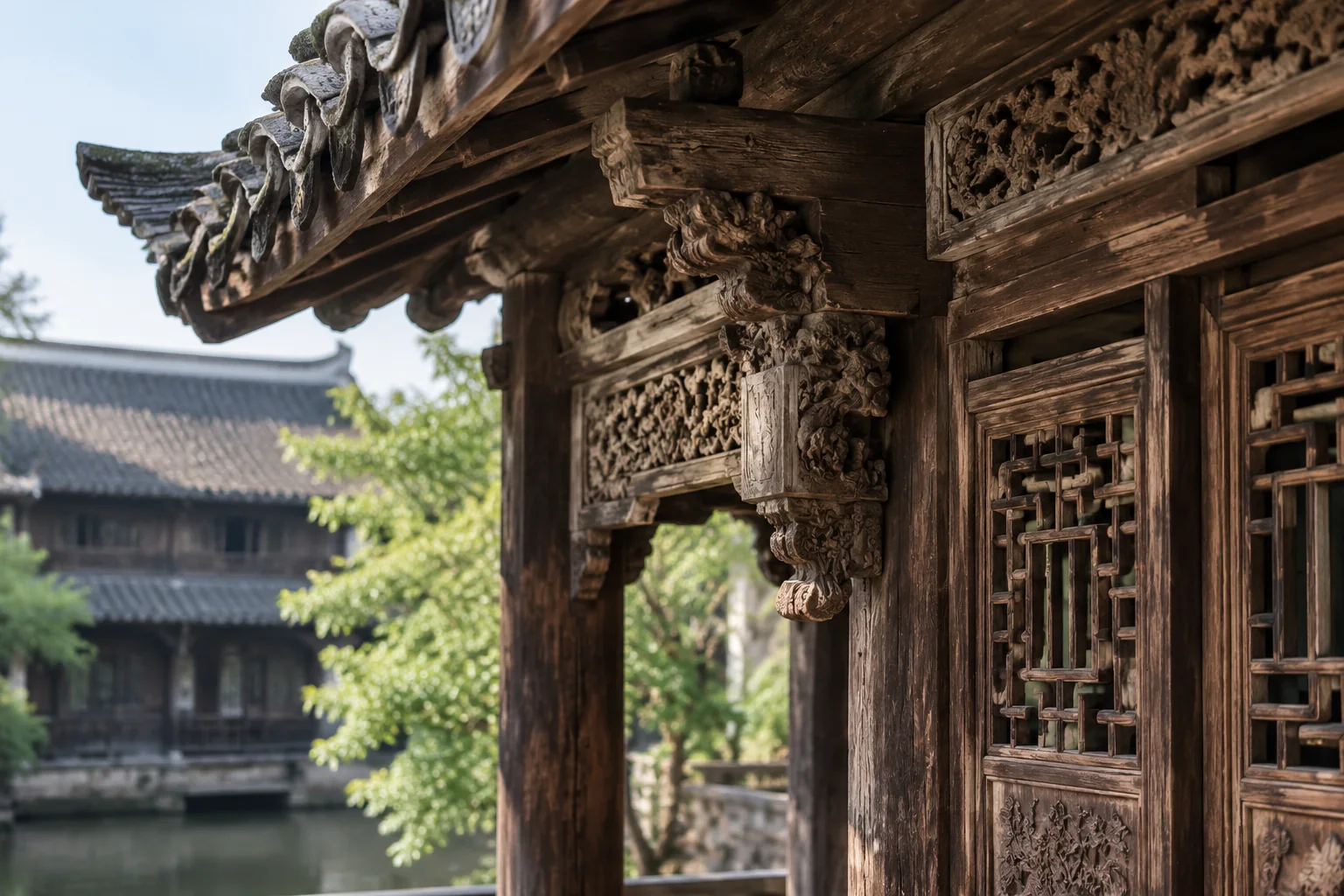
The Jiangnan Wood Carving Museum, or 江南木雕陈列馆, is the second anchor of a craft-focused Dongzha visit. The reference describes a collection of many carved components, including work tools, beam pads, hanging fascia, bracket sets, upturned eaves, struts, door lintels, window lattice and lower skirt panels. That list is useful because it shows that the collection is not only about decorative panels. It is about the parts of a Jiangnan building.
The best way to look at the museum is to ask what each piece does before asking whether it is ornate. A bracket set helps carry a roof; a hanging fascia finishes a junction; a window lattice frames light and view; a lower panel protects and finishes the base of a door or screen. Once you see the architectural role, the carving becomes easier to read. You can compare dense and open compositions, deep and shallow relief, and the way repeated motifs change across different components. The reference does not identify the wood species or the age of every piece, so avoid treating the labels as a full materials lesson. Focus on visible function, joinery, finish and wear.
The old stage is a useful companion to the museum. The reference notes that its sparrow braces, or 雀替, are carved, and that the stage is an attached structure of the Xiuzhen Temple with a hipped roof and upturned eaves. Use the stage as a bridge between the museum fragments and a standing building. After looking at isolated components under glass, you can see how carved detail sits within an actual timber structure. Photography rules and opening conditions should be checked on site rather than assumed.
Sanbai jiu: three ingredients and a local craft
Sanbai jiu, or 三白酒, is Wuzhen’s traditional white liquor. The name is usually explained through three white ingredients: white rice, white flour and white water. The reference quotes a local gazetteer to that effect and describes the drink as rich in aroma, mellow, soft on entry and clean in the finish. It is an alcoholic drink, not a casual soft drink, so a visit can focus on ingredients, history and display rather than tasting.
The historical background is part of the craft story. The reference says Wuzhen’s brewing trade was thriving in the Ming period, with more than twenty workshops, and that the surviving historic distillery is associated with the Gao Gongsheng name. It also repeats a local account that a Wuzhen liquor was once selected as tribute. Treat such stories as local heritage narrative rather than as independently verified current fact. What matters for a visitor is the connection between a simple recipe, local grain and water, and a long-standing town trade.
The reference gives the ingredient formula and the sensory description more clearly than it gives a step-by-step brewing demonstration. Do not assume that a full technical walkthrough will be available. On site, look for the display sequence, any fermentation or storage vessels that are visible, and the way the site explains the three ingredients. If you are traveling with non-drinkers or children, the visit can still work as a cultural stop, but check current tasting rules and suitability rather than assuming a sample is included.
A workshop-focused route through Dongzha
Use the reference’s Dongzha sight sequence as a spine, then adjust it to the day’s demonstration times. A sensible craft-first order is: enter Dongzha early; go to the indigo-cloth dye workshop while the outdoor drying stage is most likely to be visible; continue to the wood-carving museum for a slower indoor look; visit the traditional workshop area for other craft displays; and keep the historic distillery as a later stop. Add Mao Dun’s former residence, the old stage or a performance only if time and energy allow.
The reference’s broader Dongzha route includes the high-pole performance, Fengyuan Twin Bridge, the Jiangnan Hundred Beds Museum, the folk museum, the indigo workshop, the traditional workshop area, the wood-carving museum, Mao Dun’s former residence, the old stage and shadow puppetry. That is more than a craft visit needs. Trying to complete every stop turns the day into a checklist. If craft interpretation is your priority, protect the three main stops and let the rest be optional. A half-day is a realistic minimum for the craft spine; a full day gives you room for the other Dongzha sights and a proper pause.
Keep a buffer for demonstration schedules, queues and weather. The reference records specific performance times and a then-current ticket structure, but those details are historical and are not repeated here as current facts. Check the scenic area’s current information for the day you plan to visit. If you also want Xizha, do not squeeze it into the same cramped sequence. Give it a separate block of time, ideally with an overnight stay, or treat it as an alternative rather than an add-on.
Compare the three craft stops
| Craft stop | What you learn | Best for | Planning note |
|---|---|---|---|
| Indigo-cloth dye workshop | How cotton cloth, a soybean-paste resist and blue-plant dye produce patterned blue calico; the sequence from stencil to drying | Travelers who like visible, tactile processes and textile detail | Drying is weather-sensitive; check which stages are running and whether interpretation is available |
| Jiangnan Wood Carving Museum | How carved components fit into Jiangnan buildings: bracket sets, lintels, lattice, skirt panels and other architectural parts | Visitors interested in architecture, joinery and close looking | Indoor and slower-paced; do not expect a full timber-species lesson from the reference alone |
| Sanbai jiu distillery | The three-white ingredient idea, the town’s brewing history and the sensory profile of the local liquor | Travelers interested in food and drink heritage, with or without tasting | Alcoholic product; verify current display, tasting rules and family suitability |
Practical planning: tickets, access and timing
The reference describes Wuzhen as a town in Tongxiang, near Jiaxing, without its own airport or railway station. Its access notes point to nearby rail and road gateways, including Tongxiang railway station and bus connections onward. Treat that as historical route background, not a current timetable. Confirm the present rail station, bus route, taxi availability and last-mile transfer before setting out. If you are based in Hangzhou, Wuzhen is a separate town rather than a Hangzhou neighbourhood, so plan it as a day trip or an overnight stay.
Ticket scope is another detail to verify. The reference lists the dye workshop, wood-carving museum, traditional workshop area and other Dongzha sights within a then-current ticket arrangement. Do not assume that today’s ticket works the same way. Check whether the craft sites are open, whether they are included in the current Dongzha ticket, and whether any separate demonstration or performance requires a booking. The same applies to opening hours and any seasonal closures.
Weather affects the dye yard more than the museum. Families may find the process stops easier to enjoy than long label reading, but the reference gives no child-specific facilities. Limited-mobility visitors should not assume step-free access through old lanes, workshops or museum interiors; ask the scenic area directly. If you need English interpretation, confirm it in advance. The reference does not establish that English labels or guides are available at every craft stop.
Common mistakes and a pre-trip checklist
The most common mistake is treating Wuzhen as one compact craft site. Dongzha and Xizha are separate zones, and the craft stops are only one part of Dongzha. A second mistake is arriving late and finding that the outdoor drying stage or a demonstration has already passed. A third is using old ticket prices, performance times or bus schedules from a guidebook as current facts. A fourth is rushing the dye workshop for photos and skipping the process. A fifth is assuming that every craft stop offers a guided explanation or a tasting; neither is guaranteed by the reference.
Before booking, check:
- Which zone your ticket covers, and whether the indigo workshop, wood-carving museum and distillery are open on your date.
- Current demonstration times and whether any craft stop requires a separate booking.
- The current rail, bus or taxi connection from Hangzhou, Shanghai or Tongxiang.
- Weather on the day, especially for the outdoor drying stage at the dye workshop.
- Accessibility along old lanes and inside museum or workshop buildings.
- Language support, if you need English interpretation.
- Whether tasting is offered at the distillery and whether it suits your group.
FAQ
Can I see indigo dyeing, wood carving and rice wine in one day?
Yes, if you keep the day focused on Dongzha and check the demonstration times in advance. Treat the three craft stops as the spine and add other sights only if time allows. If you also want Xizha, use a separate half-day or stay overnight instead of trying to force both zones into one tight schedule.
Is Dongzha or Xizha better for craft workshops?
Dongzha is the better base for the craft workshops described in the reference. It contains the old workshop quarter, the indigo-cloth dye workshop and the Jiangnan Wood Carving Museum. Xizha is stronger for water-town atmosphere, shops and evening scenery, so use it as a complement rather than the main craft destination.
Do the workshops run as guided tours?
The reference describes workshop displays and production steps, but it does not guarantee a guided tour at every stop. Some craft sites may have staff explanations, signs or demonstrations; others may be self-guided. Check at the entrance and ask what is running that day. Do not build your visit around a specific demonstration unless you have confirmed it.
What happens to the indigo dyeing visit in rain?
The drying stage is outdoors, so wet weather can affect what you see. The wood-carving museum is a more reliable indoor stop, but workshop arrangements can still change. Keep the dye workshop flexible, ask on arrival which stages are operating, and avoid treating the outdoor yard as a guaranteed all-weather exhibit.
Is sanbai jiu suitable for families or non-drinkers?
Sanbai jiu is an alcoholic drink. A visit can still be useful for learning about local ingredients and brewing history, but do not assume that tasting is included or suitable for children. Check current rules at the site and decide whether the cultural stop works for your group.
If you want help fitting these craft stops into a wider Hangzhou or Jiangnan itinerary, you can send a travel inquiry with your dates, group size and interests. The inquiry form is attached separately at the end of this guide.
Sources and verification
This article is based on internal reference documents, not live fact-checking. The source-backed background includes the blue-calico process, the categories of carved architectural components in the Jiangnan Wood Carving Museum, the three-white sanbai jiu ingredient idea, the historical brewing trade, the distinction between Dongzha’s workshop quarter and Xizha’s commercial and evening role, and the general Dongzha route sequence.
Internal references used:
- Wuzhen Guide (乌镇攻略), pages 2, 3, 4, 5, 6, 9, 11, 12 and 13.
- Zhejiang Guide (浙江攻略), pages 16, 17 and 18.
These are internal reference PDFs, not current official visitor information. The following details need confirmation with the scenic area or transport operator before publication or travel: current ticket scope and prices, opening hours, craft demonstration times, whether the named workshops still operate as described, current rail and bus connections, accessibility, language support and any tasting arrangements. The article deliberately avoids presenting the older guide’s prices, schedules or ticket inclusions as current facts.
Find places & plan your visit
These links open external search results. Confirm the exact place, entrance and current arrangements.
Need help planning your trip?
Tell us about your travel plans and send an inquiry.