In this guide
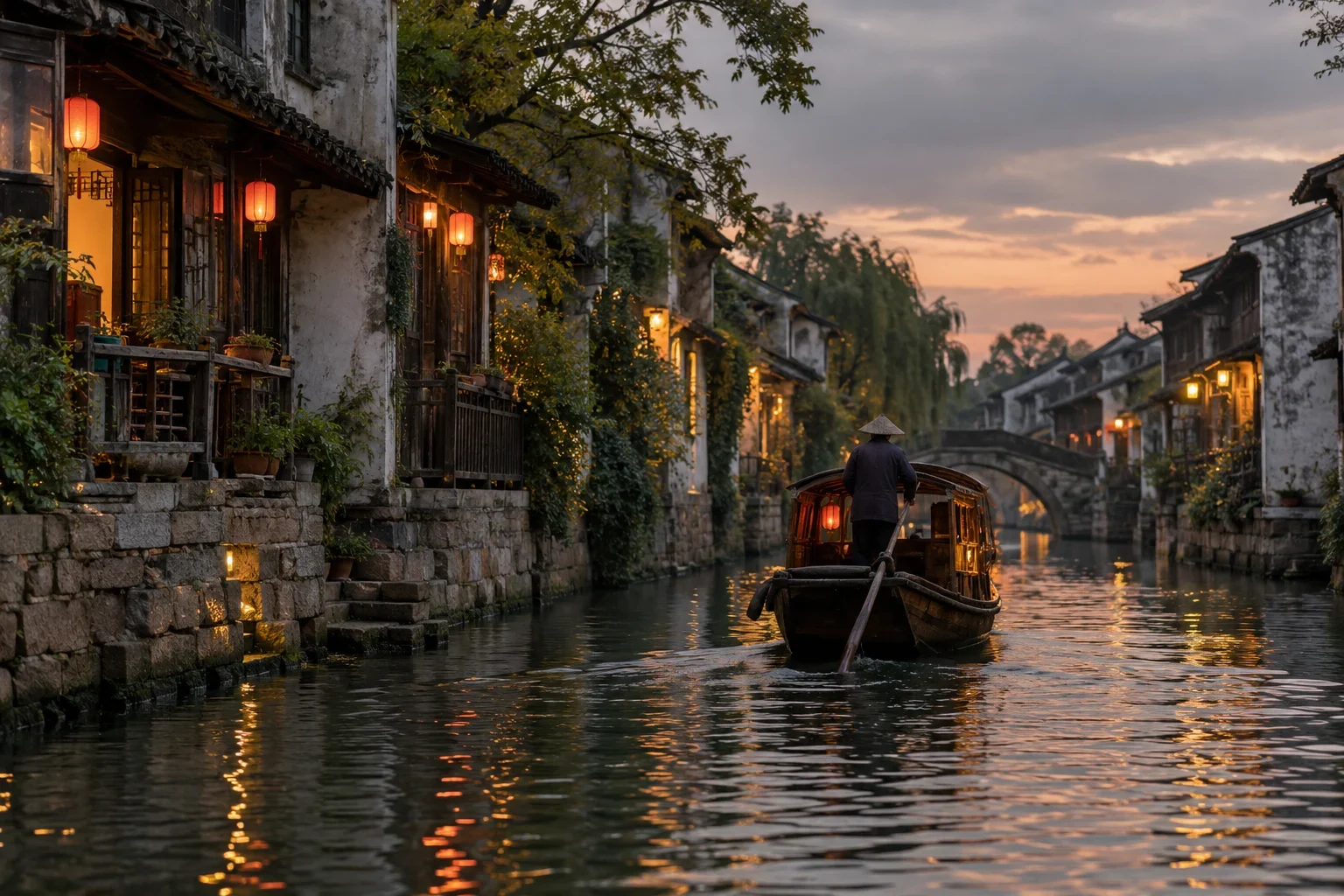
Wuzhen’s night boat ride is one of those images that sells the trip: dark water, whitewashed walls, red lanterns, and the creak of an oar. The practical version is less romantic but easy to plan once you know the geography. The evening experience belongs to Xizha, the West Scenic Area. Dongzha, the East Scenic Area, is a daytime visit and does not offer the same after-dark canal setting. Xizha boats are not a round-trip loop; they run one-way between piers, so your ticket decides where you start and where you walk back from. Fares are separate from scenic-area admission, shared and private boats suit different groups, and the longest route takes roughly 25 minutes on the water. This guide covers the choices, the timing, and the details that need checking on the day.
Night-Boat Reality Check: Xizha Versus Dongzha
The first decision is which scenic area to visit after dark. Dongzha is the more compact, traditional quarter and works well in the morning or afternoon, but it is not the place to plan an evening lantern-lit boat ride. It closes before the evening, and its canal does not stay open as a night-scenery product. If a night boat is a priority, do not buy a Dongzha ticket and assume you can wait for darkness.
Xizha is the area that stays alive after sunset. Its canals are lit, its lanes stay open later, and the atmosphere changes as day visitors leave around sunset. That exodus is useful: the middle of the day is crowded, but the early evening can be calmer once the tour groups head back. The trade-off is that everyone who stays wants the same few boats, so the period just after the lights come on is also the busiest for the pier.
Treat "night boat" as dusk-to-early-evening, not a late-night ride. The last boats leave before the scenic area closes, and that time changes with the season and the day’s demand. Ask at your hotel or the pier ticket office for the last departure on the day you plan to ride, and arrive with a buffer rather than cutting it close.
Xizha Departure Piers and Route Segments
Xizha’s rowing boats work as one-way segments between named piers, not as a single loop that returns you to where you started. Route descriptions connect the Service Center/Andufang area with Ruyi Bridge, Wangjinli/Longxingtian and other piers. The longest option partly encircles the 1.8-km Xizha Street and takes about 25 minutes on the water; allow closer to half an hour once boarding and disembarking are included.
That route pattern matters when you choose a ticket. Decide where you want to finish, then buy the segment that ends there. If you are staying inside Xizha, walk to the nearest pier that is operating and ask which direction is running. If you are arriving from the entrance, the Service Center/Andufang side is the natural starting point, but confirm that evening departures are running from that pier on your date.
Not every pier is a round-trip terminal, and not every pier necessarily runs after dark. Do not assume that because a pier appears on a map it is a night departure point. Ask the ticket desk which piers are active that evening, and treat the map as a guide to the route network rather than a timetable.
These are point-to-point rides, so plan to get off at the pier where your ticket ends. Mid-route stops are not part of the standard product. If you want to end near a particular restaurant or hotel, choose the segment that finishes closest and walk from there.
Shared, Private and Child Boat Tickets
Scenic-area admission and boat tickets are separate. Your admission gets you into Xizha; it does not automatically include a rowing boat. Check any combination ticket carefully before buying, and budget for the boat as an add-on rather than assuming it is included.
Shared boats are sold by seat and are the cheaper way to ride. They also involve the most waiting, because the operator fills each boat before departure. If your group is larger than the remaining seats, you can be split across different boats. That is not a problem for a couple, but it is worth avoiding for a family with young children or a group that wants to stay together.
A private boat buys the whole boat. It costs more, but you board together, stay together, and have more room to move for photographs. For families, older travellers, or anyone who wants a quieter ride, the private option is usually worth the premium. Capacity is limited, and the exact number of passengers allowed depends on the boat and the operator’s rules.
Ask about children and infants when you buy. Policies on whether a small child counts toward capacity, sits on a lap, or needs a separate seat vary, and they are not worth guessing at the pier. The same applies to life jackets: ask for child sizes before boarding.
Advance booking is not something to assume. Some channels may sell boat tickets ahead, while at other times you buy at the pier. During weekends, holidays and peak autumn periods, the safest approach is to ask your hotel or the official visitor channel earlier in the day, then collect or buy your ticket before the evening rush.
Timing the Ride Around Sunset and Crowds
Sunset is the anchor for the whole evening. The lights come on around dusk, and the half-hour or so after that is when Xizha looks its best: there is still colour in the sky, the lanterns are reflected in the canal, and the lanes are not yet fully dark. It is also the peak demand period at the boat piers.
There are two sensible strategies. The first is to board just before the lights come on, accept a queue, and get both twilight and lantern light on the water. The second is to wait until after the dinner rush, when the first wave of riders has gone and the piers are calmer. You will lose the twilight, but you may gain a shorter wait and a quieter ride.
Check the last-boat time before you commit to either plan. If the last departure is early, the "wait until later" strategy can fail. Ask at the pier in the afternoon, not at 8 p.m. when the queue is already long.
Crowds are not uniform. Weekends, public holidays and the autumn peak are busier than midweek. A light drizzle can empty the piers, but it can also suspend open boats. If you have only one evening, go early, take the queue, and treat the ride as the main event rather than something to squeeze between dinner and a show. Wear flat shoes, keep your ticket handy, and allow time to walk back from the pier where you disembark.
Dongzha Boats If You Visit by Day
Dongzha’s boats are a daytime pleasure, not a substitute for the Xizha night ride. The area has two short rowing-boat routes: Parking Lot Pier to Xinhua Bridge Pier, and Caishenwan Pier to Xinhua Bridge Pier. Both are short hops through the eastern canals, useful for seeing the water while you are already visiting Dongzha, and both fit a daytime itinerary.
They do not solve a night-ride request. Dongzha closes before the evening, and the canal is not lit as an after-dark attraction. If you board a Dongzha boat in the afternoon, enjoy it for what it is: a compact, traditional canal view, not the lantern-lit Xizha experience.
If you want to see both areas, the practical split is Dongzha in the morning or early afternoon and Xizha from late afternoon onward. Check the admission rules for combined tickets and for moving between areas, because the two scenic areas are separate and entry policies can change. Do not plan to finish in Dongzha, take a boat there after dark, and then walk into Xizha expecting the night scenery to be waiting. Build the day around Xizha for the evening and treat Dongzha as the daytime half.
Weather, Operations and Verification
Open rowing boats are weather-dependent. Rain, strong wind, lightning, fog and high water can all lead to suspensions, and the decision is made by the operator on the day. A drizzle is not automatically a cancellation, but it can mean wet seats and no cover. A thunderstorm is a clear no. Have a backup plan that does not depend on the water: a covered walk through the lanes, a teahouse, an indoor performance, or dinner with a canal view.
Seasonal closing times and advance-booking rules change, and a general guide cannot confirm what is running tonight. Before you go, verify the following:
- The last boat departure time for your date.
- Which piers are operating in the evening.
- Whether shared and private boats are both running.
- Whether your child or infant needs a seat and counts toward capacity.
- Whether tickets can be bought in advance or only at the pier.
- The weather forecast and the operator’s suspension policy.
- Whether your admission ticket allows re-entry if you leave and return.
Use the scenic area’s official website or official social account, your hotel, the visitor centre or the pier ticket office as the final word. A planning guide can tell you how the system works; it cannot tell you what is running tonight. If a boat is cancelled, ask whether tickets are refundable or exchangeable before you leave the desk.
Practical Access and Stay Notes
Admission is the first practical step. Foreign visitors should carry their passport, because ticket desks and entry gates may ask for identification that matches the booking. Book through official channels or a reputable hotel, and keep a digital and paper copy of the confirmation. The name on the booking should match the passport you carry.
Some visitors arrive via a free entrance ferry that connects the service area with the scenic area. It is a transfer, not a canal tour, and its operation can change with the season and the crowd. Confirm at the visitor centre whether it is running and where it departs.
If you are staying overnight inside Xizha, ask your hotel about a re-entry pass before you leave the scenic area. Policies for overnight guests can allow you to go out and come back without paying admission again, but this is an operational detail that needs confirmation on arrival. Keep your admission ticket, your boat ticket and your passport together, and ask the hotel to write down the exact procedure if language is a barrier.
Staying inside Xizha is the simplest way to make the night boat work. You can walk to the pier when the lights come on, ride one way, and walk back through the lanes without worrying about the last entrance bus. Bring flat shoes for the stone paths, a light layer for the water, and mosquito repellent in the warmer months. If anyone in your group has mobility limitations, ask about boarding assistance before buying, because the boats are small and the piers are not all equally easy to access.
Need help planning your trip?
Tell us about your travel plans and send an inquiry.