In this guide 20 sections ▾

Bai Jian Lou (百间楼) rewards a deliberately short visit. Give the quarter roughly one to two hours, walk its waterside lane in both directions, and place it at the end of a Nanxun day rather than at the front of a rushed checklist. The reference material behind this guide identifies Bai Jian Lou as the Ming-era building group that best expresses Nanxun’s old character, and describes Nanxun Ancient Town (南浔古镇) as quieter than Wuzhen (乌镇) and Zhouzhuang (周庄).
This guide is for travellers who would rather read one quarter properly than collect four. The decision it helps with is sequencing: whether Bai Jian Lou opens or closes your day, and whether you pair it with Nanxun’s mansion-and-library circuit or give it the whole afternoon. The limitation is worth stating plainly. The internal reference documents are older background material, not live checks, so current access, ticketing, interior openings, boat service and restaurant hours all need confirming before you lock in a tight schedule.
The Short Answer: What Bai Jian Lou Is and How Long to Give It
Bai Jian Lou is described as a Ming-era building group, not a single monument with one entrance and one explanatory panel. That distinction shapes everything about the visit. There is no facade to queue for; the experience is the lane, the water and the way the two sit against each other. Treat the lane as the attraction and your time will be well used.
Budget one to two hours. One hour is enough to walk the length once and come back. Two hours lets you sit, double back and let the light change. If Nanxun is a day trip for you, that is a realistic block to protect in the schedule. With less than an hour, walk one bank slowly rather than hurrying both.
The references also connect the quarter with riverside family-run lodging: old houses at Bai Jian Lou and the so-called pillowed-on-the-river homes (枕河之家) are named as the stays most characteristic of the town. Whether any particular house is open to visitors, let alone letting rooms, is precisely the kind of current detail to check rather than assume.
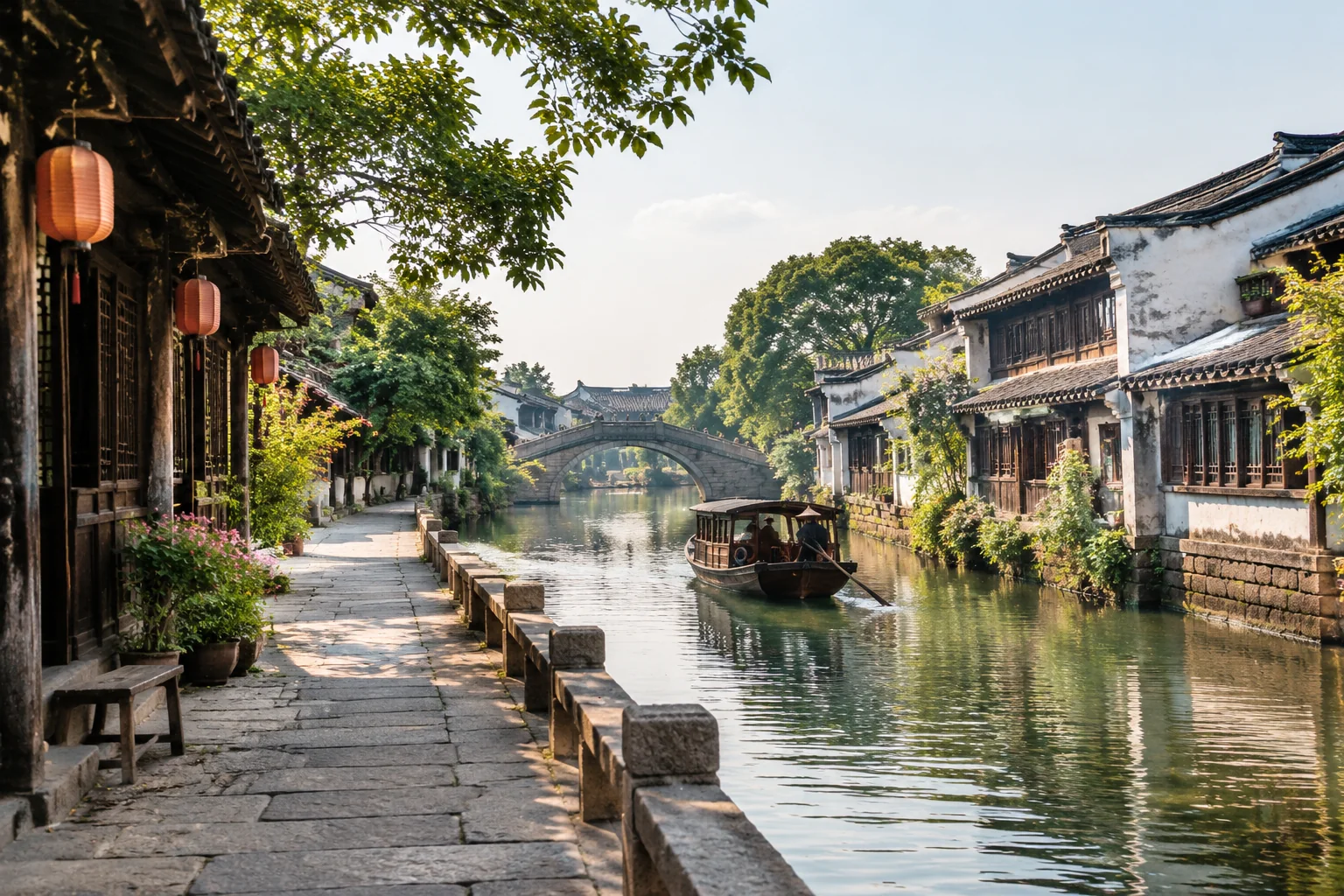
Why Nanxun Suits a Slower Day
Nanxun’s reputation in the reference material is comparative: quieter than Wuzhen and Zhouzhuang, less disturbed by the noise of the everyday world. Read that as a reason to slow down, not as a promise that you will have the lanes to yourself. Quiet is relative, seasonal and dependent on the hour; the sources do not establish current visitor numbers.
The reputation is still useful for setting expectations. Arrive braced for crowds and you may rush even when the lane is calm, simply out of habit. Arrive expecting a working town with visitors in it and you will notice more: the small signs of a lane still in use, the places where the public path and someone’s frontage meet. The old character the references praise lives in that ordinary texture rather than in a reconstructed set piece.
The practical translation is simple. Build slack into the day, avoid pinning the walk to a fixed appointment on the other side of it, and accept that the best ten minutes may not be the ones you planned.
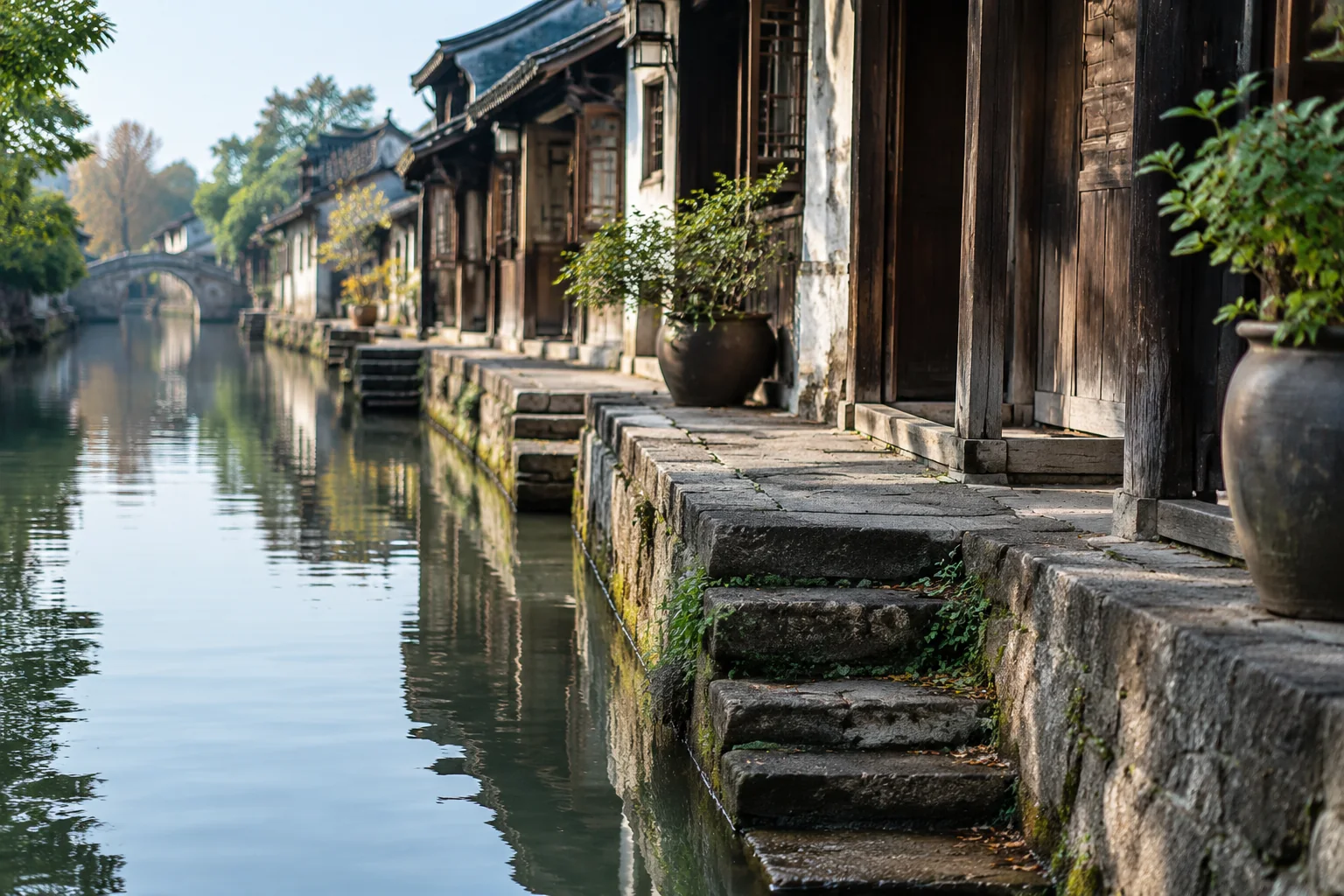
Reading the Lane-to-Water Relationship
Most visitors scan a water town horizontally: canal on one side, buildings on the other. Try instead to read the seam between them.
Start with the water edge. Ask how the lane actually meets the canal — a hard line, a strip of steps, a low wall, a narrow ledge. Those transitions are what make a riverside settlement legible, and they change along a single stretch. Look at how doorways address the water, whether a house turns its face or its back to the canal, and where the public path narrows.
Then read repetition. A building group gains character from a repeated unit — comparable widths, comparable rooflines, comparable relationships to the water — punctuated by small differences. That is why a second pass matters more than the first. On the first pass you are learning the rhythm; on the second you notice where it breaks.
Walk one bank, then the other. The opposite side gives you the elevation you cannot get from the near bank, and the water doubles whatever you are looking at. Photographers should also notice what the reflections hide: the surface is not a mirror, and the buildings are not exhibits.
Finally, remember that this is a lived-in edge. Keep your voice low near doorways, ask before photographing people, and treat closed doors and private thresholds as exactly that. The lane is not only for visitors, and the walk is better when you behave as though it is not.
Where Bai Jian Lou Fits in a Nanxun Day
The reference itinerary for Nanxun runs Xiao Lianzhuang (小莲庄), then Jiaye Hall Library (嘉业堂藏书楼), Zhang Shiming’s Former Residence (张石铭旧宅), Liu Family Tihao (刘氏梯号) and Zhang Jingjiang’s Former Residence (张静江故居), finishing at Bai Jian Lou. Two things are useful about that order: it treats the mansion-and-library circuit as the historical context, and it puts Bai Jian Lou last, as the place where the day loosens.
Take the sequence as a suggestion, not a measured route. Distances between stops, opening hours and whether a single ticket covers the group are current details to confirm on the spot or through official channels. What travels well is the logic: context first, waterside decompression after.
Alternatives worth considering:
- Half-day visit: Bai Jian Lou plus one nearby sight, rather than the full circuit at speed.
- Overnight stay: walk the quarter late and again the following morning, when the same lane reads completely differently. Confirm lane access and any tickets with whoever you stay with.
- Heat or rain: shorten the circuit and lengthen the waterside pause. A covered bench beats a forced march between mansions.
One word of caution on geography: Nanxun is not inside Hangzhou. If you are based in Hangzhou, treat the visit as an excursion and check current connections and journey times rather than trusting an old schedule.
Comparing Your Options: Four Ways to Shape the Visit
| Way to shape the visit | Best for | Pace | Trade-off |
|---|---|---|---|
| Bai Jian Lou only | Short stays, repeat visitors, anyone who prefers one place to a checklist | One to two hours, both banks, sitting included | Skips the mansion-and-library circuit that gives Nanxun its historical context |
| Full circuit, Bai Jian Lou last | First-time visitors who want the standard sequence | Most of a day, with the quarter as a late, slow finish | You arrive tired, and the quarter gets whatever energy is left |
| Bai Jian Lou first, circuit after | Early risers and anyone who wants the quietest hours at the water | One to two hours first, then the sights | The circuit may land in the busier middle of the day |
| Lane walk plus a boat | Travellers who want the canal from the water as well as the bank | A separate block added to the walk | A boat gives a different view, not a substitute for lane-level reading; current service needs checking |
None of these is the correct answer. The choice is really about where you want your attention to go, and how much walking you want in one stretch.
Pacing the Walk: A Two-Pass Sequence
- Arrive at one end of Bai Jian Lou without a shopping agenda or a list of photo spots.
- Walk the length once at normal speed, without stopping, just to learn the rhythm.
- Turn around. Now walk slowly, with your eyes on the water edge rather than the rooflines.
- Sit down once, if there is a public place to sit, for five minutes without a screen.
- Leave before you feel finished. The quarter works better as somewhere you want to return to than somewhere you have exhausted.
The timings above are suggestions, not measurements. Adjust them to the weather, your company and how far you have already walked that day. On a hot afternoon, two short passes with shade in between will beat one long one.
Pairing the Walk With Nanxun Food
Nanxun is river-fish country. The references note local river fish cooked with care, bamboo shoots prepared in several ways, and a local water-chestnut cake as a known snack. Menus shift with the season and the day’s catch, so treat any specific dish as something to ask about rather than something to order from a fixed list.
Two patterns work well:
- Lunch, then walk. A proper river-fish lunch, then Bai Jian Lou as a slow afternoon. The reference day route puts river fish at midday, which fits this shape.
- Walk, then early dinner. Walk first, while you still have attention, and eat once the light softens.
Practical notes: ask what fish came in that day rather than pointing at a photograph; ask whether a dish is served for one or for sharing; confirm prices before ordering; check opening hours the same day. If you do not eat fish or meat, ask directly what is available before sitting down — a small local kitchen may have limited alternatives, and it is better to know in advance.
Practical Differences: Weather, Families, Mobility and Short Stays
Wet weather. The references do not describe shelter along the lane, so carry a compact umbrella, wear shoes you do not mind getting damp, and be willing to cut the walk short. Conditions underfoot after heavy rain should be checked locally rather than assumed.
Families. A short out-and-back suits young children better than a full circuit. The water edge is the obvious supervision point, and a ten-minute walk with a clear finish is often kinder than an hour with no end in sight.
Limited mobility. The sources do not document gradients, bridge steps, paving condition or step-free access at Bai Jian Lou. If you use a wheelchair or have limited stamina, ask locally or consult official information before committing; this waterside lane should not be assumed to be an easy accessible route.
Short stays. With a single half-day in Nanxun, choose between the sight circuit and Bai Jian Lou rather than squeezing in both. The quarter is the better choice if you want atmosphere over inventory; the circuit is the better choice if you want the town’s social and architectural history explained.
Common Planning Mistakes
- Treating ‘quieter than Wuzhen and Zhouzhuang’ as ’empty’. It is a comparison, not a guarantee.
- Saving Bai Jian Lou for the moment you have the least energy, then walking it in ten minutes and wondering what the fuss is about.
- Looking for a headline monument. The group is the sight.
- Over-scheduling a day trip so that the waterside stretch becomes the thing you cut.
- Photographing people and open doorways as though the lane were a stage set.
- Trusting any published hours, prices or boat timetables — including anything in this guide — without checking.
Pre-Trip Checklist
- Confirm how you will reach Nanxun and how long the transfer really takes on the day.
- Check entry arrangements for whichever sights you plan to visit, and whether they are sold separately or together.
- Do not assume any Bai Jian Lou house is open inside; ask locally if interiors matter to you.
- Look at the forecast and decide whether the walk opens or closes your day.
- Keep the block after the walk free, so a slower-than-expected hour does not cost you a connection.
- Carry what you need to be comfortable standing and walking for an hour without a shop nearby.
Frequently Asked Questions
Is Bai Jian Lou worth visiting if I only have half a day in Nanxun?
Yes, if you want atmosphere rather than a checklist. Skip the full circuit, walk both banks of the waterside lane once, sit for a few minutes and eat nearby. You will see less of Nanxun’s mansion architecture but understand more about how the town meets its water.
How long should I spend at Bai Jian Lou?
One hour covers a single out-and-back walk. Two hours is better: it allows a slow second pass, a pause, and a change of light. More than that only makes sense if you plan to eat nearby as well.
Should I see Bai Jian Lou before or after Nanxun’s other sights?
The reference itinerary finishes there, and that order makes sense for a first visit because the mansions and library supply context first. If you want the quietest hours at the water, reverse it and do the circuit afterwards.
Can I see Bai Jian Lou by boat?
A boat gives a different reading of the canal, but it cannot replace the lane-level view — you lose the water edge, the thresholds and the sense of walking. The references do not establish current boat routes, piers or operating hours here, so check locally and treat a boat as a separate short experience.
Is Nanxun really quieter than Wuzhen and Zhouzhuang?
The reference material describes it that way, and it is a reasonable expectation to carry into planning. It is not a guarantee of empty lanes: quiet varies by season, day of week and hour, and the sources do not provide current visitor figures.
What should I eat around Bai Jian Lou?
River fish is the local speciality, bamboo shoots appear in several preparations, and a water-chestnut cake is noted as a local snack. Ask what is fresh that day, confirm prices before ordering, and check opening hours rather than relying on an old guidebook.
Sources and Verification
This guide was assembled from internal reference documents, not from a site visit, interview or inspection. The documents are Chinese-language travel guides held in a private reference library; their original PDF pages are cited below. They are not public links, and no publication date or fact-check date has been verified for them.
- 乌镇攻略 (Wuzhen guide), page 15 — describes Nanxun as quieter than Wuzhen and Zhouzhuang; identifies Bai Jian Lou as the Ming-era building group that best expresses the town’s old character; notes riverside family lodging, river fish, bamboo shoots and a local water-chestnut cake.
- 杭州攻略 (Hangzhou guide), page 15 — repeats the Bai Jian Lou description and the riverside lodging note, and gives the one-day sight order that ends at Bai Jian Lou, with river fish at midday.
- 西溪湿地攻略 (Xixi Wetland guide), page 10 — repeats the Bai Jian Lou description, the lodging note and the same one-day sight order.
What is source-backed background: the characterisation of Bai Jian Lou as a Ming-era group, the comparative quiet, the general food notes and the suggested sequence of sights. What is not verified and needs official or on-the-ground confirmation: current entry arrangements, ticketing, interior access at Bai Jian Lou, boat service, restaurant hours and prices, transport connections from Hangzhou, and conditions underfoot or step-free access.
If you would like help fitting Nanxun into a wider Zhejiang itinerary, you can send an inquiry using the form below. It is a request for contact, not a booking or a confirmed quote.
Find places & plan your visit
These links open external search results. Confirm the exact place, entrance and current arrangements.
Need help planning your trip?
Tell us about your travel plans and send an inquiry.