In this guide 19 sections ▾
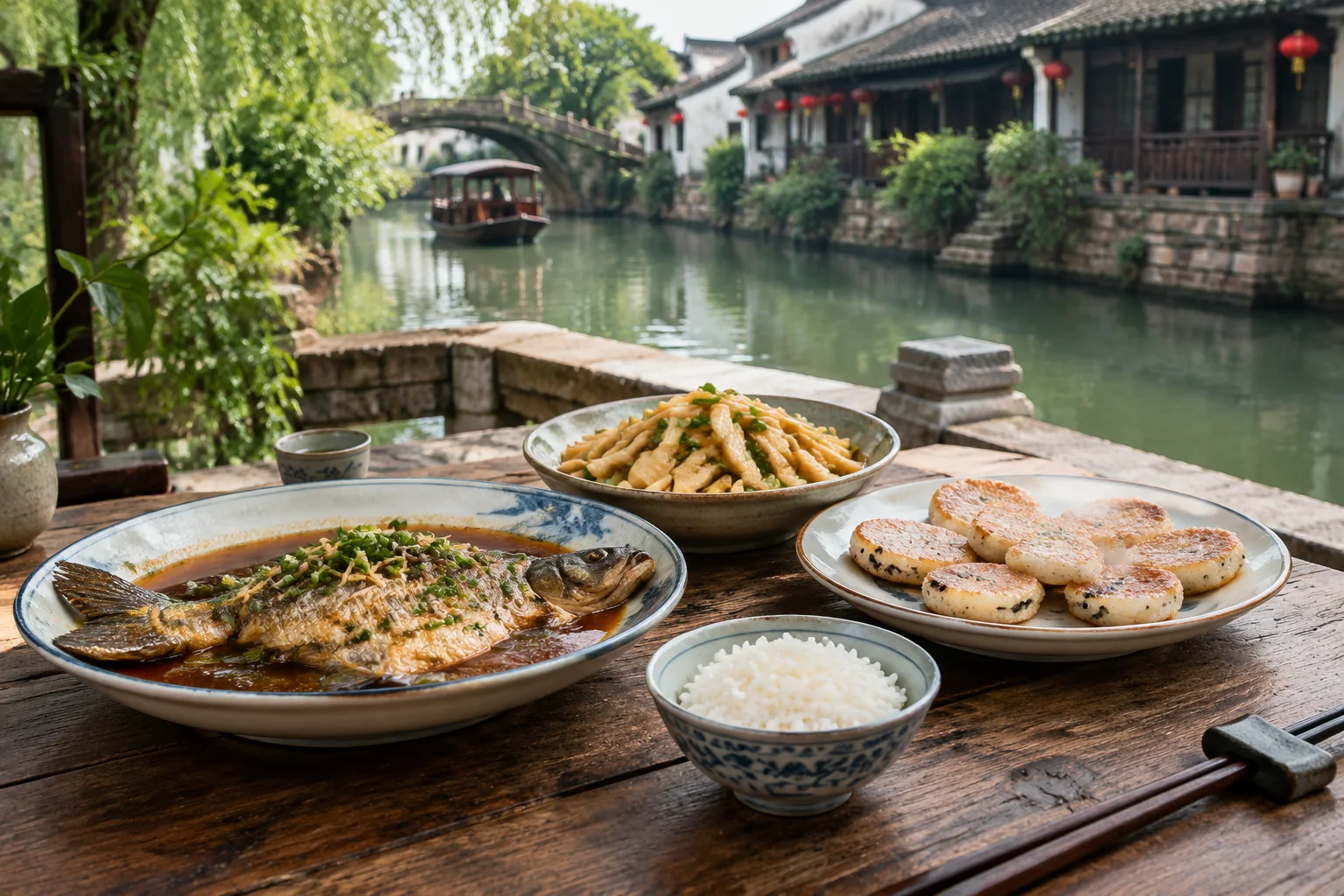
The short answer: If Nanxun gives you one meal, build it around three things — a freshwater fish, a bamboo-shoot dish, and one plain vegetable or rice dish to keep the table balanced — then buy the water-chestnut pastries afterwards as a snack or a box to take home, never as a substitute for lunch.
This guide is written for travellers based in Hangzhou who are weighing Nanxun as a day out and would rather eat deliberately than sit at the first canal-side terrace they reach. It is not a restaurant shortlist. The reference material behind it is general, small water-town kitchens change what they cook with the season and the day’s catch, and the details most likely to trip you up — ticket arrangements, opening times, prices, transport timetables — are exactly the ones that need checking against current official information before you travel. What follows is the part that stays useful: what to order, in what proportion, at what point in the day, and what to ask before the fish goes into the pan.
The Short Answer: One Fish, One Shoot, One Balance
Nanxun sits in the "land of fish and rice" (鱼米之乡) belt of northern Zhejiang, and its table reflects that. Descriptions of the town’s food return again and again to two ingredients: freshwater fish from the canals and surrounding waterways, and bamboo shoots, which are described as abundant locally, eaten with enthusiasm, and cooked in many different ways. A third item, water-chestnut pastry (野荸荠糕点), is named as a local speciality — but it is a sweet, and treating it as the main event is the most common way visitors end up under-fed and over-sugared.
So the working rule is simple. One fish dish, one bamboo-shoot dish, one balancing dish, rice. For two people that is usually enough. For four, add a soup or a second vegetable rather than a second deep-fried dish. Sweets come later, on foot, from a counter rather than a menu.
The main decision is not where to eat but how to compose the table. Get that right and almost any decent kitchen will serve you a recognisably local meal.
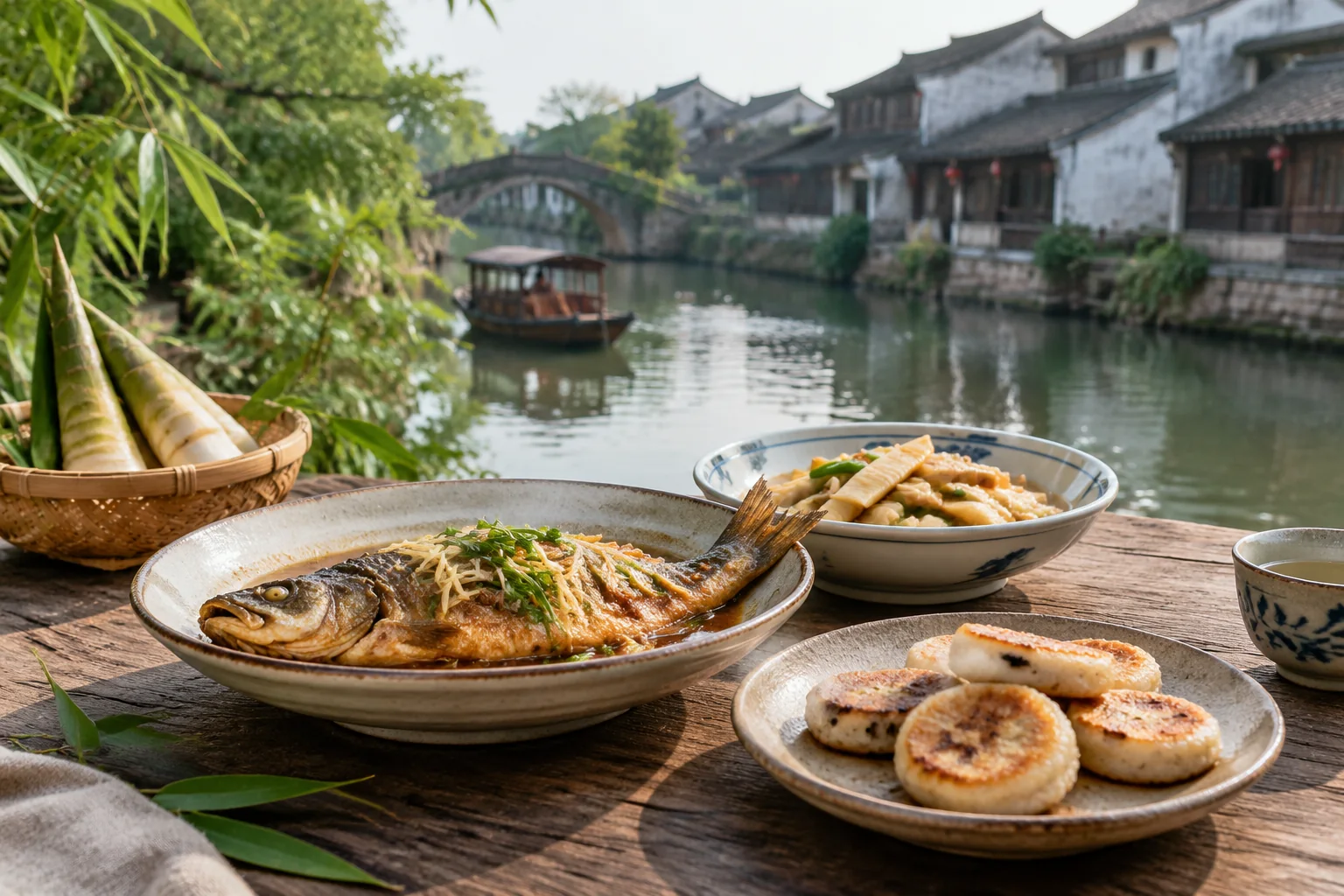
Why River Fish and Bamboo Shoots Define the Local Table
The same references describe Nanxun through its water and its mulberry fields — a fish-and-rice township and a silk town at once — and the food follows that logic. Fish comes from water that is everywhere around you; shoots come from the bamboo hills behind the plain. Neither is a novelty dish invented for visitors. They are ordinary regional ingredients, which is why the cooking is described as careful and varied rather than showy: the point is the ingredient, handled well.
It helps to place Nanxun in a wider Huzhou frame. The prefecture’s better-known snack names — 周生记馄饨 (wontons), 丁莲芳千张包 (bean-curd-sheet parcels), 震远同酥糖 (crisp sesame sweets) and 诸老大粽子 (rice dumplings) — are sometimes mentioned alongside Nanxun’s table. They belong to the wider Huzhou area rather than to any single canal-side kitchen, so treat them as things you may well run into in town rather than a checklist you must finish in one afternoon.
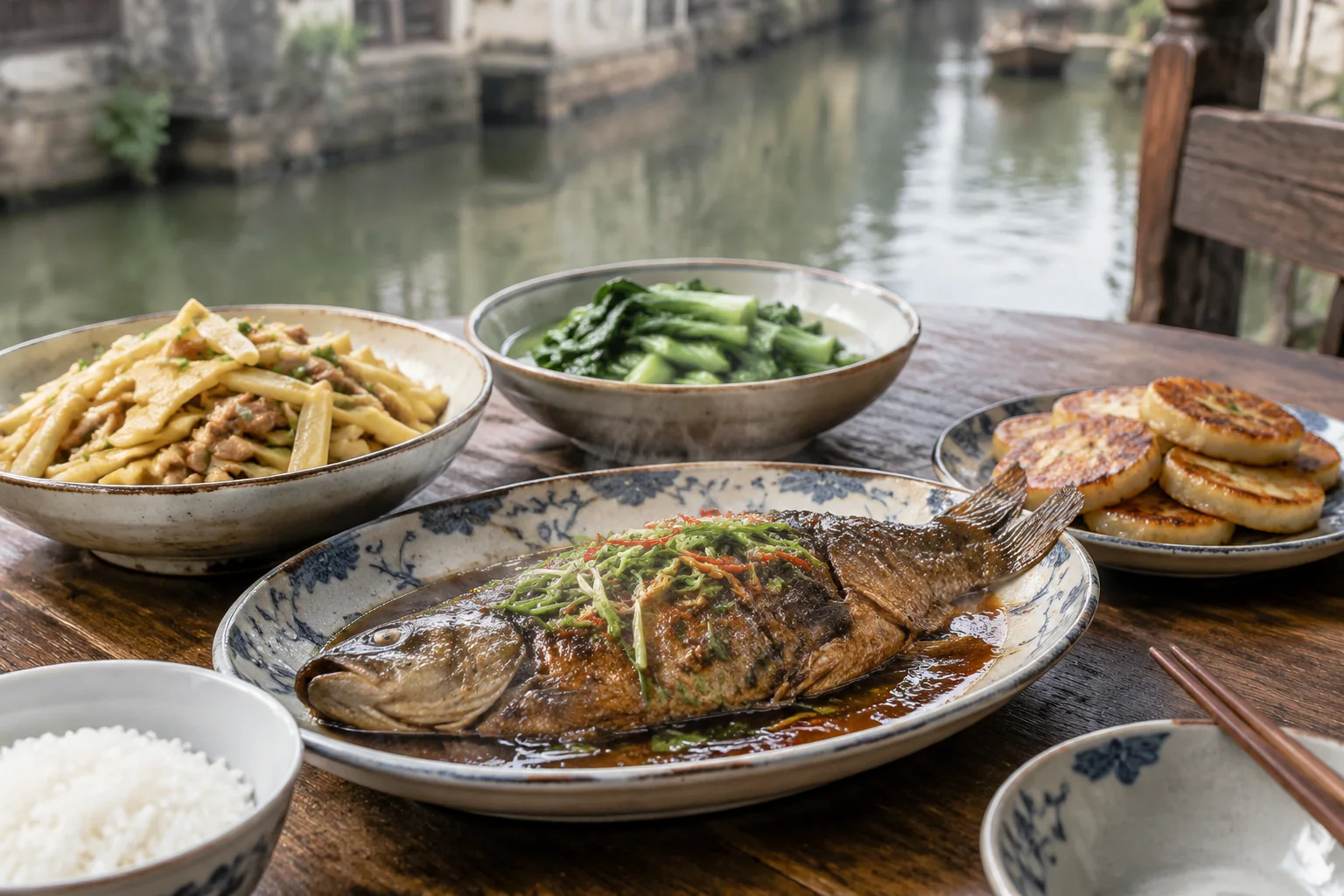
How to Order a Balanced Canal-Side Meal, Step by Step
- Fix the fish first. The fish is the centre of the meal and the dish most likely to be priced by weight or limited by what came in that day. Settle it before anything else, and ask what is actually available rather than choosing from a printed list.
- Add one bamboo-shoot dish. One is enough. Ask whether it is a fresh-shoot dish or a preserved/braised one, because they eat very differently: the fresh version is lighter and more delicate, the braised version richer and oilier.
- Add one plain dish. A green vegetable, a tofu dish or a simple soup. This is the part visitors skip, and it is the part that keeps a fish-and-pork table from becoming heavy.
- Add rice. Rice, not a second starch. If you also want noodles or a stuffed bun, treat it as the snack course later rather than as a second main.
- Stop and reassess. Two people rarely need more than three dishes plus rice. If the fish turns out to be large, drop the soup. If it is small, add one vegetable.
When you size up a kitchen, remember that the canal view and the cooking are two separate decisions. A table over the water is pleasant; it tells you nothing about the fish. Ask what is fresh that day, ask how the fish is normally cooked here, and — if the fish is sold by weight — confirm the weight and the price before it is cooked. Ask about portion size too: water-town dishes vary widely between homes, and what looks like a small order can arrive as a platter.
River Fish: Choosing a Preparation You Can Actually Eat
Freshwater fish in this part of Zhejiang usually arrives in one of three forms: steamed whole, braised whole in soy and aromatics, or made into a soup. Steaming shows off the ingredient and is the least forgiving if the fish is not fresh; braising is more robust and more strongly flavoured; soup is the easiest entry point if you are wary of bones. Reference descriptions of river-fish cooking in neighbouring Shaoxing emphasise light oil, broth-forward seasoning and an absence of chilli heat — useful as a regional expectation, not a promise about any individual Nanxun kitchen.
Whole fish means bones, including small ones. If that is a problem, say so at the start rather than at the table: ask whether the kitchen can do a soup or a filleted version, and accept that the answer may be no. It is also worth asking which end of the fish is best eaten first, since the flesh near the head and along the backbone behaves differently from the tail.
One fish is enough for a small group. Ordering two fish dishes in the same meal usually means one goes cold and the bamboo shoot gets ignored — which defeats the point of the trip.
Bamboo Shoots: The Dish That Makes the Meal Feel Local
The references describe Nanxun’s bamboo shoots as plentiful and prepared in many different ways. In practice, shoots are a vehicle for fat: stir-fried with pork, braised with cured meat, or simmered in a soup. A useful template to recognise on a menu is 腌笃鲜, the Jiangnan home dish that pairs salted pork with spring bamboo shoots — the kind of slow, savoury cooking that shows up in nearby Hangzhou kitchens and makes the most of a fresh shoot.
Season matters. Water-town households in this region are described as eating by the calendar, with spring bamboo shoots and winter bamboo shoots treated as different ingredients rather than interchangeable ones. Spring shoots are more tender and quicker to cook; winter shoots are denser and hold up to longer braising.
Two questions are worth asking. Is the shoot fresh or preserved? And is there pork in the dish? Bamboo shoots are so often paired with cured or fresh pork that vegetarians can end up with a dish they did not expect, even when the menu sounds vegetable-led.
Water-Chestnut Cakes and the Sweet Stop
The references single out 野荸荠 pastries as locally famous, and this is where expectations need managing. These are sweets: starchy, sweet and filling. They are not a lunch, and a box of them eaten at midday will flatten your appetite for the fish you came for.
Buy a small quantity first and taste before committing to a gift box. Ask what is in the pastry, how sweet it is, and how long it keeps — practical questions that decide whether it survives the journey home. Sweetness levels and textures vary between makers, so one sample tells you more than any recommendation.
The wider Jiangnan water-town snack repertoire gives useful context: steamed rice cakes such as 定胜糕, fermented rice balls (酒酿圆子) and green herb dumplings (青团) all appear in water-town snack references. If the water-chestnut pastry does not appeal, one of these is a reasonable second choice — and a cup of tea alongside turns a sweet stop into a rest rather than a course.
Meal Shapes at a Glance
| Situation | Roughly what to order | Why it works | What to watch |
|---|---|---|---|
| Two people, normal appetite | One fish + one bamboo-shoot dish + rice | Covers both local specialities without waste | Whole fish can be large; confirm size and weight first |
| Four people | One fish + one bamboo-shoot dish + a soup or green vegetable + rice | More variety, still balanced | Skip a second fried dish; it crowds out the fish |
| Short stop of an hour or two | Tea + one or two pastries | Fits a brief visit without a full sit-down meal | Sweet pastries are filling; do not then order a full table |
| Mixed group with cautious eaters | Fish soup or a filleted preparation if available + bamboo shoots with pork + rice | Easier to eat, fewer bones | Confirm whether the kitchen can fillet; not all can |
A Realistic Eating Timeline for a Hangzhou Day Trip
Treat the meal as the anchor of the day and build the walking around it, not the other way round. Arrive late morning, walk first — the riverside lanes and the old riverside building group at 百间楼 are the obvious place to slow down — and sit down for the main meal at lunch, when a kitchen is at full stretch and the day’s fish is freshest in the pot.
After lunch, walk again, then take the sweet stop mid-afternoon: tea plus one pastry, bought from a counter rather than ordered as dessert. Leave the late afternoon free for the journey back. Cross-city transfers in this region take real time, and older route notes pointing to coach services from Hangzhou’s north bus station are exactly the kind of detail to re-check with current operators before you plan a tight schedule.
If you would rather eat dinner than lunch in Nanxun, the references describe riverside family inns around 百间楼, which is the natural way to stay for an evening table. Availability, standards and booking arrangements all need independent verification — do not assume a canal-facing room because a description mentions one.
Families, Older Travellers, Wet Weather and Short Stops
With children, the two practical issues are bones and waiting. A fish soup or a filleted preparation removes the first; ordering the bamboo-shoot dish first removes the second, since it usually arrives faster than a whole fish. Sweet pastries are an easy win with children, but keep them for after the meal.
If mobility is a concern, ask about steps, thresholds and seating before committing to a specific riverside table. Old water-town lanes and bridges typically involve uneven paving and changes of level, and a canal-side view often means a step down to reach it. Wet weather pushes everyone indoors at once, so an early or late lunch is more comfortable than the noon peak — and it is worth having a second choice in mind rather than queueing in the rain.
On a short stop, do not attempt the full table. One bamboo-shoot dish plus rice, or tea and a pastry, is a better use of an hour than a rushed fish.
Common Ordering Mistakes and a Pre-Trip Checklist
The recurring mistakes are predictable. Ordering two heavy dishes and no vegetable. Treating the famous pastry as a meal. Assuming an English menu exists. Leaving the fish decision until everyone is already hungry. And planning the day so tightly that the meal has to be swallowed rather than eaten.
Before you go:
- Check how you will reach Nanxun and return the same day, using current transport information rather than old route notes.
- Confirm whether any sights you want to see have separate ticketing or opening arrangements.
- Decide in advance that lunch is your main meal, and protect an unhurried slot for it.
- Write your dietary restrictions in Chinese characters, especially "no pork" or "no shellfish", rather than relying on spoken English.
- Carry a payment method that works for you and a little flexibility for small kitchens that may not take it.
- Leave a buffer of at least half an hour either side of the journey, and do not plan a heavy dinner back in Hangzhou on the same evening.
FAQ
Do I need to reserve a table for a canal-side lunch in Nanxun?
There is no reliable current information here on reservation practice, and small family-run kitchens may not take bookings at all. The practical approach is to arrive slightly before or after the noon peak, ask your accommodation for local guidance on the day, and keep a second choice in mind. Anyone promising you a guaranteed canal-view table without a confirmation in hand is guessing.
I don’t like picking bones out of a whole fish — can I still eat river fish in Nanxun?
Yes, if you ask. Fish soup is the simplest alternative, and some kitchens can prepare a filleted version. Ask before ordering rather than after, and be prepared for the answer to be no in a small kitchen working with a set preparation. If bones are a hard limit, make the bamboo-shoot dish and a vegetable the centre of your meal instead.
Are bamboo shoots available all year, and does the type matter?
Seasonality affects both texture and flavour, and regional water-town cooking is described as following the calendar, with spring and winter shoots treated as different ingredients. Spring shoots are more tender; winter shoots are denser and suit longer cooking. Ask what is in the kitchen that day, and ask whether the dish uses fresh or preserved shoots — the two produce quite different plates.
Are water-chestnut cakes a meal or a snack?
A snack, and a filling one. They are sweet and starchy, so they work best mid-afternoon with tea, or as a boxed gift, rather than as lunch. Buy a small amount first, ask how sweet they are and how long they keep, and only then decide whether to take a larger box home.
Can a mixed group with a vegetarian eat well at a Nanxun canal-side table?
It takes some care, because bamboo shoots are frequently cooked with pork or cured meat, and the local identity of the table is built on fish. Say clearly what you do not eat, ask specifically whether each dish contains pork or fish stock, and lean on plain vegetable and tofu dishes plus rice. Do not assume a vegetable-sounding dish is vegetarian.
If you would like help fitting a Nanxun food day into a longer Hangzhou itinerary, you can send a travel inquiry using the form below.
Sources and Verification
This article was built from internal reference documents, not from a site visit: 乌镇攻略 (Wuzhen guide), PDF page 15; 杭州攻略 (Hangzhou guide), PDF pages 11 and 15; 西溪湿地攻略 (Xixi Wetland guide), PDF page 10; and 浙江攻略 (Zhejiang guide), PDF pages 15, 17 and 28. Page numbers refer to the original PDFs.
The source-backed background is narrow and worth stating plainly: that Nanxun is described as a fish-and-rice township with abundant freshwater fish and bamboo shoots cooked in varied ways; that water-chestnut pastries are named as a local speciality and Huzhou-wide snack names are listed; that water-town households in the region eat by season, with spring and winter bamboo shoots distinguished; that 腌笃鲜 pairs salted pork with spring shoots in nearby Hangzhou kitchens; and that river-fish cooking in this part of Zhejiang is described as light, broth-forward and without chilli heat.
Everything time-sensitive sits outside that background. Ticket arrangements, opening times, prices, portion sizes, reservation practice, accessibility and transport timetables were not verified for this article and should be confirmed with current official local information before you travel. The documents behind it are reference material of uncertain date and are not a fact-check record; nothing here should be read as a claim that current conditions have been checked.
No restaurants, inns or businesses are recommended, and no visit, tasting or local expertise is implied.
Find places & plan your visit
These links open external search results. Confirm the exact place, entrance and current arrangements.
Need help planning your trip?
Tell us about your travel plans and send an inquiry.