In this guide 16 sections ▾
The Short Answer: Match the Souvenir to Its Use
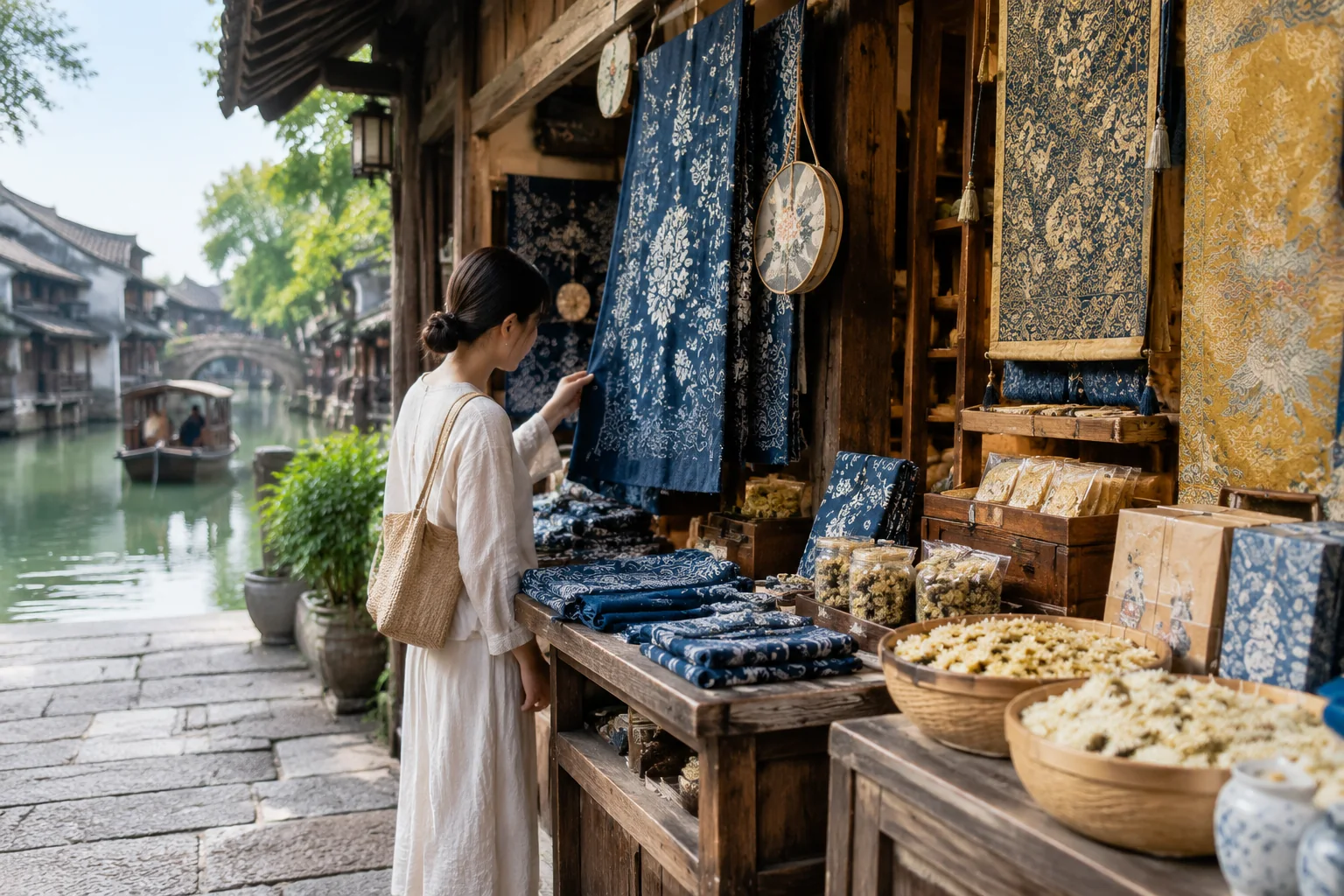
Wuzhen craft shopping is easier when you separate three purchases that are often displayed together. Blue calico is a textile decision. White chrysanthemum is a food-and-tea decision. Wuzhen brocade is a high-consideration textile purchase where fibre, weave and the meaning of gold thread matter more than the word traditional.
Buy blue calico if you want a usable cloth object with a visible link to Wuzhen’s workshop culture. Buy white chrysanthemum if you want a light, locally associated consumable and will check freshness, dryness and packaging. Approach brocade cautiously: the available references describe Wuzhen as a silk-producing region and list blue calico, white chrysanthemum, sanbai wine and local snacks as specialties, but they do not document brocade’s production, patterns, gold-thread content or current retail standards.
This guide is for a visitor with half a day to two days in Wuzhen, especially someone coming from Hangzhou or Shanghai who wants a souvenir connected to the place rather than a generic gift. The main decision is not which shop to visit; it is which category fits your use, budget and tolerance for care. The limitation is important: no current prices, shop hours, stock, authentication schemes or return policies are asserted here. Those need checking at the counter and through current official visitor information.
Blue Calico: A Cotton Textile You Can Read
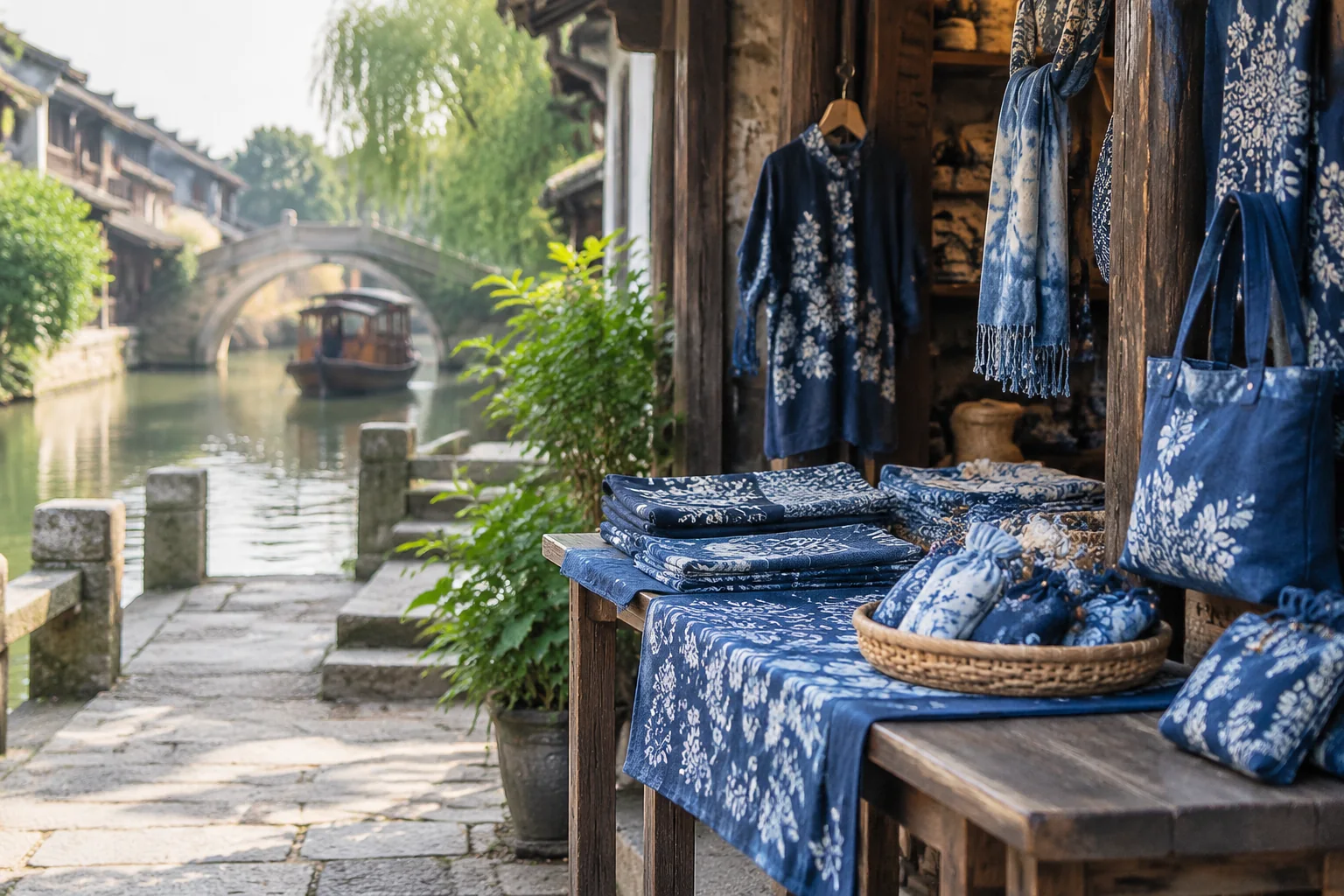
Blue calico is the most straightforward of the three categories for most visitors. It is a resist-dyed cotton cloth in the indigo-blue palette associated with Jiangnan water towns, and it is sold as bags, scarves, table runners, clothing, pouches and small household textiles. The Wuzhen reference lists blue calico among local products and includes a blue-calico dye workshop in its East Scenic Area route, alongside a cluster of traditional workshops. That does not prove every piece sold in Wuzhen is made there, but it does give you a craft context to look for.
The first thing to judge is the cloth, not the story. A useful blue-calico souvenir should feel like a textile you would actually use: dense enough not to distort, with even seams and a lining that does not twist. Hold it up to the light. Check whether the pattern sits cleanly on the reverse as well as the front. Resist-dyed cloth often has slight irregularities, but irregularity alone is not proof of handwork; printed cloth can imitate variation, and hand-finished cloth can be poorly made.
Ask how the blue was applied and how the piece should be washed. A seller who can explain the process is more useful than a label that says traditional. If you are buying clothing, try it on and check the seam allowance and dye transfer at folds. For a first purchase, a small pouch, scarf or table runner is lower risk than a large furnishing fabric. Wash separately in cold water, use a mild soap, and dry in shade unless the seller gives different care instructions. Do not assume colourfastness, especially on a dark indigo piece that will touch light clothing or upholstery. The reference does not provide a pattern catalogue, so do not accept a claim that one motif is the only authentic design. Judge the piece in front of you.
Blue calico also works well as a contextual purchase. Seeing a dye workshop or a textile demonstration first makes the cloth easier to read: you notice the difference between a flat printed surface and a cloth with texture, pattern registration and finishing. If craft shopping is a priority, put the East Scenic Area workshop route early in the day, then compare what you saw with what is offered in the West Scenic Area’s shopping lanes. Keep the purchase small enough to carry through the rest of the day.
White Chrysanthemum: A Tongxiang Product With a Hangzhou Name
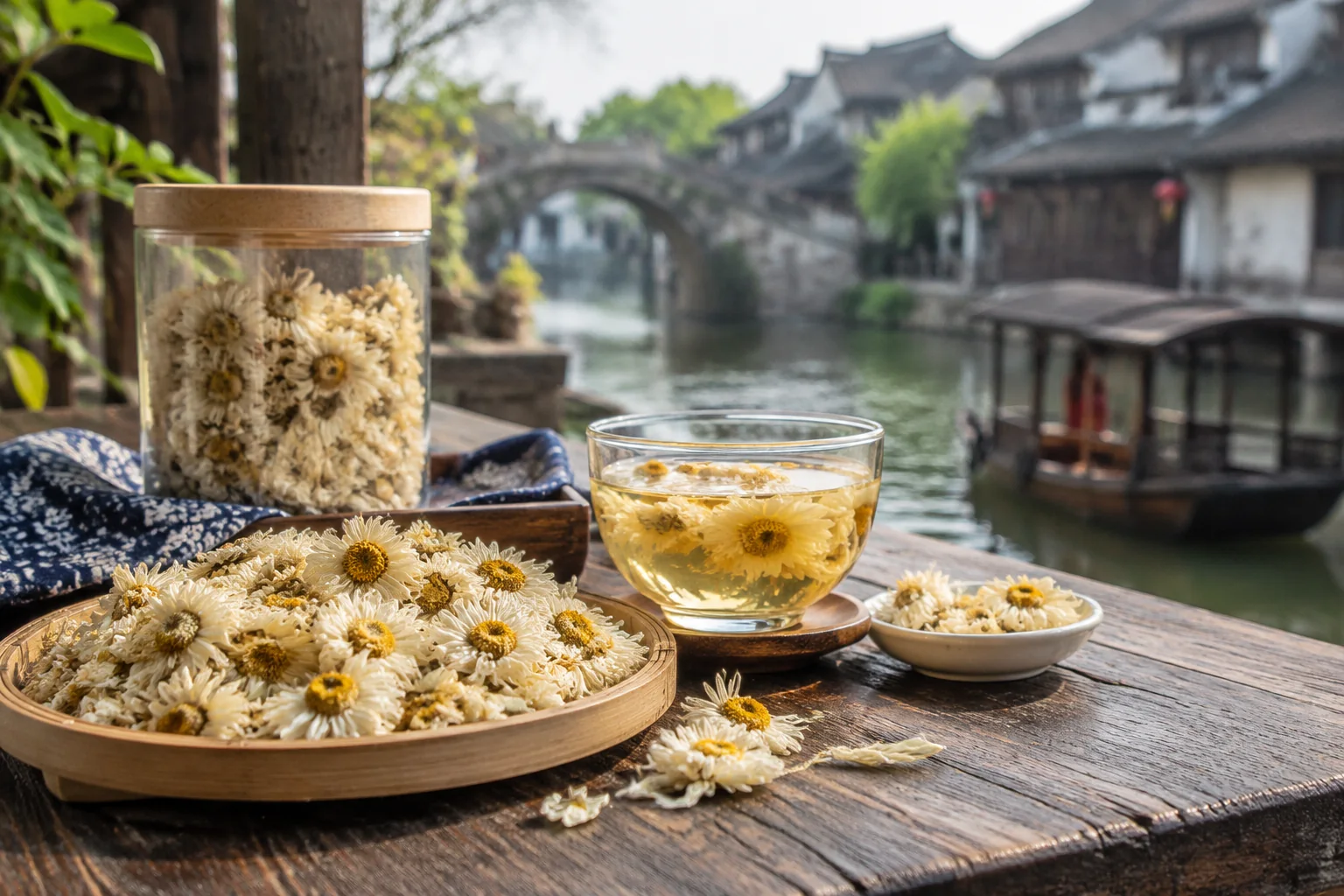
Hangzhou white chrysanthemum is one of the clearest examples of a souvenir name that can mislead. The reference is explicit that the name does not mean the flowers are produced in Hangzhou city. It identifies Tongxiang, the county-level city that contains Wuzhen, as the origin, and describes the dried flower heads as having white petals, a golden centre, a full shape and a clean, sweet aroma. For a Wuzhen visitor, that makes white chrysanthemum a more locally grounded purchase than the name suggests.
The product is usually sold as loose dried flower heads or sealed packs for tea. The reference also mentions bath use. Judge it as you would any dried herbal product: the flower heads should be dry, intact and not dusty or crumbly; the aroma should be clean rather than musty; the colour should not be dull brown throughout. Broken petals and powder are not automatically bad, but a pack that is mostly dust will not brew well. If the tea is sold loose, ask how long it has been open and how it has been stored. Moisture and strong smells are the enemies of dried chrysanthemum, so a sealed, food-grade pack with a clear origin and packing date is easier to assess than an open scoop.
The reference repeats traditional and pharmacological claims about inflammation, eyes, blood pressure and lipids. Treat those as historical background, not medical advice. A souvenir tea is not a treatment, and anyone with a health condition, pregnancy or medication use should ask a clinician before using it medicinally. For ordinary drinking, brew a small amount and taste before making a large purchase; chrysanthemum can become bitter if overbrewed or if the flowers are old.
White chrysanthemum is the easiest category to give as a gift because it is light and consumable, but it is also the easiest to buy badly. Check the packaging, the smell and the date. If you are carrying it abroad, check your destination’s plant-product import rules before packing it. The reference’s description of Tongxiang as a principal origin is useful background; it is not a current market survey, and it does not verify every packet sold in Wuzhen.
Wuzhen Brocade: The Category That Needs the Most Verification
Wuzhen brocade is the category where the available references are weakest. The Wuzhen shopping passage names blue calico, white chrysanthemum, sanbai wine and local snacks; it does not describe brocade’s weave, pattern vocabulary, gold-thread content or retail network. The broader reference describes the Wuzhen area as a home of silk, which makes silk textiles a plausible regional purchase. That is context, not a product guarantee. It does not verify that a particular piece sold in Wuzhen was woven there, nor does it establish what woven with gold thread should mean on a modern label.
That gap matters because brocade is a higher-cost textile decision. Brocade can describe a jacquard-woven fabric with a raised pattern, but the word is used loosely in retail. Silk can mean pure silk, a silk blend or a synthetic satin. Gold thread can mean metal-wrapped silk, a synthetic metallic yarn, a coated film or a printed effect. None of those distinctions can be settled by look alone, and a dark shop interior makes colour and sheen especially hard to judge.
Use a simple inspection sequence. Turn the piece over and look at the reverse: a genuine woven pattern should be structurally part of the cloth, not sitting on the surface like a print. Ask for the fibre content in writing and check whether the label names silk or only uses silk in the product name. Ask what the metallic yarn is made of and how the piece should be cleaned. If the answer is dry clean only, decide whether you will actually do that. Check the drape, the lining, the seam allowance and whether the pattern aligns at seams. A very low price for a large silk textile is not proof of fraud, but it is a reason to ask more questions.
If you want a wearable piece, prioritise fit, weight and care over the word brocade. If you want a display piece, choose the design you will still like when the holiday is over, and ask for a receipt that describes the fibre and the price. If the seller cannot explain the material, do not treat the purchase as an investment. Buy it because you like the object, at a price you can accept without verification.
Where These Crafts Fit Into a Wuzhen Visit
Wuzhen is not a single market street. The historic town is organised around old streets and waterways, with the East Scenic Area associated with traditional residential lanes, workshops and small museums, and the West Scenic Area associated with shops, waterways and evening atmosphere. The two areas are separate visits, not one continuous stroll. If you are coming from Hangzhou, remember that Wuzhen is in Tongxiang, not inside Hangzhou city, so the day needs a transfer buffer rather than a tight city schedule.
For a short visit, use the East Scenic Area to understand the craft and the West Scenic Area to compare and buy. In the East Scenic Area, the reference route includes a blue-calico dye workshop, traditional workshops, a woodcarving museum, a bed museum and a folk-customs museum. That sequence gives you material context: you see cloth, tools and finished objects before you see a retail display. In the West Scenic Area, the shopping lanes are better for browsing and for choosing between several versions of a similar item. Do not try to do both at a rushed pace if you also want to eat and walk the waterside lanes.
If you have two days, split the visit. Give the East Scenic Area a slower morning and keep the afternoon for the West Scenic Area and an evening walk. If you have only half a day, choose one craft category and one area. Blue calico is the easiest to combine with a workshop visit; white chrysanthemum is easy to buy in a sealed pack; brocade needs more time and better light than a rushed stop allows.
Check the current status of individual workshops before building the day around them. Demonstration spaces can close, change use or operate on a different pattern from the scenic area itself. Carry a light rain layer if the forecast is unsettled, and keep purchases in a dry bag. Families with children may find the dye workshop and small textile items easier than a high-value brocade purchase, but the references do not provide a current family programme or accessibility audit, so confirm facilities directly.
A Comparison Table for Deciding Before You Shop
| Category | What you are buying | Best for | Checks before buying | Main tradeoff |
|---|---|---|---|---|
| Blue calico | Resist-dyed cotton cloth in an indigo-blue palette, sold as bags, scarves, runners, clothing or small household items | A usable souvenir with a workshop connection; easy gifts for people who like textiles | Cloth density, seam quality, pattern on the reverse, dye transfer, washing instructions, whether the piece is hand-finished or printed | Attractive but variable quality; colourfastness and finishing need checking |
| White chrysanthemum | Dried flower heads from Tongxiang, used for tea or bath; the name references Hangzhou but the reference identifies Tongxiang as the origin | A light, consumable gift; local tea for someone who enjoys floral infusions | Dryness, aroma, dust, broken petals, sealing, packing date, food-grade labelling, import rules | Perishable and easily stale; medicinal claims should not be treated as medical advice |
| Wuzhen brocade | A silk or silk-style patterned textile associated with the region in visitor searches; the supplied reference does not document its weave or gold-thread content | A higher-value textile for someone who will wear or display it and can verify the material | Fibre label, reverse structure, metallic yarn type, lining, seam alignment, cleaning method, receipt description | Highest verification burden; the word brocade is not a guarantee of silk or handweaving |
Common Mistakes and a Practical Buying Checklist
The first mistake is buying the label rather than the object. A blue-calico bag with a weak seam, a tea pack with no date, or a brocade shawl with no fibre information is not a better souvenir because the stall uses the word traditional. The second mistake is treating Hangzhou in the product name as a production address. For white chrysanthemum, the reference points to Tongxiang. The third is assuming that silk and brocade are protected descriptions. Ask what the words mean on that specific label.
The fourth mistake is shopping at the first display. In a water town with many similar stalls, compare three pieces in different sizes or price bands before deciding. The fifth is ignoring care. A textile that needs dry cleaning may be a poor choice for a long trip; a tea that has been open in a humid stall may be a poor gift. The sixth is failing to ask for a receipt. A receipt will not authenticate a craft, but it gives you a record of what the seller claimed.
A practical pre-trip checklist:
- Decide the category before you arrive: usable textile, consumable tea, or high-value display textile.
- Set a maximum budget and a maximum packed size; water-town lanes are easier without bulky bags.
- For blue calico, bring a small measuring note if the item must fit a specific table or bed.
- For tea, check whether your destination allows plant products and whether the pack is sealed.
- For brocade, ask for fibre content, metallic yarn type and cleaning instructions in writing.
- Keep receipts and avoid removing care labels until you are home.
- Check current opening arrangements and workshop operation through official visitor information before relying on a specific demonstration.
FAQ: Wuzhen Craft Shopping
Is Hangzhou white chrysanthemum actually from Hangzhou?
The name is misleading. The reference says Hangzhou white chrysanthemum is not originally produced in Hangzhou city and identifies Tongxiang, the county-level city that contains Wuzhen, as the origin. That makes it a sensible local purchase in Wuzhen, but it does not verify every packet on sale. Check the pack’s origin, packing date and storage.
How can I tell blue calico from a printed imitation?
You cannot rely on one test. Look at the reverse, the pattern edges, the cloth texture and the finishing. Resist-dyed cloth may show slight variation, but printed cloth can imitate that. Ask how the blue was applied and how the piece should be washed. A seller who can explain the process and the care is more useful than a label that says handmade.
Should I buy Wuzhen brocade in Wuzhen or wait?
Buy in Wuzhen only if you can inspect the material and the seller can explain the fibre, metallic yarn and care. The supplied references do not document brocade’s production or retail standards, so there is no source-backed reason to treat a Wuzhen purchase as automatically better than one elsewhere. If the answers are vague, wait.
Can I see craft workshops in the East Scenic Area and shop in the West Scenic Area?
That is the cleaner sequence if you have a full day. The East Scenic Area route includes a blue-calico dye workshop and traditional workshops; the West Scenic Area has shopping lanes and a different evening atmosphere. Treat them as separate visits and allow a transfer buffer. Check current workshop operation before you go.
How should I pack tea and textiles?
Keep tea sealed and dry, away from strong-smelling items. Double-bag it if you are carrying it in a pack with food or toiletries. Roll textiles rather than folding sharp creases, and keep dark blue calico away from light clothing until you have washed it. Ask the seller for specific care instructions; the references do not provide a universal washing rule.
Sources and Verification
This article is based on internal reference documents, not on a current shop survey. The main background comes from the Wuzhen Guide (乌镇攻略), especially pages 2, 4, 5, 11, 12 and 17, which cover Wuzhen’s setting, the East and West Scenic Areas, the East Scenic Area workshop route, the shopping passage and the white chrysanthemum description. The Zhejiang Guide (浙江攻略), pages 16–17, provides the wider context that Wuzhen sits in Tongxiang and that the area is described as a silk-producing region.
The references are older guidebook material. They are useful for understanding categories and geography, but they are not a price list, a shop directory, a product-authentication guide or a statement of current opening hours. Prices, stock, workshop operation, food labelling, import rules and return policies need current checks with official visitor information or the seller. No specific shop, current price, opening time, booking channel or fact-check date is asserted here.
Find places & plan your visit
These links open external search results. Confirm the exact place, entrance and current arrangements.
Need help planning your trip?
Tell us about your travel plans and send an inquiry.