In this guide 18 sections ▾
A half-day in Wuzhen’s East Scenic Area works best as a compact heritage walk, not a race through every door. The route has a clear spine: cross Fengyuan Twin Bridge (逢源双桥), visit the Jiangnan Bed Museum (江南百床馆), Jiangnan Folk Customs Museum (江南民俗馆) and Jiangnan Wood Carving Museum (江南木雕陈列馆), continue to Mao Dun’s Former Residence (茅盾故居), then treat the Ancient Opera Stage (古戏台), shadow-puppet theater and workshop lanes as a flexible final block.
This guide is for travelers with roughly half a day, especially those using Hangzhou or another Zhejiang city as a base. Wuzhen is not a Hangzhou neighborhood: it lies in Tongxiang, Jiaxing, so the trip needs its own transfer time. The main decision is where to slow down. Museum interiors and historic houses reward attention; performances and craft streets depend on timing. A half day rarely supports both in depth. Use the sequence below as a planning spine, and verify current opening status, performance times, ticket scope and transport before you go.
Quick orientation: what the East Scenic Area is
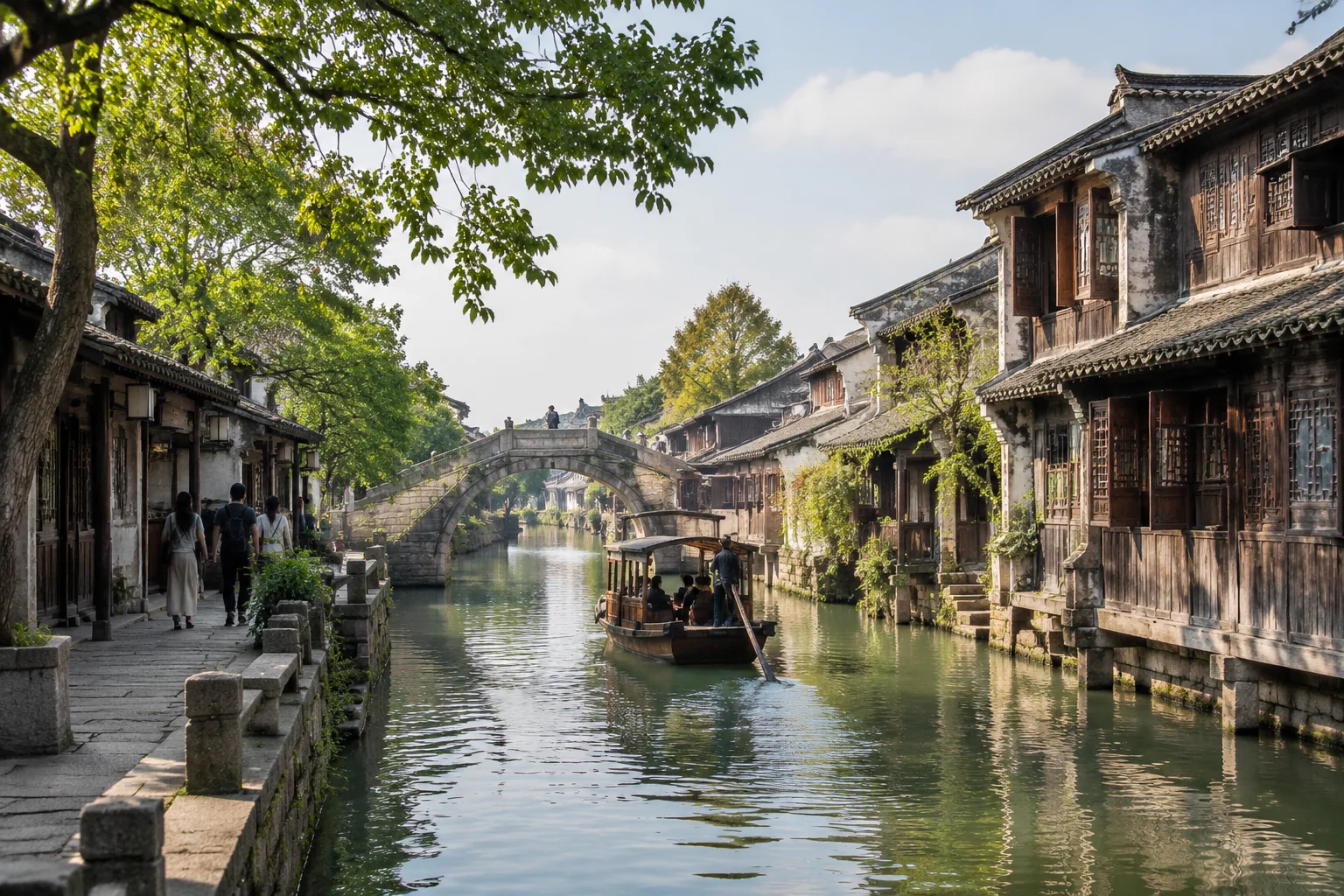
Wuzhen is a canal town in Tongxiang, Jiaxing, in northern Zhejiang. The reference material describes the East Scenic Area as the older, smaller settlement-and-workshop quarter, with traditional houses, museums and craft displays. The West Scenic Area is presented as the larger, more resort-oriented side of town. That distinction is useful for planning: East suits a heritage walk; West is a separate visit, not an add-on to a cramped half day.
The old town’s streets and waterways create a dense pattern of lanes, bridges and canal-side houses. You do not need to follow a rigid compass route. Instead, use the main sights as anchors and let the lanes between them do the work. The sequence in the reference runs from the entrance over Fengyuan Twin Bridge to the bed, folk-customs and wood-carving museums, then Mao Dun’s former residence, the old stage, shadow puppetry and the workshop streets. That is a sensible order for a first half-day because it moves from domestic life to literary identity and then to performance and craft traditions.
Start at Fengyuan Twin Bridge
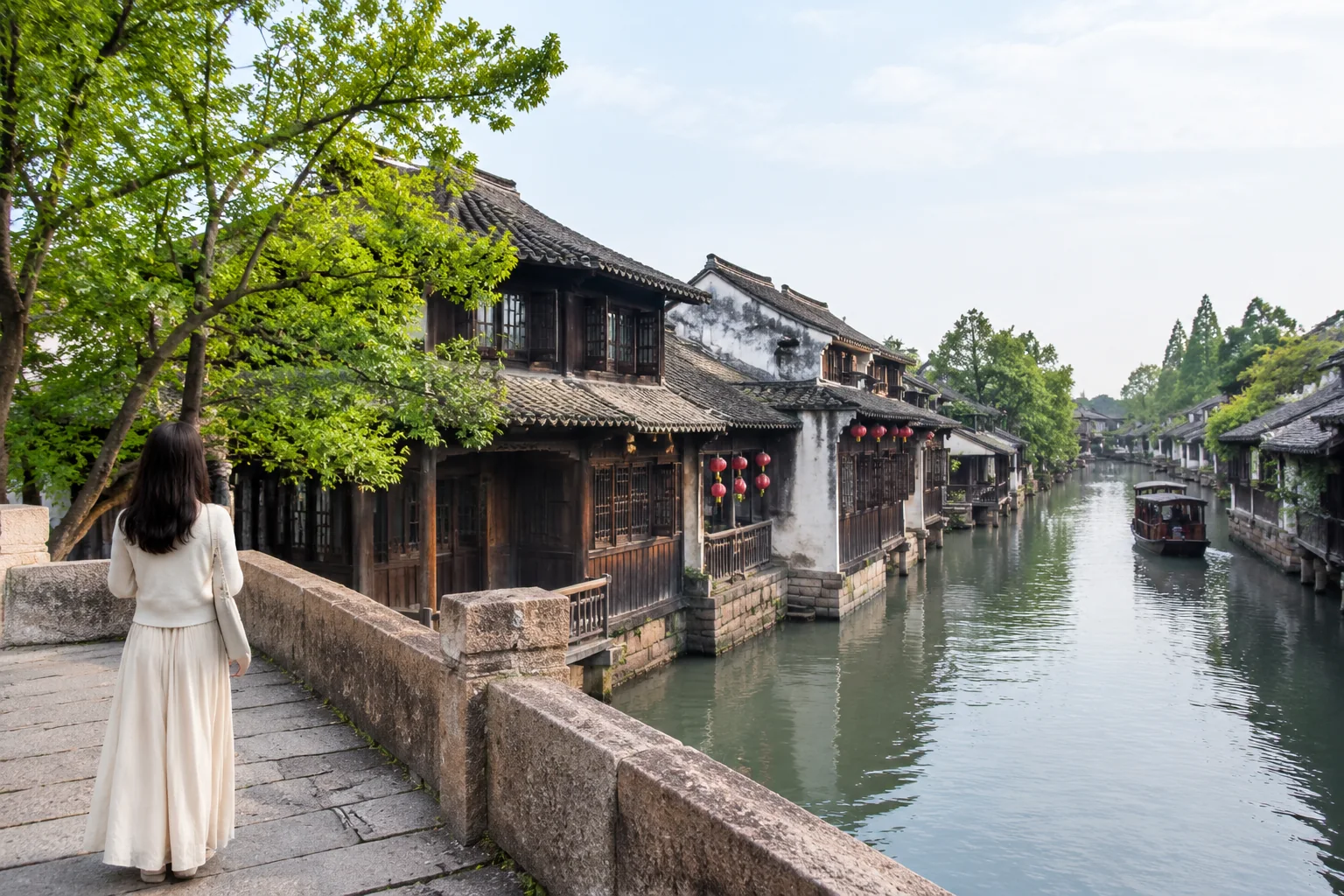
Fengyuan Twin Bridge is the threshold to the East Scenic Area in the cited route. Cross it first, then pause to read the water-town layout: canal, stone parapet, low houses and lanes leading away from the water. The bridge is not the main museum stop, but it is a useful orientation point. It tells you that this is a place to look up at eaves, down at stone paving and sideways into narrow alleys, not just from one attraction door to the next.
From the bridge, keep the museums as your first cluster. The reference route places the Jiangnan Bed Museum immediately after the bridge, followed by the folk-customs and wood-carving museums. This order works because each museum trains your eye for the next: furniture and carving, then social life, then the architectural details you will notice in the historic houses later.
The museum trio: beds, folk customs and wood carving
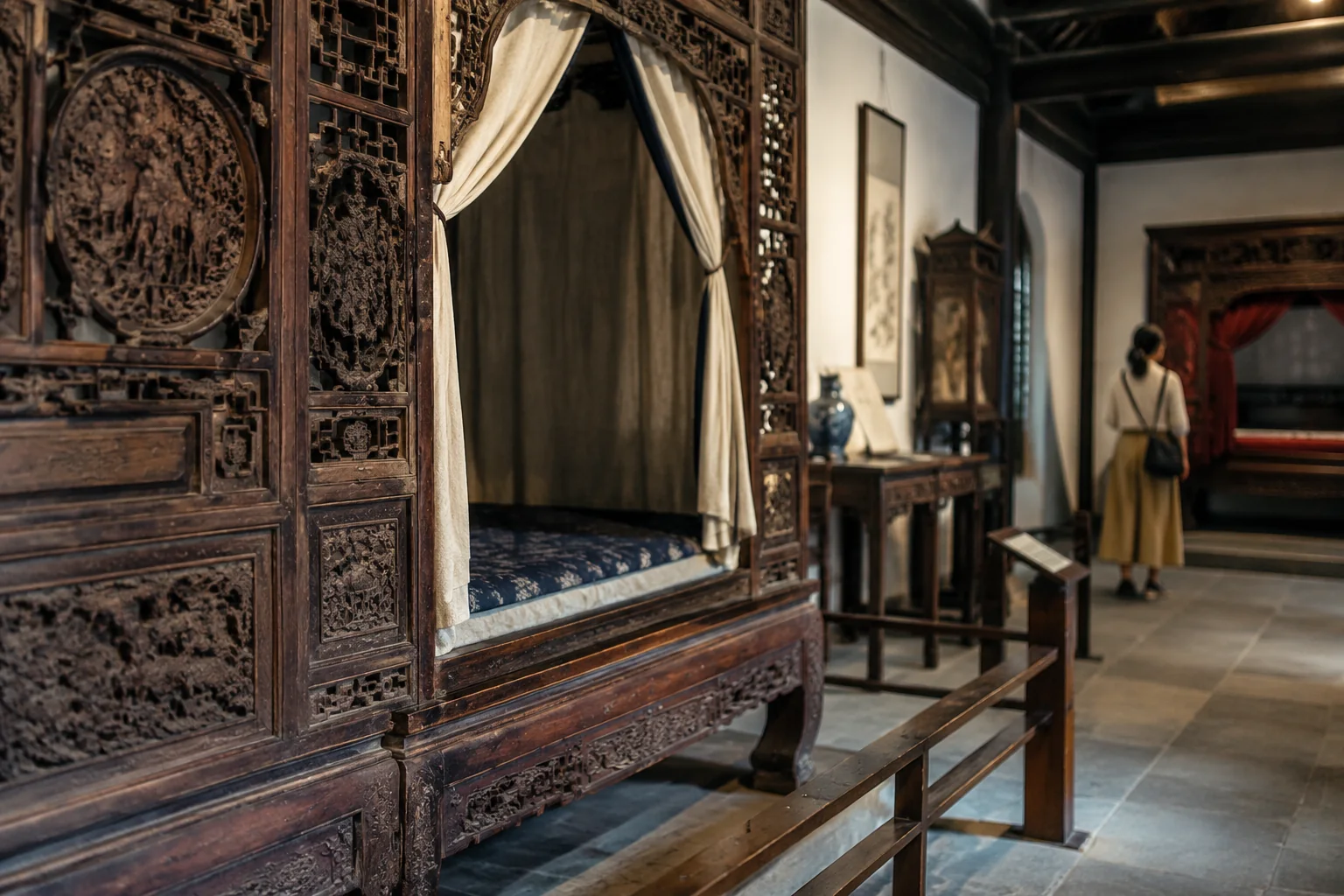
The Jiangnan Bed Museum is the first interpretive stop. The reference highlights a collection of antique beds from the Ming and Qing periods. Rather than treating the beds as a single photo opportunity, look at them as domestic craft: carved frames, joinery, sleeping arrangements and the status they imply. The museum is compact enough to serve as an introduction, but it can also absorb time if you read every label. Decide early whether you are browsing or studying.
The Jiangnan Folk Customs Museum shifts from furniture to social history. The reference says the museum occupies the former residence of the Jin family and displays late Qing to Republican-era customs connected with clothing, weddings, childbirth, seasonal festivals and everyday life. Wax figures and objects are used to reconstruct scenes. This is the most narrative of the three museums, and it is where a half-day visitor gets the clearest picture of how the old town lived. Give it enough time to read the room labels rather than walking straight through.
The Jiangnan Wood Carving Museum is the third anchor. The reference describes displays of carved architectural components such as beams, brackets, hanging ornaments, door lintels and window lattices. This is the museum that makes the rest of the walk more legible. Afterward, you will notice the same kinds of carving on historic houses and the old stage. If time is tight, choose your depth by interest: beds for furniture and craft, folk customs for social life, wood carving for architectural detail. Seeing all three quickly is possible; seeing all three in detail is not a half-day plan.
Mao Dun’s Former Residence and the literary layer
Mao Dun’s Former Residence (茅盾故居) is the walk’s literary stop. The reference places it on Guanqian Street and describes a timber house associated with the writer’s birth, family life and early study. It is not a vast museum. Its value lies in the connection between a specific house and a wider literary imagination of the Jiangnan water town.
Mao Dun is one of the town’s best-known modern cultural figures in the source material, and his work is described as drawing on life in the region. You do not need to have read him to appreciate the residence. Read the panels for the family story, the house layout and the way the town appears in his writing. If you are traveling with someone who enjoys literature, this is the place to slow down. If not, treat it as a short, focused stop and leave more time for the performance and workshop block.
The residence also marks a useful psychological midpoint. You have moved from the museum cluster into the historic street fabric. From here, the route becomes less about exhibits and more about timing: the old stage, shadow puppetry and craft lanes.
The Ancient Opera Stage, shadow puppetry and workshop lanes
The Ancient Opera Stage (古戏台) is attached to Xiu Zhen Guan (修真观) in the reference. Even if no performance is running, it is worth looking at as an architectural object: a two-level stage with carved wooden details, set into the temple and street context. The source associates the stage with flower-drum opera, a local performance tradition. Treat the stage as both a building and a possible event venue; the two experiences depend on the day’s schedule.
The shadow-puppet theater is the other performance anchor. The reference places Wuzhen’s shadow puppetry at Hanlin Di (翰林第) in the East Scenic Area and describes it as a short indoor show with music, movement and local dialect. That makes it a good wet-weather or mid-walk pause, but only if it is running. Do not build the entire half day around one show without checking the current timetable. The same applies to riverside performances such as the high-pole boat display mentioned in the source; the reference notes that waterborne performances may be suspended in special weather.
The workshop lanes are the flexible final block. The reference describes traditional craft streets with dyeing, wine-making, woodwork, shoes, tobacco and other workshops, plus a snack street. The blue-calico dyeing workshop is described as showing steps from pattern design to dyeing and drying; the wine workshop is associated with sanbaijiu, a local rice liquor. You do not need to visit every workshop. Pick one or two demonstrations that interest you, watch the process, and leave time for a snack or tea break. The workshop streets work best as a pause between museums, not as a second forced march.
A flexible half-day plan
The table below is a pacing tool, not a timetable. It assumes you have already reached the East Scenic Area and have a ticket that covers the sights you plan to enter; confirm both locally.
| Block | What to do | Why it works | What to verify |
|---|---|---|---|
| Arrival and orientation | Enter the East Scenic Area, cross Fengyuan Twin Bridge, walk one canal-side lane | Sets the water-town context before museum fatigue | Current entry point, ticket scope and opening status |
| Museum cluster | Jiangnan Bed Museum, Jiangnan Folk Customs Museum and Jiangnan Wood Carving Museum | Concentrated heritage; lets you compare domestic craft, social history and architectural detail | Which museums are open; whether any galleries are closed for maintenance |
| Literary and performance block | Mao Dun’s Former Residence, then the Ancient Opera Stage at Xiu Zhen Guan | Moves from a writer’s house to the town’s public performance culture | Whether the residence and stage are open; current performance times |
| Shadow puppetry and workshops | Hanlin Di shadow-puppet show if scheduled; one or two craft demonstrations; snack street; exit | Ends with living crafts and a break instead of another dense exhibit | Show times, weather cancellations, workshop demonstration times and return transport |
If you have only a short block, do the bridge, two museums that match your interests, Mao Dun’s residence and the old stage. If you have more time, add shadow puppetry and the workshop lanes. If a performance time does not fit, do not force it; the walk still works as a heritage route. The main risk is trying to pair East and West Scenic Areas in the same half day. Treat West as a separate visit with its own transfer buffer.
Pacing, weather, families and access
The reference does not provide verified accessibility details for the East Scenic Area. Historic bridges, stone lanes and old buildings may have steps, thresholds and uneven surfaces. If you use a wheelchair, stroller or walking aid, ask the scenic area directly about step-free routes, accessible entrances and facilities before relying on this itinerary. Do not assume that a compact map means an easy surface.
Wet weather changes the plan. Museums and the shadow-puppet venue are the obvious indoor options, but confirm that they are open and that performances are running. Waterborne performances may be cancelled in poor conditions. Stone paving and bridge steps can be slippery, so footwear matters more than a detailed schedule. A light rain jacket and a flexible order are more useful than trying to keep to a fixed route.
For families, the museum cluster can be text-heavy. Shorten the interiors, use the old stage and workshop lanes as movement breaks, and check current child ticket rules rather than assuming a family ticket. For short stays, East Scenic Area alone can fill a half day at a relaxed pace. If you are based in Hangzhou, remember that Wuzhen is in Tongxiang, Jiaxing; the transfer is part of the trip. The reference mentions bus and rail connections via Tongxiang and direct buses from Hangzhou, but services and timetables must be checked before travel.
Common planning mistakes and pre-trip checklist
A common mistake is treating Wuzhen as a Hangzhou city walk. It is a separate canal town in Tongxiang, Jiaxing, and the journey needs a buffer. Another is assuming that every performance runs continuously. The source lists performance traditions and old schedules, but those are not a live timetable. Check the current show times and whether tickets are separate.
A third mistake is buying or validating a ticket without understanding its scope. The reference describes a combined sight ticket, but ticket products and entry rules can change. Confirm what is included, whether re-entry is allowed and whether performances or special exhibitions require a separate ticket. Finally, do not try to cover East and West Scenic Areas in one half day. East is the heritage walk; West is a separate planning block.
Before you go, check:
- Current opening hours, ticket types and entry rules for the East Scenic Area.
- Current performance times for flower-drum opera, shadow puppetry and any riverside display.
- Weather conditions and whether waterborne performances are running.
- Transport from Hangzhou or Tongxiang, including the last return service.
- Accessibility directly with the scenic area if you need step-free routes.
- A current map or signage at the entrance, since the walking order may change with closures.
FAQ
Is half a day enough for Wuzhen’s East Scenic Area?
Yes, for a focused heritage walk. The reference treats East Scenic Area as a half-day visit and describes it as smaller than West Scenic Area. You can cover the bridge, two or three museums, Mao Dun’s Former Residence and one performance or workshop block. You cannot see every exhibit in depth. Decide whether museums or performances matter more, and leave a buffer.
Should I visit East Scenic Area or West Scenic Area first?
If you have only half a day, choose East Scenic Area for the traditional streets, museums and workshops. West Scenic Area is described as the larger, more resort-oriented side and deserves a separate block. If you are staying overnight, split the two areas across different parts of the day and check current transport between them rather than assuming a quick connection.
Do I need a separate ticket for the performances?
The reference does not establish current performance ticketing. It lists shadow puppetry, flower-drum opera and a high-pole boat display as performance traditions, but ticket inclusions can change. Check the scenic area’s current information or ask at the entrance. Do not assume that entry to the East Scenic Area automatically includes every show.
What should I do if it rains?
Use the museums and the shadow-puppet theater as indoor pauses if they are open. Confirm whether waterborne performances are still running; the source notes that special weather can suspend them. Wear shoes with grip for stone lanes and bridge steps, and keep the order flexible. A wet day is a good reason to shorten the museum list rather than abandon the walk.
Is the route suitable for wheelchairs or strollers?
The source does not confirm step-free access. Historic bridges, thresholds and stone lanes may be difficult. Ask the scenic area about accessible entrances, routes and facilities before relying on this walk. If accessibility is essential, plan around confirmed facilities rather than the standard heritage sequence.
How do I get to Wuzhen from Hangzhou?
Wuzhen is in Tongxiang, Jiaxing, not central Hangzhou. The reference mentions direct buses from Hangzhou and rail connections via Tongxiang with a local bus onward. Those services and timetables change, so check current train and bus information and confirm the last return before setting out.
If you would like help fitting this walk into a wider Zhejiang itinerary, you can use the travel inquiry form at the end of this guide.
Sources and verification
This guide draws on two internal reference PDFs:
- 乌镇攻略 (Wuzhen Guide), pages 2–9, 11, 13, 14 and 17: East Scenic Area route, museum descriptions, Mao Dun’s Former Residence, performance traditions, workshop streets, local food and transport context.
- 浙江攻略 (Zhejiang Guide), pages 4, 16–18: Wuzhen’s location in Tongxiang, Jiaxing, the East Scenic Area overview, the Hangzhou–Wuzhen route context and the Tongxiang rail/bus connection.
These are internal reference documents, not live official pages and not a current fact-check. The route sequence and background are source-backed; current opening hours, ticket prices, ticket validity, performance schedules, transport services and accessibility are not verified here. Confirm them with the scenic area’s official information before travel. No public URL or current fact-check date is asserted in this guide.
Find places & plan your visit
These links open external search results. Confirm the exact place, entrance and current arrangements.
Need help planning your trip?
Tell us about your travel plans and send an inquiry.