In this guide 17 sections ▾
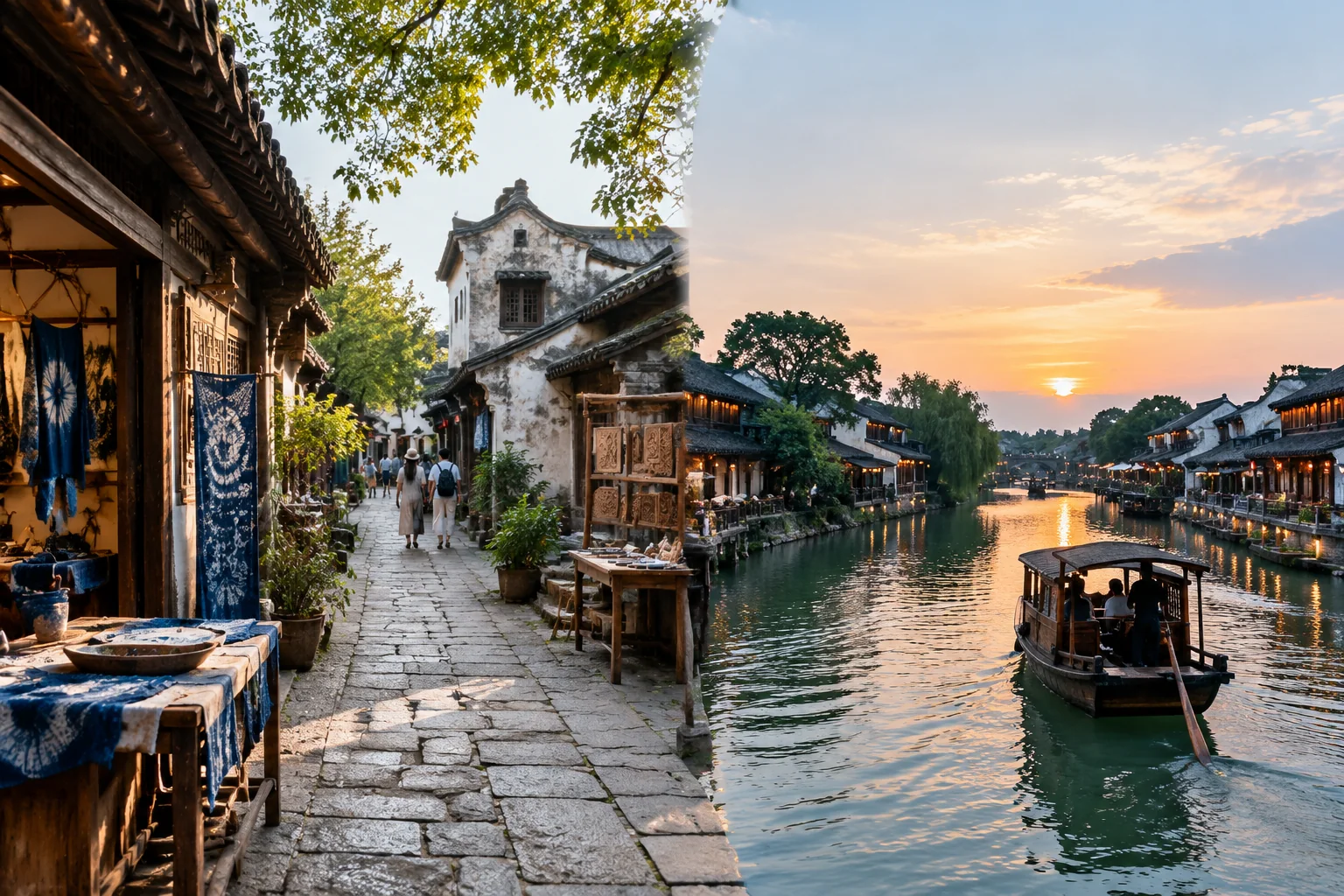
Wuzhen rewards a slower plan than its postcard image suggests. The practical answer for two days is to give the East Scenic Area (东栅景区) the first morning and early afternoon, then move to the West Scenic Area (西栅景区) for late afternoon, evening lights and an overnight. Day two stays on the west side for waterways, lanes and boats.
This guide is for independent travelers who want a coherent route, especially those basing in Hangzhou or Shanghai. The main decision is whether to sleep in Wuzhen or commute. Sleeping near West makes the evening easier; a day trip from Hangzhou can work, but it compresses East and leaves little room for the night atmosphere.
One limitation matters: Wuzhen is in Tongxiang, Jiaxing, in northern Zhejiang, not inside Hangzhou. The reference material is also older. Use the route logic below, but verify current tickets, hours, transport, boats and performances with official channels.
Why East first and West second
East is the older, more residential and workshop-oriented side. Its lanes, museums and craft displays are compact enough for a half-day to full-day visit. West is larger and more geared to leisure stays, with canals, shops, restaurants and an evening atmosphere. That is why the old guidebook logic still makes sense: see the heritage side first, then shift to the water-town side for the night.
There is also a pacing argument. East rewards detail: a bed museum, a folk customs museum, a wood-carving collection, a dye workshop, a former residence, an old opera stage. If you rush, they blur. West rewards lingering: a canal walk, a boat ride, a teahouse, lights on the water.
Do not treat the two areas as one continuous old town. They have separate entrances, ticket arrangements and transport links. The old references describe a shuttle connection, but current operation, frequency and hours need checking. Build in a buffer.
Day 1: East Scenic Area at a walking pace
Start early, before tour groups build. Enter, check the day’s performance board, and begin with the lanes rather than a fixed museum checklist.
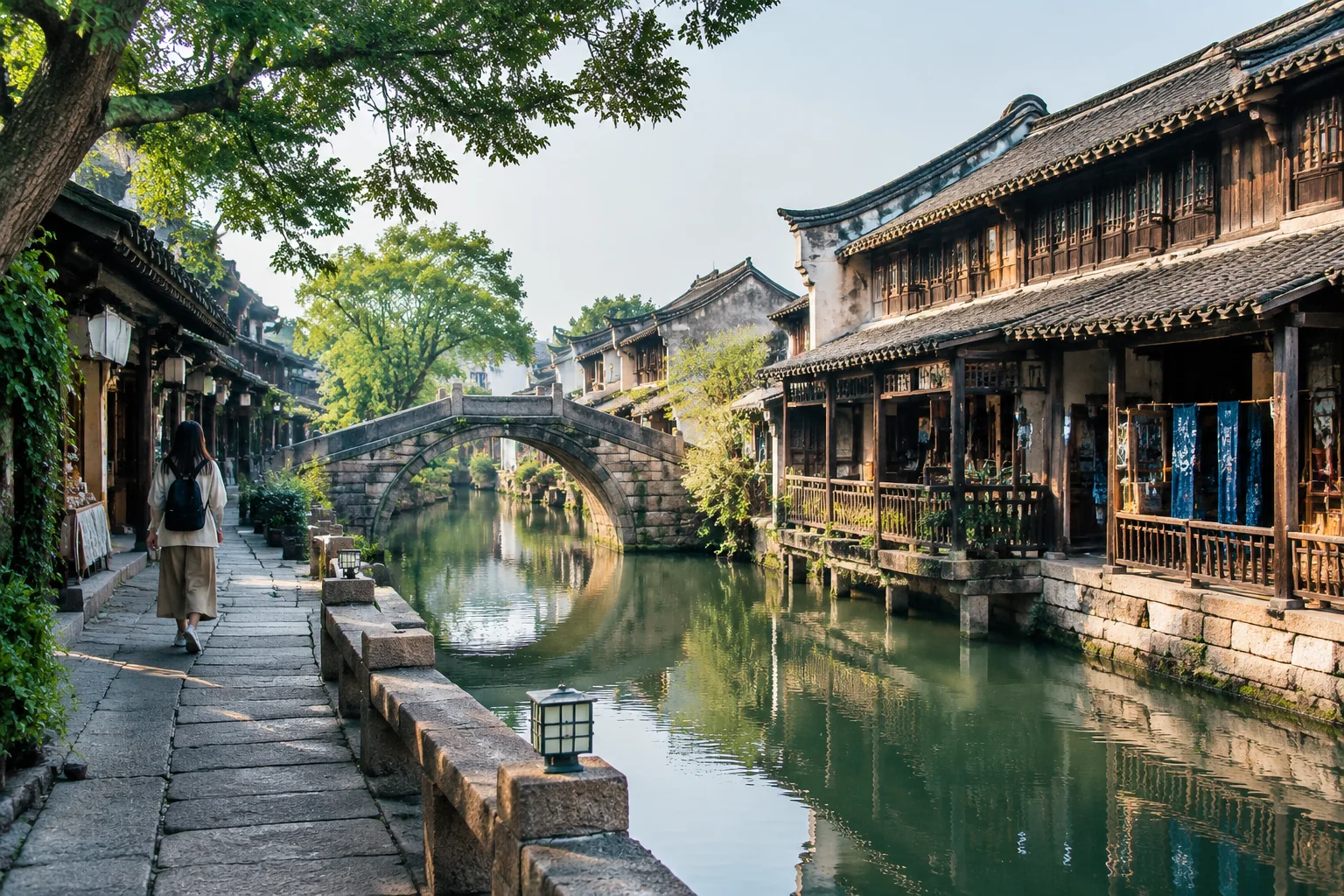
A coherent sequence is: the high-pole performance if it is running, Fengyuan Double Bridge (逢源双桥), the Jiangnan Hundred Beds Museum (江南百床馆), the Jiangnan Folk Customs Museum (江南民俗馆), a blue-print cloth dye workshop, the traditional workshop street, and the Jiangnan Wood Carving Museum (江南木雕陈列馆). The names matter less than the rhythm: bridge, lane, museum, workshop, canal.
The Hundred Beds Museum introduces the domestic craft and status language of the water town. The Folk Customs Museum adds ceremonies, family life and seasonal customs. The workshop street is where East feels most like a working heritage quarter. Keep your pace slow; look at how the buildings meet the water.
For lunch, the traditional snack street is the flexible option. Choose something simple, then pause. The old route suggests lunch at Fengyuan Restaurant or in the snack street; check current hygiene, opening and menus rather than relying on an old recommendation.
In the afternoon, continue to Mao Dun Former Residence (茅盾故居), the ancient opera stage, the shadow puppet theatre, the traditional shop area and Huiyuan Pawnshop (汇源当铺). If you have energy, end with a teahouse stop at Fanglu Pavilion (访卢阁) or a canal walk. East does not need to be exhaustive.
If you are day-tripping from Hangzhou, accept that East may be compressed. The reference material treats Hangzhou as a gateway, with bus and rail-plus-bus options, but timings and services must be checked. A late start plus a transfer can turn East into a two-hour dash.
Where to sleep and how to handle the transfer
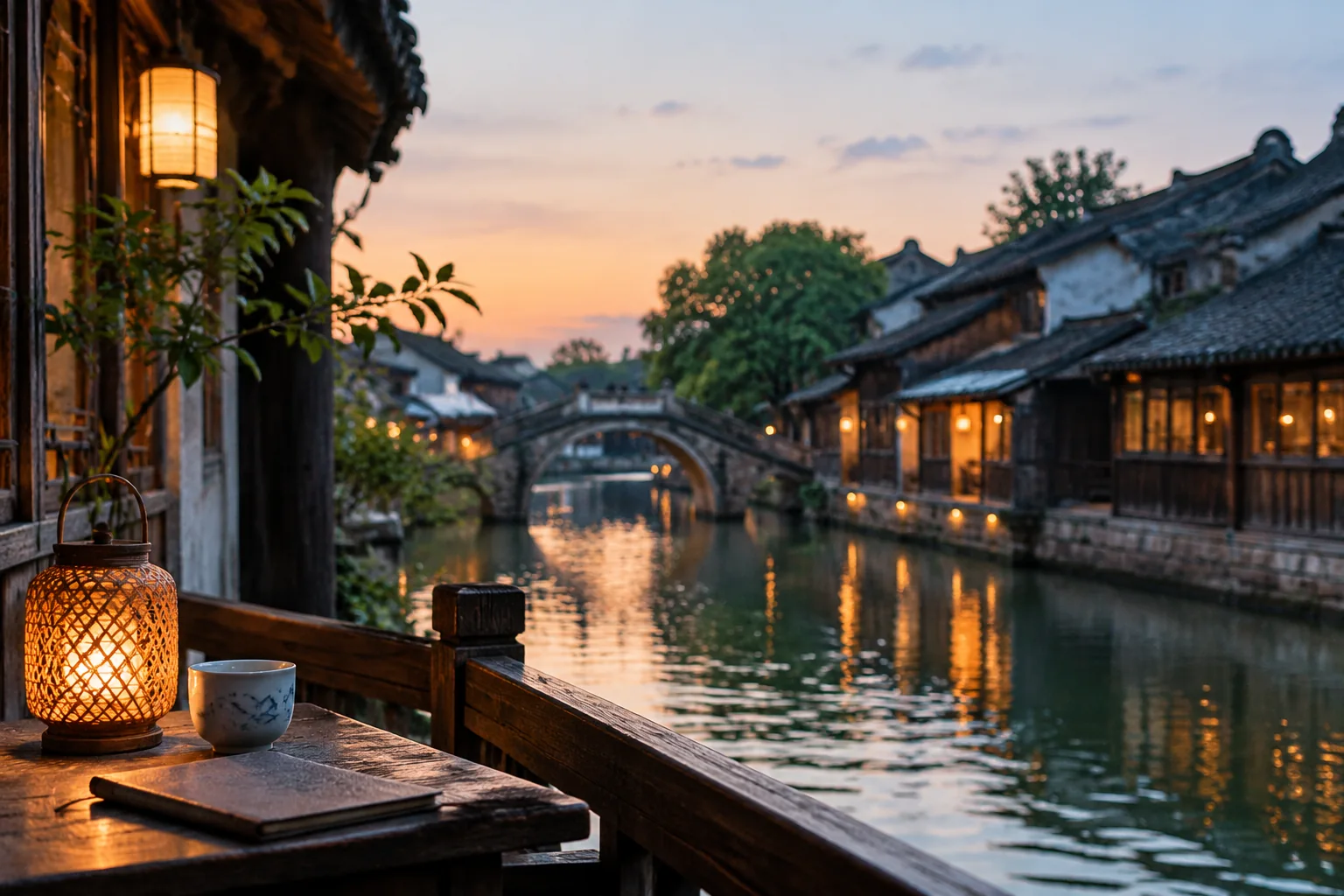
The accommodation decision is really a decision about the evening. Sleeping in or near West means you can stay for the lights without worrying about the last transfer. The old references describe guesthouse-style rooms inside West and hotels near the entrance. They do not establish current availability, prices or standards, so check recent reviews and official property information.
If you sleep on the East side or outside the scenic areas, plan the evening return before dinner. Ask your accommodation or the visitor centre about current transport between the two areas, the last service and taxi or ride-hail costs. Do not rely on an old shuttle timetable.
Keep the transfer simple: finish East by mid-afternoon, move with luggage if needed, check in, and enter West with enough daylight to learn the layout. Arriving after dark is atmospheric but disorienting.
Day 2: West Scenic Area by water and lane
Day two belongs to West. Start with the water. The west side is organized around canals, bridges and island-like quarters, and its appeal is strongest when you move slowly. Begin near the arrival pier, pick up a map or ask for the day’s route, and walk one side of the main canal before crossing.
The Old Post Office (老邮局) is a natural early stop if you want to send a postcard; it also gives a sense of the old town’s commercial life. From there, follow the lanes rather than a rigid checklist. West has small museums, craft shops, courtyards and waterside teahouses. The White Lotus Pagoda (白莲塔) is a useful orientation point and a good place to pause for a wider view. Check whether climbing or interior access is currently available.
Lunch should be unhurried. Choose a place with a clear menu and current reviews rather than chasing a name from an old book. After lunch, take a boat if the water is the reason you came. Boat rides have historically been sold separately, with different day and evening pricing, but routes, fares and boarding points change. Confirm at the dock.
If you skip the boat, walk the quieter lanes away from the main axis. West is not only a night backdrop; its daytime texture is courtyards, bridge shadows and shopfronts. Leave at least an hour unscheduled.
Day 2 evening: lights, boats and performances
The evening is the second half of West’s appeal. As the light drops, the canals and bridges become the main show. Walk the waterside path, stop for a drink, and loop back toward the brighter sections rather than trying to cover every lane.
Performances need a current check. The old references mention pingtan at Wuzhen Grand Theatre (乌镇大戏院), shadow puppetry and outdoor film, but schedules change. Look at the day’s board or ask at the visitor centre. Do not build the whole evening around a specific show unless you have confirmed it.
A boat ride after dark is atmospheric but not essential. If you take one, check the last departure and boarding point before dinner. If you are staying overnight, you can wait for the lights to settle; if you are leaving the same night, keep the evening short and confirm transport first.
East vs West: a practical comparison
| Planning question | East Scenic Area | West Scenic Area |
|---|---|---|
| Character and best use of time | Older residential and workshop quarter; best for heritage, museums and craft displays in a compact half-day to full-day visit. | Larger water-led area with shops, restaurants, lanes and evening atmosphere; best for a slower day and an overnight. |
| Ideal rhythm | Arrive early, walk the lanes, visit the main museums and workshops, lunch, then finish with the former residence and canal walk. | Start with the water and Old Post Office, wander the lanes, visit the pagoda, take a boat or tea break, then stay for the lights. |
| Evening potential | Limited as an evening focus; the heritage streets are more of a daytime experience. | Strong evening focus; canals, bridges, lit facades and performance venues are the main draw. |
| What to verify | Current opening hours, ticket type, which museums are open, and performance times. | Current evening access, last entry, boat operation, performance schedule and return transport. |
The table is a planning tool, not a claim that one side is better. East gives historical and social context; West gives the water-town stay. The two-day route uses each side for what it does well.
Tickets, transport and the details that need a current check
The old references describe separate East and West tickets and a combined option. They also mention shuttle transport between the areas and boat services inside West. Treat that as historical background. Ticket structures, prices, validity and entry rules can change, and a ticket that covered both areas on one day may not work for a two-day visit.
Check before you go:
- Current ticket options and whether a combined ticket covers your dates.
- Opening hours, last entry and whether evening access to West is included.
- Transport from your base to Wuzhen and between the two scenic areas.
- Boat routes, fares, boarding points and last departures.
- Performance schedules and whether booking is required.
- Accommodation check-in, luggage storage and any transfer service.
For transport, the reference material points to Tongxiang as the rail gateway and to bus connections onward to Wuzhen. It also describes direct bus options from Hangzhou and Shanghai. These are route shapes, not verified timetables. Use official transport channels and leave a buffer for the last mile.
Families, limited mobility, rain and short stays
For families, the main lever is pace. East is compact enough to cut short without feeling that you have missed the whole town. West gives children more space and the boat as a change of scene, but check age rules, boarding arrangements and queuing before promising a ride.
For limited mobility, the source material does not provide reliable step-free routes or accessibility guarantees. Stone-paved lanes, arched bridges and boat boarding may be difficult. Ask the scenic area directly about accessible entrances, routes, toilets and boat access rather than assuming a water town is easy to navigate.
Rain changes the balance. East has a denser sequence of indoor museums and workshops, so it can absorb a wet morning better. West is more exposed and its evening appeal depends on being outside. Carry rain gear and be willing to shorten the evening.
With only one day, choose one side. East for heritage and crafts; West for waterways and evening atmosphere. Trying to do both usually means a rushed East and a dark, disoriented West.
Common planning mistakes and a pre-trip checklist
The most common mistake is treating East as a photo stop. Its value is in the museums, workshops and residential lanes, and those need time. The second is going to West only after dark; you miss the daytime texture that makes the evening feel earned.
Other mistakes include assuming one ticket covers two days, relying on an old shuttle timetable, booking a tight train after the evening lights, and planning around a performance without checking that it is running. Wuzhen is not a place to over-schedule.
Before you go, confirm:
- Official opening hours, last entry and ticket types.
- Current transport to Wuzhen and between East and West.
- Accommodation location, check-in time and luggage arrangements.
- Boat and performance schedules.
- Weather, footwear and rain gear.
- Accessibility needs, if any.
- The ID and payment method required by your bookings.
If you want help fitting Wuzhen into a wider Hangzhou or Shanghai itinerary, the inquiry form at the end of this page is the right place to ask. It is a request for planning help, not a booking or a confirmed quote.
FAQ
Should I visit East or West first?
East first. It is the more compact heritage side, and seeing it before the transfer gives you context for the water-town stay. West then works as the late-afternoon and evening base. If you are staying only one night, this order also saves you from carrying luggage around East.
Can I see both scenic areas in one day?
You can, but it is a rushed plan. East needs at least a half-day for its museums and lanes, and West needs daylight plus evening to make sense. A one-day visit is better used on one side: East for heritage, or West for water and night atmosphere.
Is Wuzhen a good overnight stay from Hangzhou?
It can be, because Wuzhen is in Tongxiang, Jiaxing, not inside Hangzhou. The overnight makes the West evening much easier and gives you a slower start on day two. Check current rail and bus connections, and do not assume a late return after the lights.
Do I need to book boat rides and performances in advance?
That depends on the current operator and season. The old references describe boat services and performances, but they do not verify today’s booking rules. Check official channels or ask at the visitor centre on arrival. If a boat or show is essential, confirm it before committing to a tight schedule.
Sources and verification
This article draws on two internal reference PDFs supplied for planning: 乌镇攻略 (Wuzhen Guide), pages 2–5, 7–9 and 13–14, and 浙江攻略 (Zhejiang Guide), pages 16–18. They are internal reference documents, not public links, and they are not a substitute for current official information.
The sources support the broad geography, the East-first and West-second route logic, the main sight clusters, the water-town layout and the existence of evening boat and performance culture. They do not verify current ticket prices, opening hours, shuttle times, boat fares, performance schedules, booking rules or accessibility. Those details need confirmation with the scenic area’s official channels before travel. No fact-check date is claimed here.
Find places & plan your visit
These links open external search results. Confirm the exact place, entrance and current arrangements.
Need help planning your trip?
Tell us about your travel plans and send an inquiry.