In this guide 17 sections ▾
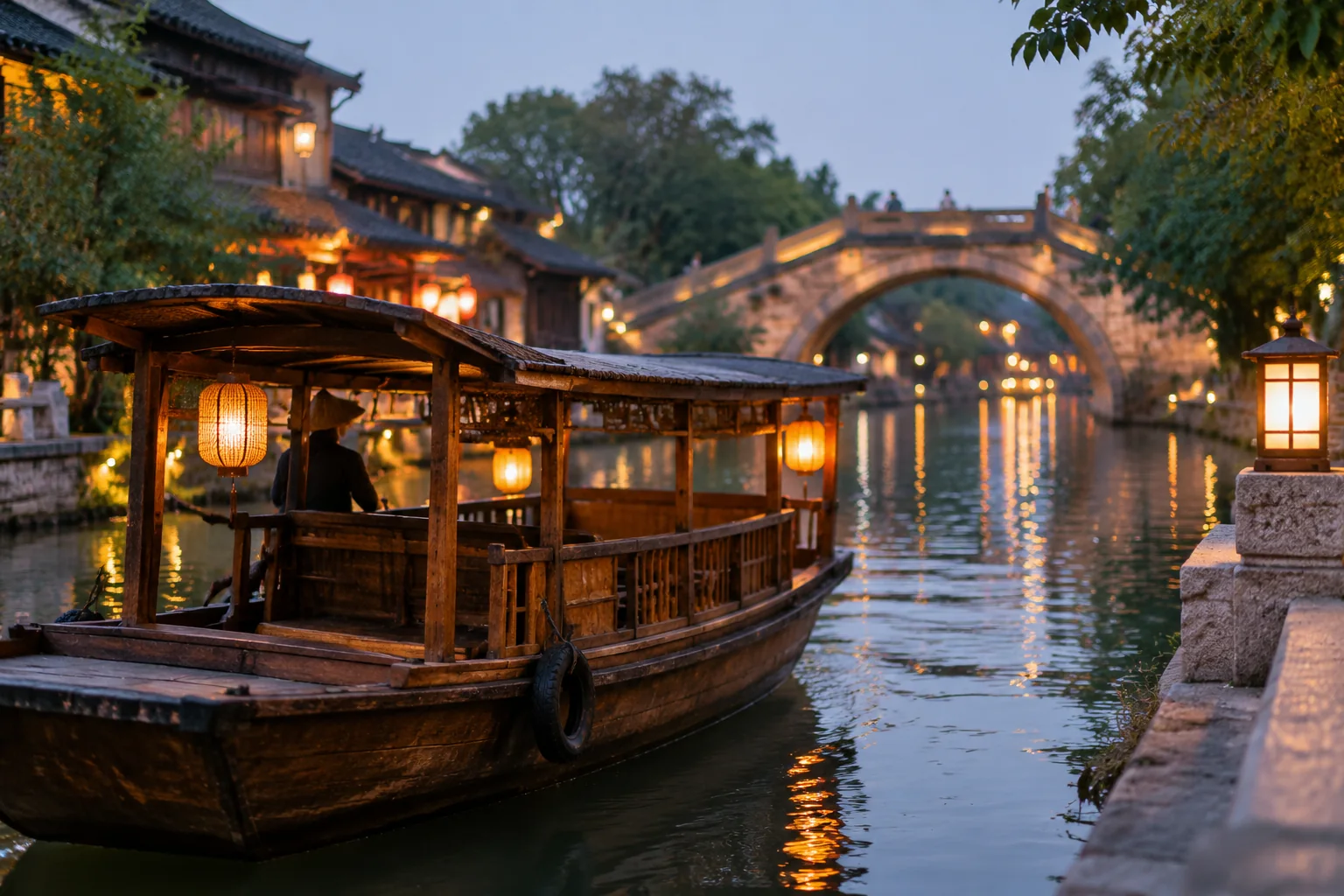
West Scenic Area (西栅, Xizha) is the part of Wuzhen that rewards a slower evening. The most satisfying plan is simple: arrive before dusk, orient yourself along the main canal, take one waterside walk, choose a boat ride or a bridge viewpoint rather than trying to do both at speed, and keep time for a performance if one happens to be running. This guide is for independent travelers who want atmosphere rather than a tick-box night tour. It does not give current ticket prices, showtimes or last-boat times, because those are operational details that need checking with Wuzhen’s official visitor services.
Why West Scenic Area suits an evening visit
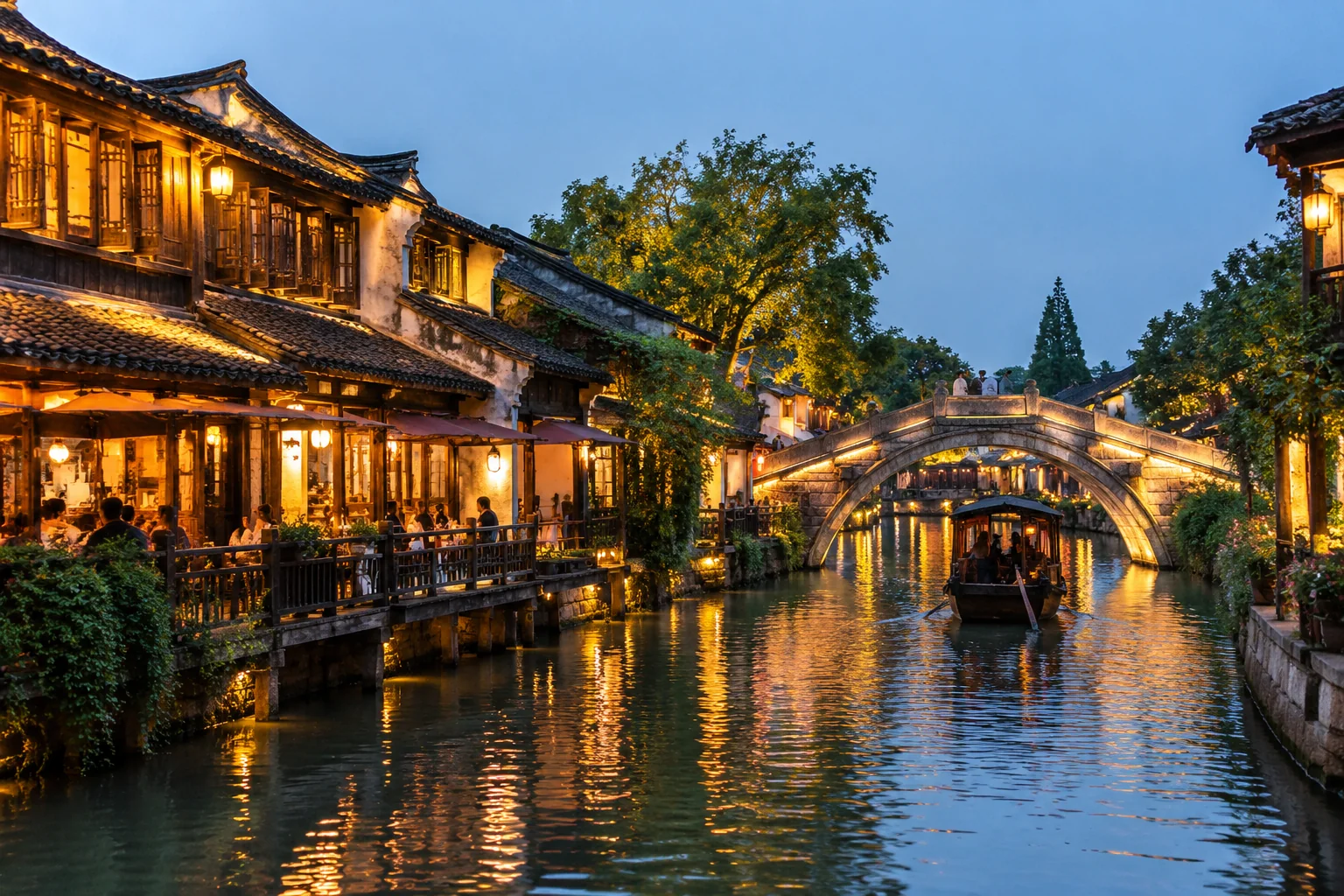
Wuzhen lies in Tongxiang, Jiaxing, not inside Hangzhou. That matters when you plan: the town is a separate water-town destination, and the final leg of the journey needs its own time buffer. Within Wuzhen, the East Scenic Area (东栅, Dongzha) is often associated with preserved residences, workshops and daytime wandering, while the West Scenic Area is the side older references describe as staying lively into the evening, with canals, bridges, shops, bars and restaurants. That does not mean every venue stays open late, but it explains why Xizha is the natural choice when your priority is the night scene.
The appeal is not a single monument. It is the way low light changes the canal: white walls become paler planes, wooden windows glow, and bridges turn into places to pause rather than pass through. A good evening here is measured in short stretches of walking, a few deliberate stops and enough unscheduled time to notice the reflections.
A loose evening sequence that leaves room to slow down
-
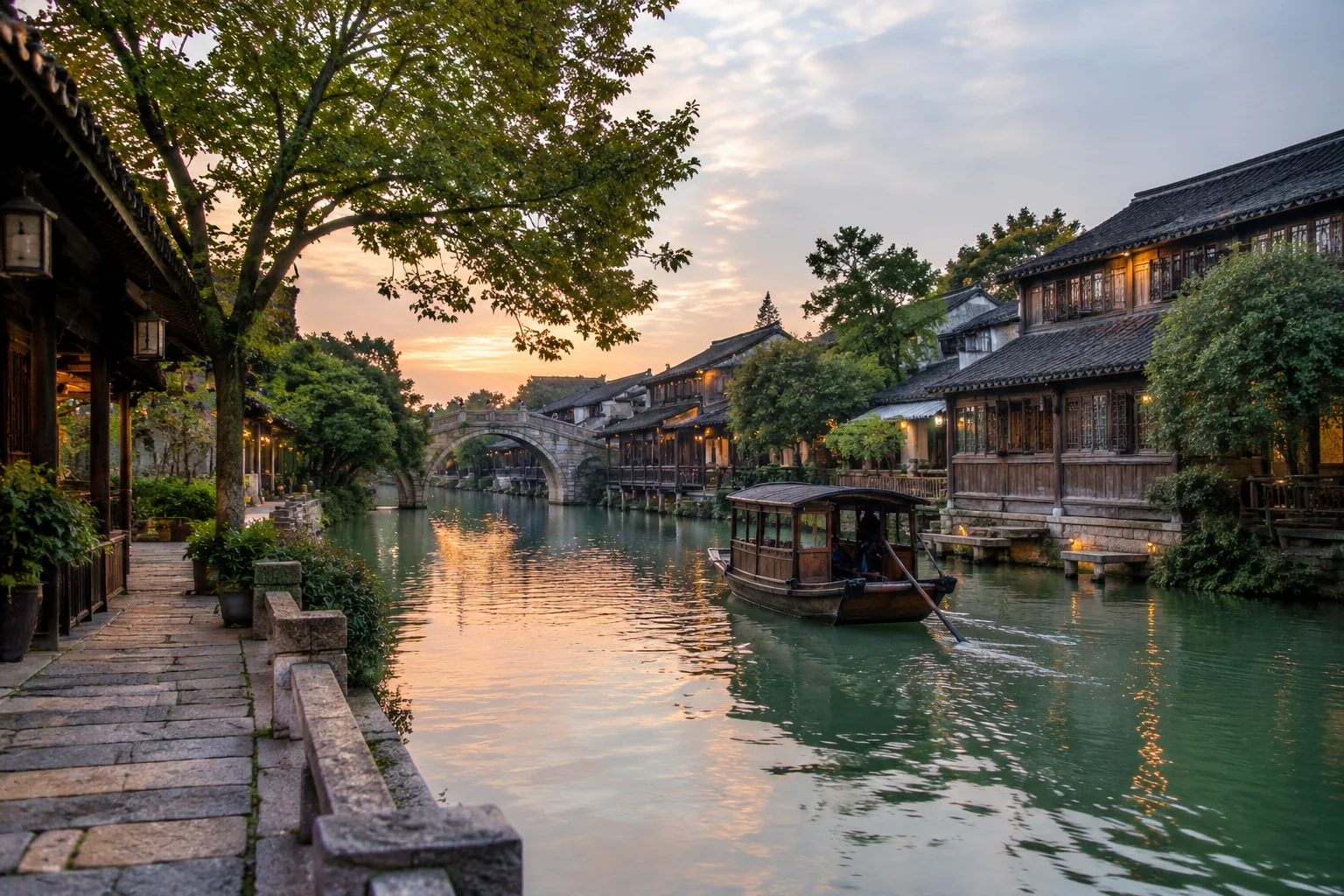
Arrive before dusk. Use daylight to find the main canal, the visitor routes and the direction of your exit. Trying to orient yourself after dark makes the evening feel more rushed than it needs to be.
-
Walk one waterside stretch first. Follow the canal at eye level while the sky is still changing. This is the best time to understand the scale of the scenic area and to choose a bridge or boat pier that suits you.
-
Pick one water-level experience. A boat ride gives a low, seated view of the banks; a bridge gives a raised, fixed view without committing to a departure time. Doing both is possible, but only if the operating times and your energy allow it.
-
Leave a gap for a performance. Older guidebook descriptions mention a water stage and an old-fashioned outdoor cinema. These are reasons to ask what is scheduled on your date, not reasons to assume a show will be running.
-
Eat or take tea without treating it as a separate excursion. A stop for local food or tea can be part of the evening rather than an interruption. Check menus and opening hours on arrival, since old references cannot confirm today’s service.
-
Finish with a quiet loop back. The last walk is often the best one: fewer errands, softer light and a clearer sense of the canals. Then leave yourself a verified route back to your accommodation or transport.
Boat, bridge or waterside walk?
| Evening option | Best for | What it gives you | What to check |
|---|---|---|---|
| Night boat ride | Travelers who want a seated, low-angle view and a stronger sense of the canals | Older descriptions emphasize lantern-lit buildings, the sound of water and views toward riverside stages | Whether boats operate that evening, the boarding point, fare, capacity, last trip and life-jacket rules |
| Bridge viewpoint | Photographers, short stays and anyone who prefers to stay on foot | A raised view along the canal and a natural pause between lanes | Which bridges are open and safe after dark, whether tripods obstruct others, and how to loop back to the exit |
| Waterside walk | Families, mixed-age groups and travelers who want flexibility | The core atmosphere at eye level, with chances to stop for tea, snacks or a quieter lane | Route surfaces, steps, lighting, toilet locations and the distance back to your starting point |
The useful decision is not “boat or nothing.” It is “which experience gives me the evening I actually want?” If you have limited time, choose one primary experience and let the rest of the evening stay loose. If you are traveling with people who tire easily, the walk plus a bridge viewpoint may be more enjoyable than queuing for a boat.
What creates the atmosphere after dark
Older guide descriptions of Xizha single out the combination of canal water, old buildings and warm light. The famous image is not a floodlit monument but a sequence of small scenes: a lamp above a doorway, a reflection broken by a passing boat, a stone bridge seen from the opposite bank. Bailian Pagoda (白莲塔) is one of the landmarks used to orient the West Scenic Area, but do not treat night illumination as guaranteed; check locally if that is important to you.
The water stage (水上戏台) is described in older references as a place for local opera or storytelling, with the added atmosphere of a performance space set beside the canal. The same references mention an outdoor cinema with an old-fashioned projector and black-and-white films. Both details are valuable as background, but they are exactly the kind of time-sensitive programming that must be confirmed for your visit. A performance is a bonus, not the foundation of the evening.
Lotus lanterns and sanbai wine also appear in older descriptions of a night boat outing. Treat these as cultural colour rather than a current promise. If any sanctioned lantern activity is offered, follow local instructions and avoid releasing loose materials into the water. If you drink, keep it modest and arrange a sober return; a water town’s narrow lanes and late transport are not the place to improvise.
Timing, tickets and the return journey
Before booking, confirm the practical chain: current opening hours, last admission, whether evening entry uses the same ticket as daytime, and whether re-entry is allowed if you leave and come back. If you stay inside or near the scenic area, ask your accommodation what access arrangements apply. Old guidebooks describe deposit-based temporary passes and ticket rules for overnight guests, but those details must not be treated as current policy.
Wuzhen is not a Hangzhou neighbourhood, so the return is part of the plan. Rail to Tongxiang followed by a local bus or taxi has historically been one way to approach the town, but schedules and service patterns change. Check the last onward train or bus before you commit to a late evening, and keep a taxi option in mind if your budget allows. A rushed after-dinner return from Hangzhou is the wrong shape for this visit; staying overnight in or near Wuzhen is the cleaner way to enjoy the canals without watching the clock.
Also confirm whether your chosen boat pier is operating that evening. Do not rely on a boat to be available simply because the scenic area is open. Boarding points, fares, trip length and last departures are operational details, not fixed facts.
Adjusting the plan for different travelers
Families. A boat ride and the old outdoor cinema are the most obvious child-friendly ingredients, but ask about life jackets, boarding rules and whether the film content suits your group. Keep the walk short and build in a snack stop. A performance that runs late may not suit younger children, so treat it as optional.
Limited mobility. Historic canal towns are not uniformly step-free. Bridges and lanes can include steps, uneven surfaces or narrow passages. Ask visitor services for a route that matches your needs, and do not assume that every boat or stage has level boarding. A shorter verified route is better than an ambitious loop.
Wet weather. Rain can strengthen reflections on the canal, but it also makes stone surfaces slippery and may suspend outdoor performances. Carry a rain layer, protect cameras and phones, and keep an indoor fallback. If the outdoor cinema or water-stage programme is central to your plan, check before setting out.
Short stays. If you have only one evening, choose the West Scenic Area and give it a single coherent loop. Do not try to combine both scenic areas after dark or chase every recommended viewpoint. One canal walk, one boat or bridge stop and one flexible pause will usually feel more complete than a hurried circuit.
Common planning mistakes and a pre-trip checklist
The most common mistake is treating Xizha as a theme park with continuous entertainment. The evening is strongest when you allow for empty stretches, slower walking and a change of plan. Another mistake is arriving after dark without any orientation, then spending the first hour looking for the canal instead of enjoying it. A third is booking a tight return before checking the last transport. Finally, do not quote old guidebook prices, showtimes or ticket rules as if they were current.
A practical checklist:
- Confirm current opening hours, last admission and ticket validity.
- Check whether re-entry is allowed if you leave the scenic area.
- Verify boat operation, boarding point, fare and last trip.
- Ask for the day’s performance and cinema programme.
- Check the weather and carry a rain layer.
- Confirm your last bus, train or taxi option.
- Check access arrangements if you are staying overnight.
- Ask about step-free routes or boarding help if you need them.
Frequently asked questions about Wuzhen after dark
Is Wuzhen West Scenic Area worth visiting at night if I have only one evening?
If your main interest is atmosphere, yes—but build the evening around a waterside walk and one extra element, not a long checklist. If you mainly want museums and craft workshops, use the daytime. Check that your ticket and transport allow the hours you plan.
Can I enjoy the evening without taking a boat ride?
Yes. Bridges and waterside lanes give the essential view; a boat adds a different perspective. For some travelers the boat is the highlight, while for others it is an unnecessary fixed time commitment. Decide using confirmed operating information, not a “must-do” label.
Are the water stage and outdoor cinema always running?
No. Older guidebook descriptions mention them, but performances can be seasonal or event-based. Ask for the day’s programme. If nothing is scheduled, the evening still works as a canal walk; do not travel solely for an unconfirmed show.
How late should I stay?
Stay long enough to see the canals after full darkness and complete one relaxed loop. The real limit should be your verified last boat, bus, train or taxi. Do not assume late transport will match the end of the evening.
Can I visit Wuzhen from Hangzhou after a full day of sightseeing?
It is possible in principle, but Wuzhen is in Tongxiang, not Hangzhou, and the final leg needs checking. A day trip that ends late is fragile. Staying overnight in or near Wuzhen is the cleaner way to enjoy the evening without rushing.
What happens if it rains?
Light rain can add atmosphere, but outdoor performances may be cancelled and stone lanes may be slippery. Carry rain protection, choose shoes with grip, and keep a flexible indoor stop. Check with visitor services before relying on an outdoor show.
If you want help deciding whether to stay overnight or how to fit Wuzhen around a wider Hangzhou itinerary, you can send a travel inquiry using the form at the end of this guide.
Sources and verification
Background for this guide comes from two internal reference PDFs: 《乌镇攻略》 (Wuzhen Guide), pages 3–5 and 7–9, 13–14; and 《浙江攻略》 (Zhejiang Guide), pages 16–18. These are older guidebook-style documents held as internal research references, not current official visitor information and not a substitute for an official fact check. They support the general description of West Scenic Area’s canals, bridges, night boat rides, water-stage performances, outdoor cinema, Bailian Pagoda, local food culture and Wuzhen’s location in Tongxiang. They also contain dated transport, ticket, lodging and performance details; those have not been treated as current facts. Before you travel, confirm opening hours, admission and re-entry rules, boat operation and last boarding, performance schedules, weather contingency and onward transport with Wuzhen’s official visitor services.
Find places & plan your visit
These links open external search results. Confirm the exact place, entrance and current arrangements.
Need help planning your trip?
Tell us about your travel plans and send an inquiry.