In this guide 20 sections ▾
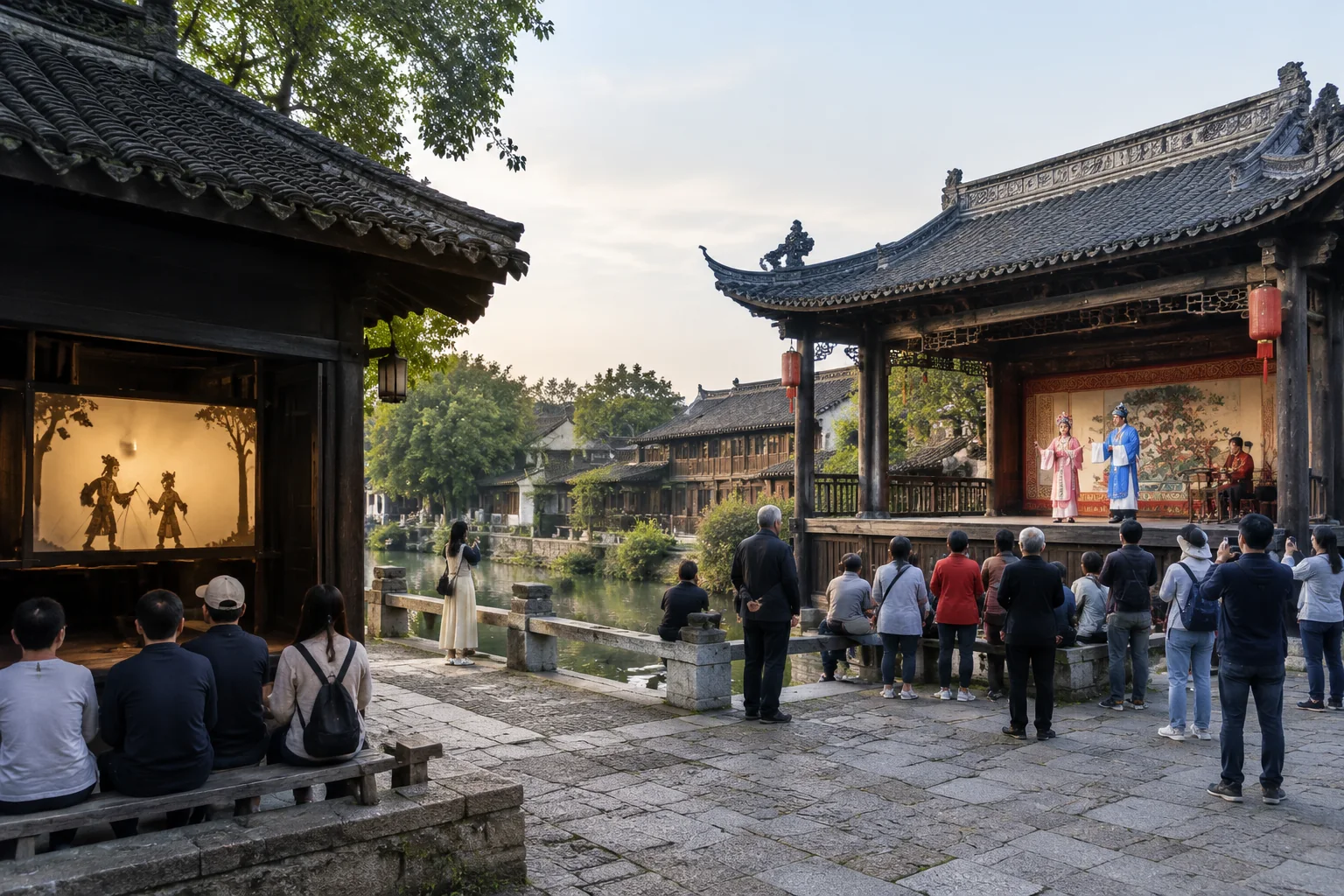
Three folk performances, one compact circuit
Wuzhen’s folk performances are not one ticketed show you book a seat for. They are three separate, short traditions scattered through the East Scenic Area (东栅, Dongzha) of this water town in Tongxiang, Zhejiang — and the real planning skill is fitting them around a slow walk through the lanes rather than sprinting between them.
In short:
- Shadow puppetry (皮影戏) plays in a small, darkened theatre at Hanlin Di (翰林第) in the East Scenic Area. Indoor, seated, short-format.
- Flower-drum opera (花鼓戏) is performed on the old stage (古戏台), a building attached to Xiuzhen Temple (修真观). Open-sided, watched from the square, stand-and-stay.
- The high-pole boat (高竿船) is a waterside display at Caishen Bay (财神湾), staged a limited number of times a day and explicitly suspended in bad weather.
This guide is for travellers who want to understand what they are watching rather than photograph it and move on, and who would rather build one coherent half-day than chase three start times. The main decision is simple: let the boat set your anchor time, and let the puppets and the opera fill in around it.
The limitation to hold onto throughout: the reference material behind this article is old travel-guide text, not a live schedule. Performance times, ticket inclusions, closures and the shuttle between the scenic areas all need same-day confirmation from Wuzhen’s official channels or the on-site visitor centre. Nothing here should be read as a verified current timetable.
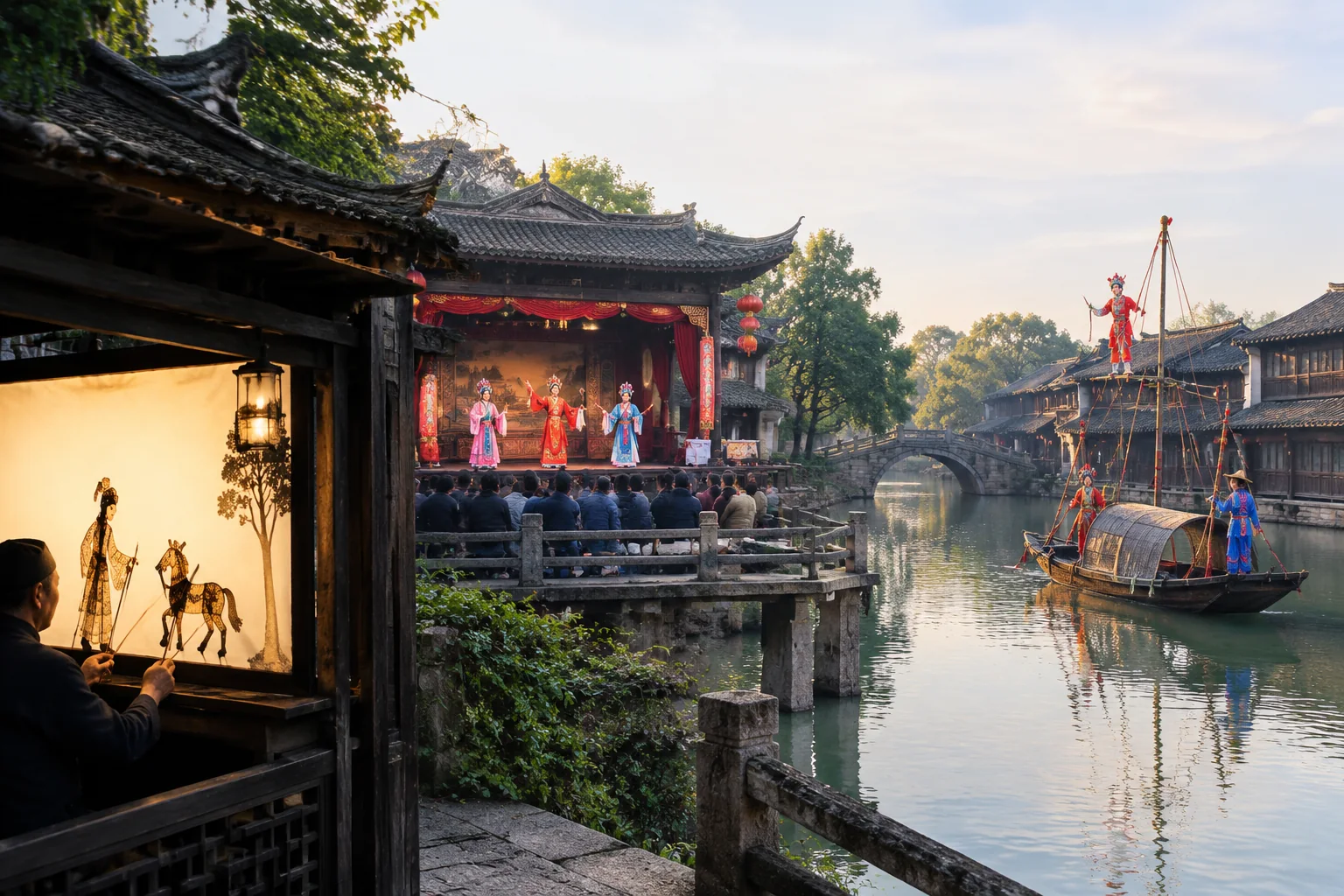
Why these three belong together
What makes the circuit worth doing deliberately is that the three performances occupy three completely different kinds of space. Shadow puppetry needs a dark room and a lit screen. Flower-drum opera needs a stage facing a public square, because the point is the crowd in front of it as much as the performers. The high-pole boat needs open water and rigging, which is exactly why it is the fragile one.
That difference in setting is also a difference in how they behave as planning items. The indoor show loops quietly all day. The opera is tied to a stage in the middle of the old town. The boat happens on water, outdoors, and can be cancelled. Understanding that saves you a lot of pointless hurrying.
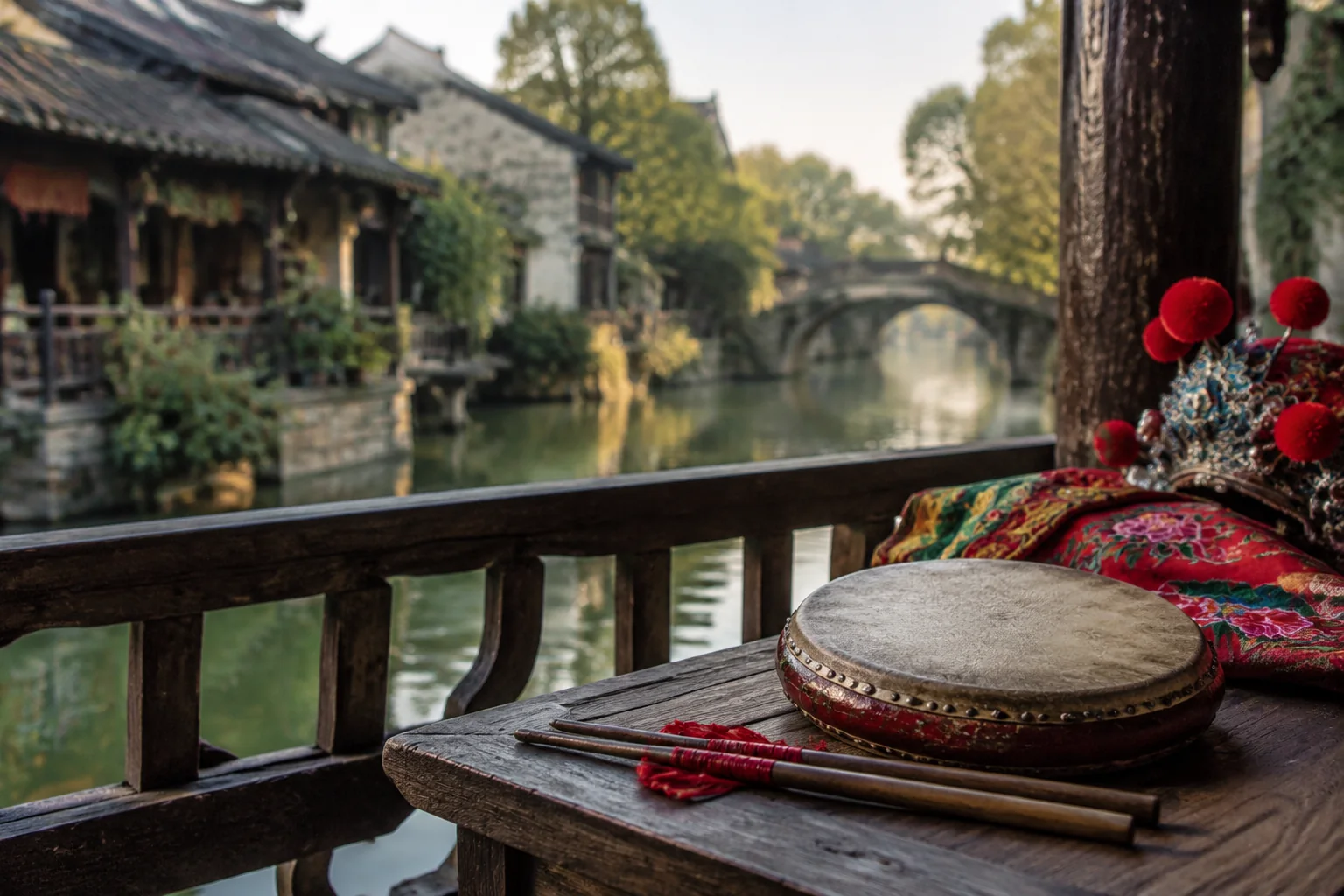
The opera tradition, in context
Flower-drum opera is better understood as a family of regional operas than a single fixed genre. The reference material describes it growing out of rural work songs, folk tunes, lantern songs and small two-person comic routines, with distinct regional forms crystallising during the nineteenth century — Changsha, Changde, Yueyang, Shaoyang, Hengzhou, Lingling and the southern Anhui (皖南) variant among them. What holds the family together is the working method: local dialect on stage, folk tunes as the score, everyday plots, and a style built to reflect ordinary life rather than courtly legend.
That context changes how you watch. You are not looking at a museum specimen frozen in a canonical form; you are looking at a flexible, dialect-based, locally rooted theatre that has always absorbed whatever was around it. The reference does not establish which regional variant or which troupe performs in Wuzhen today, so treat any label on the board as a starting point rather than a definitive attribution.
The building is half the experience. The old stage is an annex of Xiuzhen Temple, with a hip-and-gable (歇山式) roof, upswept eaves, carved bracket work between the columns, and a two-level stage sitting on a brick-and-stone base with entry doors at front and side. Stand back far enough to take in the roofline and the carved timber, not just the performers.
Practically: the stage is open-sided and faces a public square, so this is a stand-and-watch stop, not a seated concert. The libretto will be in local dialect and you almost certainly will not follow the plot. Follow the percussion instead — the cues, the comic timing, the way a single gesture carries a whole scene.
Shadow puppetry at Hanlin Di: a room, a light, a small orchestra
The reference account of the Wuzhen shadow show is worth carrying with you: the audience sits in a dim viewing room; the light comes up; the figures enter to drums and gongs while the story unfolds over sparse string music and singing in the local dialect. It is close-up, handmade theatre, and the scale is the point.
Watch for the craft rather than the plot. Look at where the figures enter and leave the screen, at the rods and joints that make a wrist or a sleeve move, at the musician sitting at the edge of the light, and at how much of the storytelling is carried by rhythm rather than dialogue. The reference describes puppeteers and a musician who were elderly at the time of writing — treat that as a reminder that this is a small, transmitted craft rather than a fixed company, and that who you actually see depends on the day.
The room is small and the show is short, so it rewards a second look rather than a single pass. If you arrive mid-show, stay for the next round instead of leaving — the format repeats, which is the whole advantage of an indoor loop.
The high-pole boat at Caishen Bay: the one that can be cancelled
Here the honest position is important. The reference records the venue (Caishen Bay), the frequency (twice a day, at set times) and one hard caveat: the display is suspended in special weather. It does not describe the routine in detail, so be sceptical of confident online descriptions and treat whatever you have read elsewhere as unverified.
What that means for planning:
- Ask first. On arrival, ask at the entrance or visitor centre whether the day’s boat displays are running. This is the single most useful question of your visit.
- Do not save it for last. Because it has fixed slots and a cancellation risk, it should be your anchor, not your finale.
- Have a fallback. If it is cancelled, the puppetry and the opera are both indoors or under cover and unaffected — which is exactly why the circuit works as a rain plan.
"Special weather" is not defined in the source. It could mean rain, wind, or water conditions. Do not assume a light drizzle is fine and do not assume a clear sky guarantees a performance; ask.
Sequencing a circuit through the East Scenic Area
The reference material contains two slightly different walking orders, and both are useful. One enters from the parking side, takes in the high-pole display first, crosses the Fengyuan double bridge (逢源双桥), then works through the Jiangnan Bed Museum, the Folk Customs Museum, the indigo dye workshop and the craft workshops, finishing the morning at the wood-carving museum. The afternoon then runs: former residence of Mao Dun (茅盾故居) → old stage → shadow puppetry → traditional shop street → Huiyuan Pawnshop.
The other version is a tighter half-day list: Bed Museum → Folk Customs Museum → Wood Carving Museum → Mao Dun’s former residence → old stage → shadow puppet theatre → Fanglu Pavilion.
Both agree on the essential geography: workshops and residences in the morning, temple square and performances in the afternoon. The differences are about stamina, not route.
| Plan | Sequence | What you get | Trade-off |
|---|---|---|---|
| Short visit (a few hours) | High-pole boat first thing → Fengyuan double bridge → Folk Customs Museum → old stage for opera → shadow puppetry at Hanlin Di | The three performances plus enough street texture to make sense of them | You skip the bed, wood-carving and dye workshops, which supply the craft context |
| Classic half-day | Bed Museum → Folk Customs Museum → wood-carving museum → lunch on the snack street → Mao Dun’s former residence → old stage → shadow puppetry → shop street | The full reference itinerary, with performances as the afternoon reward | Requires an early start if you also want the boat display |
| Full day plus evening | The above, then transfer to the West Scenic Area (西栅) for its evening offering | A change of register: the West Scenic Area’s water stage and evening programme | The transfer between scenic areas takes real time; do not bolt it on casually |
A note on rhythm: the reference describes both the opera and the puppetry as repeating in a late-morning block and an afternoon block, with a midday break, and the puppetry looping far more frequently than the opera. That pattern is a planning shape, not a promise — confirm the day’s actual slots on arrival.
Where the West Scenic Area fits
The West Scenic Area (西栅) is a different proposition. The reference mentions a large theatre by the old street with a stage built over water — locally nicknamed the "water stage" — with evening pingtan storytelling performance and outdoor black-and-white film screenings creating a deliberately nostalgic atmosphere. It also lists other West Scenic Area sights with separate arrangements.
If you are doing both areas, the reference records a free shuttle linking East and West Scenic Areas, running through the daytime with frequent departures. Verify the current operating hours and frequency before you rely on it; do not build a tight schedule around a remembered timetable. Treat East and West as two half-days with a real buffer between them, not one continuous walk.
Common planning mistakes
Treating the three as one show. They are separate venues with separate rhythms. There is no single start time and no combined ticket for the performances specifically — they sit inside the wider scenic-area admission, which you should confirm.
Anchoring the day on the boat. It is the only one that can be cancelled outright. Anchor on it only in the sense of checking it first thing.
Expecting to understand the opera. Dialect theatre is not a language lesson. Watch the movement and listen to the percussion.
Trusting remembered times. Any schedule circulated before the current season is a rumour until confirmed on the day.
Cramming East and West together. Two scenic areas, two admissions, one shuttle. Give the transfer its own space.
Who the circuit suits
- Families benefit most from the shadow puppetry: it is short, indoor, seated and visually direct, which makes it the easiest of the three for children to sit through.
- Travellers with limited mobility should plan around the open-sided stage and the indoor theatre, both of which involve standing or sitting in one place, and should ask on site about step-free routes and bridge crossings. The reference gives no accessibility detail, so no assurance can be given here.
- Wet weather is the circuit’s best case: puppetry and opera continue, the boat likely does not. Build the boat in as a bonus rather than the reason for the trip.
- Short stays should pick two of the three. Puppetry plus opera gives you the most craft for the least walking.
Before you go: a verification checklist
- Confirm current East Scenic Area opening hours and what the admission covers, including which performances are included.
- Ask, on arrival or via official channels, for that day’s performance slots for all three — and specifically whether the high-pole boat is running.
- Check the weather forecast and understand that the boat display is suspended in special weather.
- Confirm the East–West shuttle hours and frequency if you plan to visit both areas.
- Confirm rail and bus connections to Tongxiang and onward to Wuzhen through official transport channels; do not plan around published times from older guides.
- Carry cash and a payment method for small vendors, and check current ticketing procedures in advance.
If you would like help fitting these performances into a wider Zhejiang itinerary, you can send a travel inquiry using the form at the end of this article.
Frequently asked questions
Do I need a separate ticket for the performances?
The reference lists the shadow puppet theatre and the old stage among the attractions covered by East Scenic Area admission, which suggests they are included rather than separately ticketed. That was the arrangement recorded years ago. Confirm the current position when you buy, and ask specifically whether any performance has a separate charge.
How long should I allow in the East Scenic Area?
The reference treats the East Scenic Area as a half-day visit — compact enough to walk in a morning or an afternoon, with the workshops and residences taking most of the time and the performances filling the gaps. Treat that as a planning shape rather than a measured walking time, since crowd levels and your own pace will change it substantially.
What happens if it rains?
The indoor shadow puppetry and the sheltered old stage are largely unaffected; the high-pole boat is explicitly suspended in special weather. Rain therefore converts the circuit from three performances to two, which is still a good use of a morning. Bring something waterproof for the lanes regardless.
Can I see all three in a single morning?
Possibly, but not comfortably. The boat runs a limited number of times, the opera repeats less often than the puppetry, and the two venues sit at different ends of the old street. A morning is enough for two of the three; a half-day is the realistic minimum for all three without rushing.
Is the opera performed in Mandarin?
The reference describes flower-drum opera as using local dialect as its stage language, with folk tunes as its music. Do not expect Mandarin, and do not expect subtitles. The performance is legible through movement, comic timing and percussion rather than dialogue.
Should I see the West Scenic Area’s evening performance too?
It is a different experience — a water-built stage, storytelling and outdoor film screenings — and worth it if you are staying overnight. It is not a substitute for the East Scenic Area circuit, and the transfer between the two areas needs its own time. Verify the current programme before committing an evening to it.
Sources and verification
This article was synthesised from internal reference documents, not from a site visit. The sources are:
- 《乌镇攻略》 (Wuzhen Guide) — page 9 (performance listings for shadow puppetry, flower-drum opera and the high-pole boat, including venues and the weather caveat); page 5 (East Scenic Area route and admission inclusions); page 4 (half-day route and the East/West comparison); page 3 (description of the old stage architecture and the shadow puppet performance); page 7 (background on the flower-drum opera tradition); page 8 (West Scenic Area water stage and evening programme); page 14 (inter-area shuttle and transport notes); page 2 (general introduction).
- 《浙江攻略》 (Zhejiang Guide) — page 17 (Wuzhen’s location, status and layout); page 18 (rail access via Tongxiang and onward bus connections).
These are internal reference documents used to shape the guide; they are not current official publications, and their contents have not been fact-checked against present conditions. Page numbers refer to the original documents.
Source-backed background: the nature of the three performance traditions, the architectural description of the old stage, the general layout of the East Scenic Area, the existence of an East–West shuttle, and the fact that the high-pole boat is weather-dependent.
Requires official confirmation before you travel: all performance times and frequencies, admission prices and inclusions, opening hours, shuttle timetables, rail and bus connections, and whether any specific performance is currently running. No price, timetable or schedule in this article should be treated as a current fact.
Find places & plan your visit
These links open external search results. Confirm the exact place, entrance and current arrangements.
Need help planning your trip?
Tell us about your travel plans and send an inquiry.