In this guide 18 sections ▾
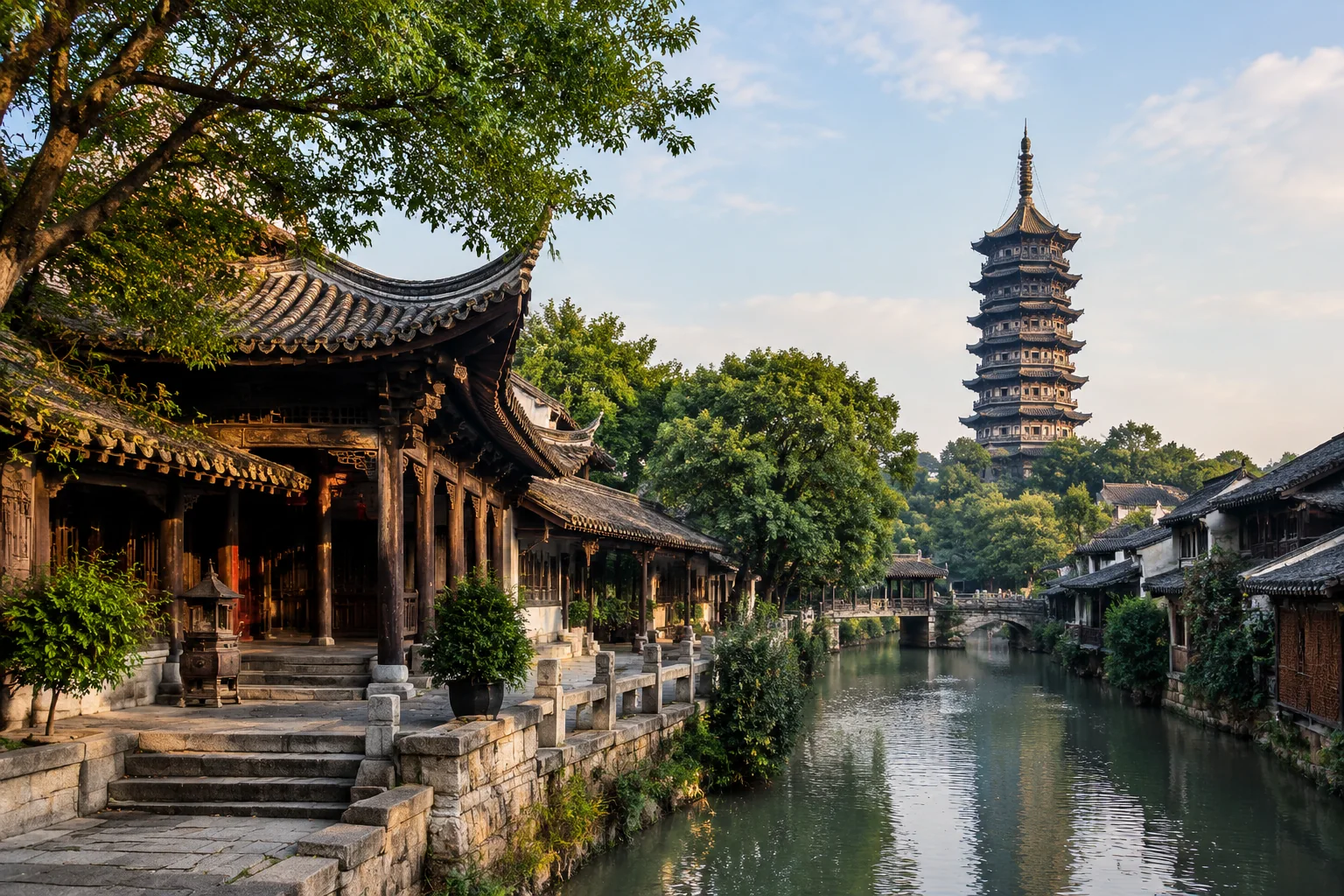
The most useful way to read Wuzhen’s old phrase ‘one view, two pagodas, nine temples and thirteen nunneries’ is as a pair of orientation anchors, not a treasure hunt. The ‘one view’ is Xiuzhen Temple (修真观) and its attached Old Stage (古戏台) in the East Scenic Area. One of the ‘two pagodas’ is Bailian Pagoda (白莲塔), the tall landmark on a river island in the West Scenic Area. Those two points give you a way to pace the town: start with the temple-and-stage cluster in the East, then use the pagoda and water edge in the West to finish the day.
This guide is for travelers using Hangzhou or another regional base for a Wuzhen visit, and for anyone trying to decide how much of Wuzhen can be understood in a day. The main decision is not ‘which building can I tick off next’ but ‘which side of the water town should carry my day.’ The limitations matter: the references identify only one of the two pagodas by name, and they are background reading rather than a live check of opening hours, tickets, performances, shuttles or pagoda access. Use them to understand the shape of the place, then confirm operating details with the scenic area’s official information.
Start With the Landmarks, Not the Full Inventory
Wuzhen’s saying is often rendered as ‘one view, two pagodas, nine temples and thirteen nunneries.’ It sounds like a route. It is better understood as a memory of a religious landscape. The character 观 in Xiuzhen Guan means a temple here, not a viewing platform, and the phrase preserves a time when temples, stages and small religious houses were part of the town’s public life.
On the ground, the phrase gives you two very different experiences. Xiuzhen Temple and the Old Stage sit inside the dense lanes of the East Scenic Area, where the references present older residences, workshops and cultural houses. Bailian Pagoda belongs to the West Scenic Area, where waterways, shops, restaurants and evening atmosphere create a more open waterfront. The contrast is the point. One cluster is close-grained and communal; the other is vertical and visible across water.
That is why the saying works as an orientation device. It does not ask you to reconstruct every religious building. It asks you to notice how a temple, a stage, a pagoda and a river island each organise the space around them.
What the Old Saying Can and Cannot Tell You
When a town claims nine temples and thirteen nunneries, the numbers describe a lost or partly lost religious topography, not a present-day count. Some sites may survive as buildings, some as names, some only as memory. Trying to locate all of them is likely to turn a water-town visit into a fruitless audit of doorways and plaques.
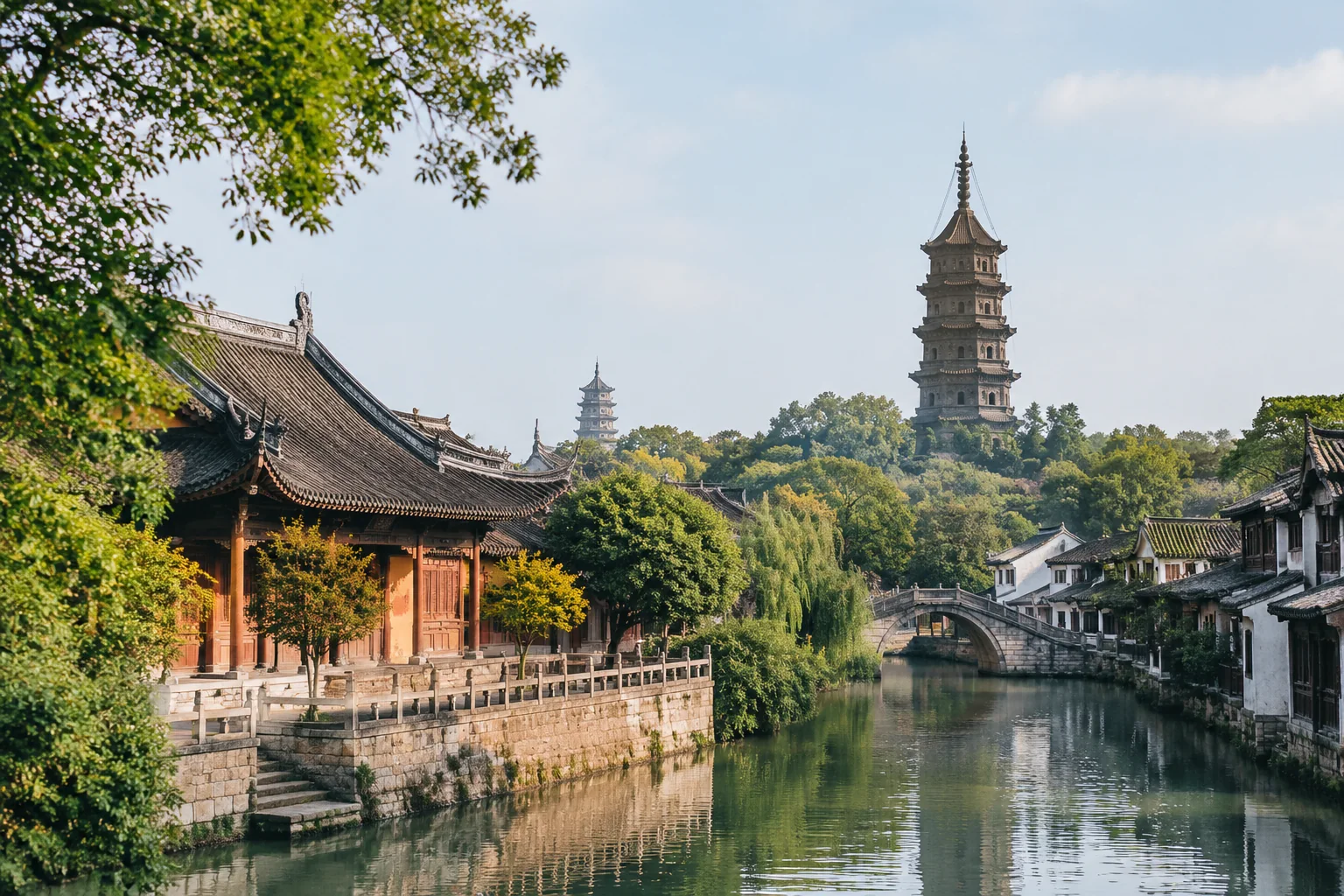
The reference material is explicit about the anchors. The ‘one view’ is Xiuzhen Temple in the East Scenic Area. One of the two pagodas is Bailian Pagoda Temple, whose pagoda is Bailian Pagoda in the West Scenic Area. The second pagoda is not named in the supplied material. That is a useful limit. A good visit does not need to complete the set; it needs to recognise the relationship between a temple, its stage, a pagoda and the water.
Read the saying as a scale rather than a checklist: one civic-religious centre, two vertical markers, and a wider field of small religious sites that have mostly dissolved into the town fabric. The numbers are context. The named landmarks are the practical handles.
Xiuzhen Temple and the Old Stage: Reading the East Scenic Area’s ‘One View’
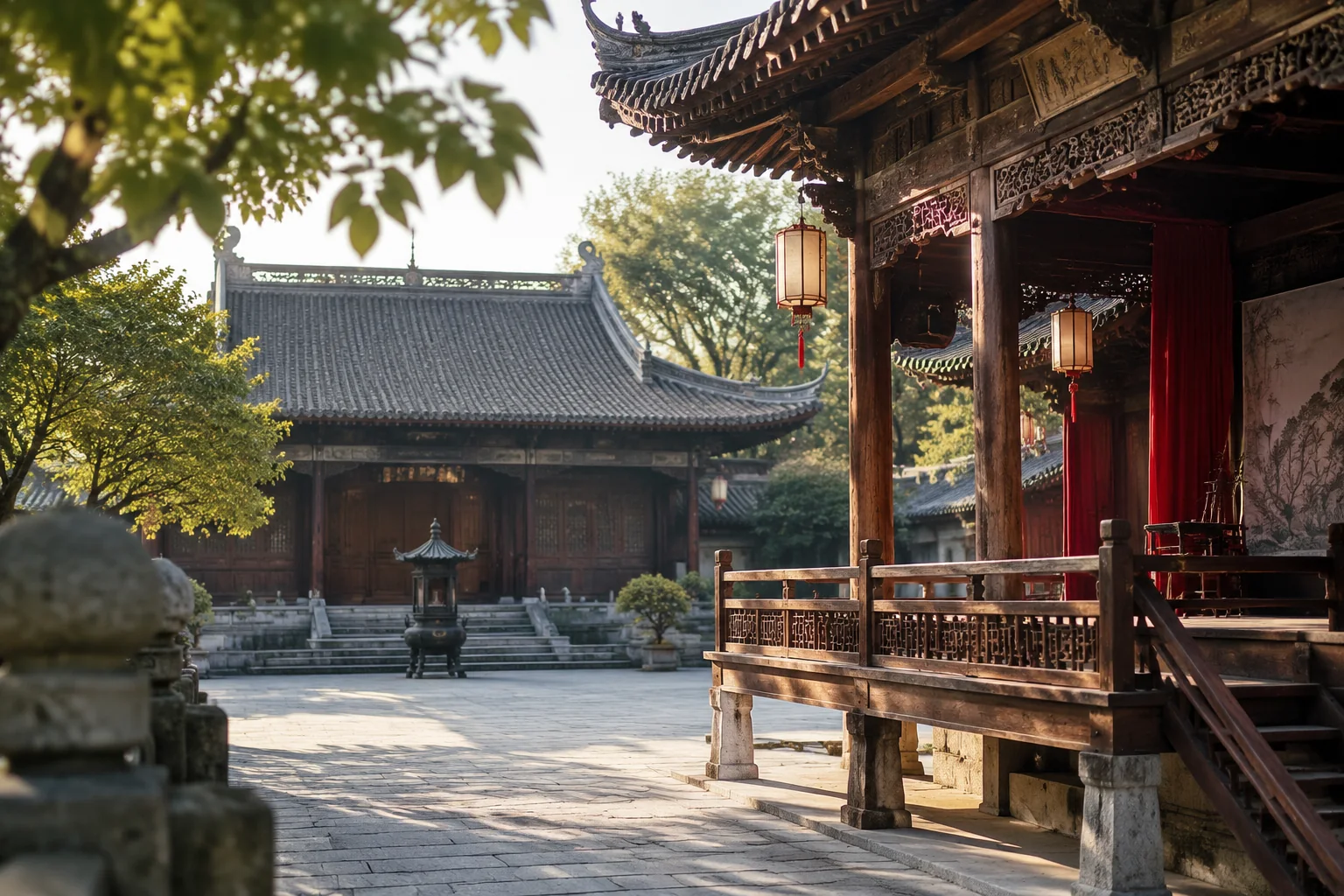
Xiuzhen Temple is the ‘one view.’ The Old Stage is not a separate attraction dropped beside it. The references describe the stage as an auxiliary building of the temple, with a two-level structure, carved timber details and a front facing the square. Historically, the stage was where public ritual and entertainment met: temple fairs, local opera and other communal events. The references mention Tongxiang flower-drum opera as the stage’s local form.
When you stand in the square, look at the relationship rather than only the facade. The temple is the enclosed sacred room; the stage is its public face. The square is the shared space between them. That arrangement explains why the ‘one view’ is more than a single hall. It is a small civic ensemble, and the stage makes the temple legible from outside.
Check whether a performance is scheduled during your visit. If there is one, it is worth timing a short stop around it; if not, the architecture and the square still carry the story. Do not confuse this Old Stage with the modern Wuzhen Grand Theatre. They are different venues with different roles.
Nearby, the East Scenic Area stacks in Mao Dun’s former residence, shadow puppetry, wood-carving displays and workshop lanes. Resist the urge to add all of them. Pick one secondary stop that fits your interest and leave the rest for the lanes. The East rewards slow looking more than list-making.
Bailian Pagoda: The West Scenic Area’s Vertical Anchor
Bailian Pagoda gives the West Scenic Area a landmark you can see before you arrive at it. The references place it on a river island in the West Scenic Area, with a plaza and a release pond at its base and a stone boat on the eastern bank. It is described as the tallest structure in Wuzhen, as a tower that can be climbed for a wide view, and as a building illuminated in the evening. Whether the tower is open for climbing, and whether the evening illumination is running, are current operating details to confirm.
The pagoda is associated with Bailian Pagoda Temple. The old name preserves the temple association; the pagoda is the element that now gives the site its vertical identity. Use it as a bearing. From the West Scenic Area’s waterways and lanes, it appears and disappears; each reappearance tells you where the river island sits relative to your route.
Late afternoon is a natural time to approach it, because the light changes and the tower’s silhouette becomes more prominent. If evening lighting is operating, it becomes an even clearer compass point after dark. The references describe a climb for views. If stairs or heights are an issue, the pagoda still works as a visual anchor from the ground; you do not need to climb it to understand its role.
How Temple, Stage, Pagoda and River Island Fit the Water-Town Fabric
Wuzhen’s old streets are described as a cross-shaped, river-and-street grid, with East and West developing as distinct visitor areas. In the East, the temple and stage create a dense room within the lanes. The stage faces the square; the temple holds the sacred interior; the surrounding streets supply the audience. In the West, the pagoda and river island create a vertical marker at the water’s edge. The town is not just a collection of buildings; it is a system of approaches, bridges, views and refusals of view.
This is why the saying is a good orientation device. It gives you two different kinds of urban reading: one horizontal and enclosed, one vertical and open. The temple-and-stage cluster asks you to look at relationships at close range. The pagoda asks you to look across water and to use a landmark at a distance. A visit that notices both will feel more coherent than one that tries to tick off every religious site.
A Flexible Day Plan Built Around Two Anchors
Treat this as a sequence of decisions, not a timetable.
- Choose one anchor per scenic area. In the East, make Xiuzhen Temple and the Old Stage the spine. In the West, make Bailian Pagoda and the river island the spine. Everything else is optional.
- If you have one full day and want both areas, start in the East. Begin with the temple and stage while your attention is fresh, then take one nearby cultural stop and walk a few lanes.
- Leave a real buffer for the transfer between East and West. The two areas are separate visitor zones, not adjoining neighbourhoods. Check the current shuttle, boat or taxi arrangements rather than assuming a timetable.
- Arrive in the West with enough daylight for the pagoda and the river island. Approach the pagoda from the water or the bank, then let the lanes lead you back toward the evening atmosphere.
- After dark, use the pagoda as a compass if it is illuminated. If not, enjoy the waterways and leave the tower for the next visit. Do not build the day around a lighting display you have not confirmed.
- If you have two days, split them: East for heritage and workshops, West for water, pagoda and evening. If you have only half a day, choose one area and one anchor rather than cramming both.
One day for both areas is ambitious; it is not a relaxed pace. The transfer alone can eat into the time you need for the temple square and the river island. If the point of the trip is to understand the saying, give each anchor room.
Comparing the Two Landmark Clusters
| Landmark cluster | Where it sits | What it helps you read | Best use in a visit | What to verify |
|---|---|---|---|---|
| Xiuzhen Temple (修真观) | East Scenic Area, within the old lanes | The ‘one view’; temple as a civic-religious centre | Start here in the East and read the temple-square relationship | Current entry arrangements, opening, any worship access |
| Old Stage (古戏台) | Attached to Xiuzhen Temple, facing the square | Public ritual and local opera; the temple’s public face | A short stop timed around a performance if one is scheduled | Performance schedule and visitor access |
| Bailian Pagoda (白莲塔) | West Scenic Area, on a river island | A vertical landmark and the water-town edge | Late-afternoon approach; evening compass if illuminated | Climb access, lighting, ticket arrangements |
Use the table to choose a sequence, not to rank the sites. The temple and stage belong together; the pagoda belongs to the water edge. The East is described as the older residential and workshop side, while the West is the more commercial and evening-oriented side. That does not make one better. It makes them useful for different parts of the day.
Families, Limited Mobility, Rain and Short Stays
Families may find the stage and the boats more engaging than a long sequence of museum rooms. The pagoda climb may not suit small children or anyone uneasy with heights; the ground-level view still works. Check what is actually open rather than promising a child a tower climb.
The references describe lanes, bridges, boats and a tower climb, but they do not provide reliable accessibility details. Ask the operator about step-free routes, boarding assistance and whether the pagoda interior is accessible. Do not assume that a water town is easy with a wheelchair or pushchair.
The temple square and river island are outdoor spaces. Wet weather can make stone lanes and boat boarding less comfortable, and it can remove the point of a pagoda climb. Keep a flexible covered or indoor fallback and check conditions on the day.
If you have only a few hours, pick one anchor. East for the temple, stage and old lanes; West for the pagoda and waterfront. Trying to do both in a short stop is the most common way to remember only the transfer.
Common Planning Mistakes and a Pre-Trip Checklist
Common mistakes are easy to avoid once you name them.
- Treating the old saying as a current map of 25 visitable religious sites.
- Assuming the East and West Scenic Areas are next door and can be combined without a transfer.
- Hunting every temple and nunnery instead of reading the two named anchors.
- Scheduling around an unverified performance, shuttle or lighting display.
- Forgetting that a pagoda may be climbable only under certain conditions.
A practical pre-trip checklist:
- Confirm which scenic areas are open and what ticket type you need.
- Check the current transfer, shuttle or boat arrangements and the last return.
- Check whether a stage performance is scheduled during your dates.
- Check pagoda climb access and evening illumination.
- Check weather, walking surfaces and accessibility before committing to a route.
- Keep one flexible hour in the plan for queues, weather or a slower lane than expected.
Frequently Asked Questions
Can I see Xiuzhen Temple and Bailian Pagoda in one day?
Yes, but treat it as an ambitious day rather than a comfortable one. Put the East Scenic Area first for Xiuzhen Temple and the Old Stage, leave a real transfer buffer, then reach the West Scenic Area with enough daylight for Bailian Pagoda and the river island. If you want to slow down, split the two areas over two days.
Is the ‘one view, two pagodas’ saying a reliable map of Wuzhen today?
No. It is a cultural memory of a religious landscape, not a present-day inventory. The supplied references identify Xiuzhen Temple as the ‘one view’ and Bailian Pagoda as one of the two pagodas, but they do not name the second pagoda. Use the phrase for orientation, not as a list of places that must still exist.
Which scenic area should I visit first?
If you want both, start in the East Scenic Area. Xiuzhen Temple and the Old Stage make a strong opening because they explain how public religious and theatrical life worked together. Then move to the West for Bailian Pagoda and the waterfront. If you only have half a day, choose one area and accept that you cannot read the whole saying in one stop.
Do I need to climb Bailian Pagoda to appreciate it?
No. The pagoda works as a landmark from the ground, from the river and from the surrounding lanes. The references describe a climb for views, but access can change. If stairs or heights are a concern, enjoy the silhouette, the island setting and the way the tower helps you navigate the West Scenic Area.
Are the stage performances and pagoda lighting always available?
Do not assume so. The references describe flower-drum opera at the Old Stage and evening illumination at Bailian Pagoda, but those are operational details that can change. Check the scenic area’s official information for your dates before building a schedule around either one.
Sources and Verification
This article draws on internal reference documents, not a live fact-check. The main background comes from Wuzhen Guide (乌镇攻略), pages 3–5, 7–9 and 14, and Zhejiang Guide (浙江攻略), page 17. These are internal reference documents; the page numbers refer to the original PDF pages.
The references describe the old saying, Xiuzhen Temple and the Old Stage, Bailian Pagoda and its river island, East and West Scenic Area itineraries, and internal transport in general terms. They do not establish current opening hours, ticket prices, performance schedules, shuttle times, pagoda access or evening illumination. Those details need confirmation with the scenic area’s official information before you travel. No public URL is supplied here because none was verified in the references.
A short note to close: if you want help turning these two anchors into a realistic Wuzhen plan around your dates, send a travel inquiry with your questions.
Find places & plan your visit
These links open external search results. Confirm the exact place, entrance and current arrangements.
Need help planning your trip?
Tell us about your travel plans and send an inquiry.