In this guide 19 sections ▾
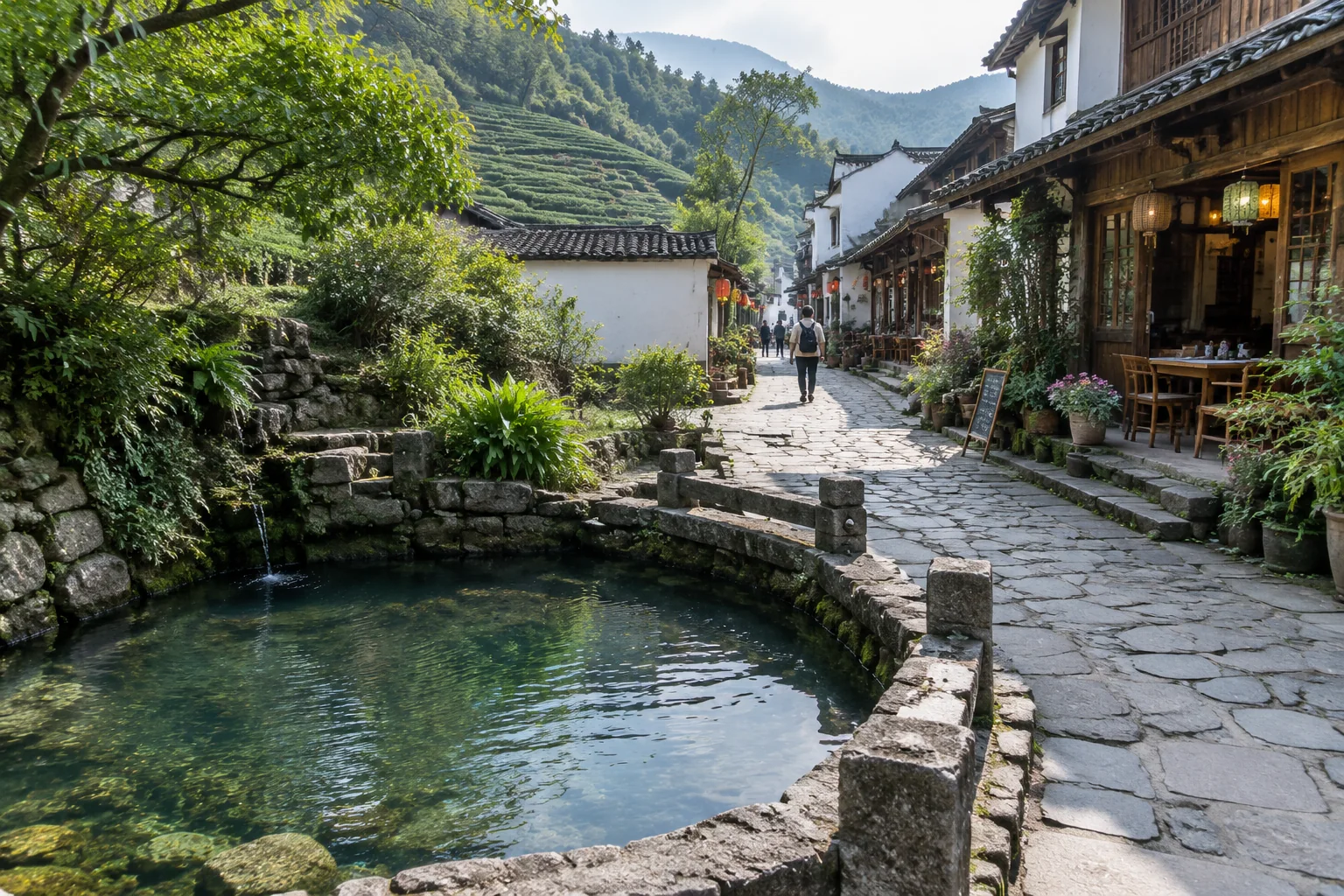
The most useful way to plan this outing is to treat Longjing Village (龙井村) as a trailhead with a tea table attached, not as a shopping stop. The village sits on Longjing Hill at the northwest foot of Wengjia Mountain (翁家山), west of West Lake, and is built along a single lane that climbs. That lane continues in the direction of Nine Creeks and Eighteen Gullies (九溪十八涧), and a set of stone steps above the village leads to the head of that valley. You can walk the lane in an hour, turn the same start into a half-day hill walk, or follow the water down through the gullies for most of a day.
The decision that shapes everything else is distance, not shopping: village only, village plus the climb, or village plus the climb plus the descent. This guide is written for independent travellers who want a walk with context rather than a guided tea-buying errand. It cannot confirm current opening hours, entry charges, bus routes, trail conditions or tea prices — those change, and old guidebook figures should not be treated as today’s facts. Confirm them locally before you go, and read the tea tasting as an optional extra rather than the point of the day.
What the Walk Actually Is
The walk has three parts, and each can be cut without spoiling the others.
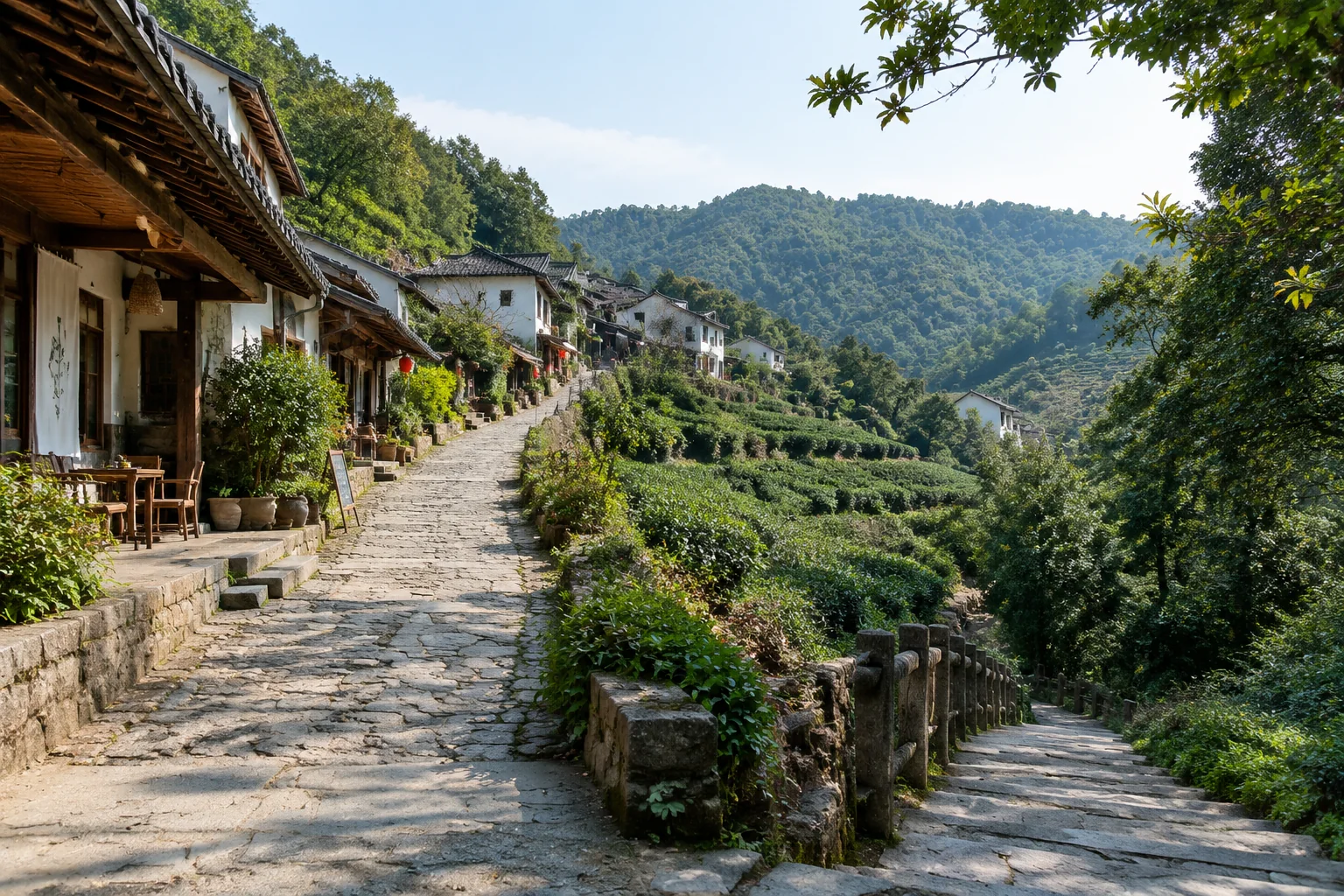
First, the village lane itself: a narrow uphill street with farmhouses, tea rooms and small eateries on both sides, and the family tea plots on the slopes immediately behind the houses. Second, the Imperial Tea Garden near the village entrance and the slope above it, where the famous bushes stand. Third, the stone steps that leave the village and climb to the source area of Nine Creeks and Eighteen Gullies, the point from which you can either turn back or descend through the wooded valley.
Older itineraries in the reference material treat Longjing as a one-day outing bolted onto other West Lake sights, which is more than this walk needs. The village rewards a slower approach: it is a working settlement with tea plots behind the houses, not a reconstructed attraction, and the most interesting things in it are small — a drying rack, a slope of bushes, a spring pool.
Reading the Village: One Lane, Tea Plots Behind, a Spring Pool at the Centre
Longjing means "Dragon Well", and the name is tied to a small round spring pool in the village. Old accounts describe the pool as never drying up, even in drought, and explain that people imagined it connected underground to the sea, with a dragon living in it. That is folklore, not geology, and it is worth enjoying as such. The pool is small and easy to walk past; descriptions differ on whether it belongs at the entrance or closer to the middle of the lane, so look for it rather than assuming a landmark will announce itself.
Around the pool, the village reads as one continuous street. Houses double as tea rooms and simple restaurants; behind them, the family plots run up the slope. That layout is the reason the village feels different from a tea market: the tea being brewed in front of you is usually the tea growing a few metres behind the wall. Whether a household is picking, processing or simply pouring that day depends on the season and the weather.
The tea from this immediate area is often labelled Lion Peak Longjing (狮峰龙井), after the slope above the village. If you hear the term used loosely by a vendor, treat it as a name rather than a guarantee of origin.
The Imperial Tea Garden and the Eighteen Bushes: Legend, Not Verified History
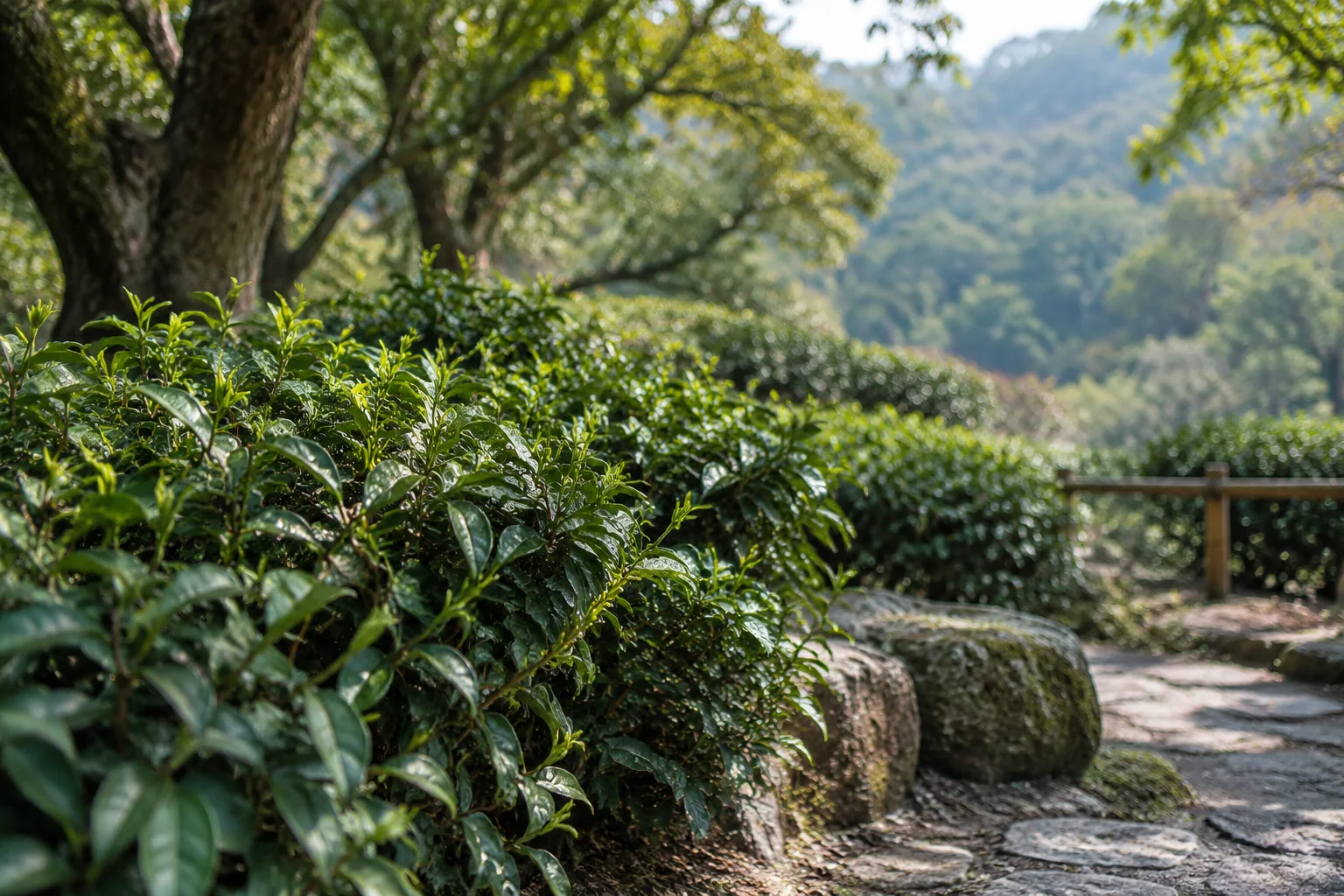
Near the village entrance, the Imperial Tea Garden (御茶园) is the setting for the Eighteen Imperial Tea Bushes, the stand of old shrubs that made Longjing famous in story. The standard telling is that the Qianlong Emperor designated them, or their produce, for the imperial tribute. There is no way to verify that claim from the material available here, and it should be presented — and received — as a local tradition rather than documented fact.
What is left is modest: the bushes themselves are not a spectacle, and visitors who arrive expecting a monumental garden tend to be disappointed. The compensation is the setting. The old trees around the tea garden are the visual highlight, and the slope gives a sense of how the village sits inside its hills. Older descriptions of the area also mention the friendship between Su Shi (Su Dongpo) and the Lingyin abbot Biancai, whose meetings became a literary theme; the pairing of tea, scholarship and hillside retreat is the real cultural thread here.
Whether there is an entry charge or a fixed opening time is exactly the kind of detail that must be checked on the day. Do not carry an old ticket price in your head.
Tea at a Farmer’s Table: Optional, Educational, and Easy to Steer
The tasting ritual is straightforward. A household will usually brew several grades for comparison, pour them in sequence, and explain the differences; the purpose is to sell, but there is no obligation to buy. If you are not interested, say so early and politely, and either pay for the tea as a drink or move on. If you are interested, the tasting is genuinely useful, because Longjing grades differ in ways you can see and taste: the leaf should be flat, smooth and straight, the colour a fresh green, the aroma clean and high, and the liquor sweet rather than dull.
Ask three questions before money enters the conversation: what the grades are, how they differ (picking date, slope, processing), and the price per unit for each. Prices vary enormously by grade, and bargaining has historically been part of the transaction. Treat any quoted figure as something to verify rather than as a market rate, and be aware that pre-Qingming spring tea is normally the most expensive category.
One practical caution: unsolicited "helpers" who approach you on the road and offer to take you to a tea village are usually working on commission, which tends to inflate the price. Arrange your own transport to the village and choose your own door.
The Stone-Step Climb to the Source of Nine Creeks
Above the village the lane gives way to stone steps. They climb into tree cover towards the head of Nine Creeks and Eighteen Gullies, the valley that older descriptions of Hangzhou list among the quieter West Lake landscapes. The steps are uneven, shaded and often damp; after rain they are genuinely slippery, and the descent through the valley can be slower than the climb.
The spot at the head of the valley carries its own tradition: it is associated with Su Shi and the Lingyin abbot Biancai, said to have met to drink tea and talk, a friendship later celebrated in writing. As with the imperial bushes, the story is the point rather than the archaeology — there is nothing on the ground to verify, and the pleasure is in standing where a well-known literary friendship is placed by local telling.
Beyond that, the walk is water, stone and trees. From the valley head, the usual continuation is to follow the creeks downstream through the gullies rather than retracing your steps. Confirm the state of the path, where it meets the road, and how you will get back before you commit to the descent.
Choosing a Route: Half Day, Full Day, or the Longer Valley Link
| Shape of the day | What it covers | Best for | Watch out for |
|---|---|---|---|
| Village only (a couple of hours) | The lane, the spring pool, the Imperial Tea Garden, one farmhouse tasting | Short stays, wet weather, travellers with children or anyone avoiding stairs | A tasting is a sales setting; ask grades and prices before committing |
| Village plus the valley head (half day) | Adds the stone steps above the village and the source area of Nine Creeks | Walkers who want hillside without a full-day commitment | Wet, uneven stone; confirm where the path rejoins the road |
| Village, valley head, then downstream (full day) | Descends through the gullies towards Nine Creeks Misty Trees (九溪烟树) | Fit walkers with a full day and an early start | Daylight, weather, and transport back from the far end |
| Longer valley-and-ridge link (full day or more) | Old track combinations joining Nine Creeks Misty Trees, the Qianlong Ancient Road, Longjing Eight Scenes and the Lingyin side | Repeat visitors building a longer route | Historic route descriptions and present-day signage may not match |
The middle two rows are the versions most visitors should weigh. The full-day descent is geographically coherent — you go up once, then down with the water — but it only works if you have checked the weather, your daylight margin and your transport out of the Nine Creeks end. The last row comes from older cycling and hiking notes; use it as inspiration and expect to re-plan on the ground.
Season, Weather and What to Wear
Spring is the liveliest time in these hills, because that is when the picking and processing happen. Pre-Qingming tea, picked in the weeks before the early-April festival, is the most prized, and the fields are busiest around then; the exact timing shifts each year with the weather. Summer is hot and humid, autumn is generally more comfortable, and winter is quiet and raw.
Footwear matters more than anything else you bring. Smooth-soled shoes on wet stone steps are the classic mistake. Wear shoes with real grip, carry a light rain layer, and take water — the climb is short but steady, and shade can make it feel cooler than it is. If it has rained heavily, or is raining while you are there, keep the day to the village and the tea garden and leave the steps for another visit; streams in the gullies rise quickly.
Who the Walk Suits — and Who Should Adapt It
Families with young children can do the village lane and the tea garden comfortably, and can sample a short stretch of the lower path without committing to the full stair sequence. Older walkers who are steady on their feet usually manage the climb; anyone using a wheelchair or needing guaranteed step-free surfaces should treat the village lane as the realistic route and ask locally about the state of the path rather than relying on general assurances. Accessibility in this landscape is variable, and no blanket claim is safe.
Wet weather is the big equaliser: it makes the stone steps the wrong choice for almost everyone, while leaving the village, the tea rooms and the Imperial Tea Garden perfectly workable. Short-stay visitors should choose the half-day version and spend the rest of the day on the West Lake side.
Common Planning Mistakes and a Pre-Trip Checklist
The recurring mistakes are simple. Treating Longjing as a shopping stop and never walking above the village; assuming a free tasting obliges a purchase; failing to ask the price per grade before agreeing to anything; wearing the wrong shoes; starting after lunch without checking daylight and the last transport back; and carrying decade-old bus numbers, ticket prices and shop names from a printed guide.
Before you go:
- Check the weather forecast and how much rain has fallen in the previous days.
- Confirm locally that the stone-step path and the valley route are open and walkable.
- Check current transport to Longjing Village and, if you plan the descent, from the Nine Creeks end.
- Confirm the Imperial Tea Garden’s opening arrangements and whether there is an entry charge.
- Carry grip-soled shoes, water, a rain layer, and a charged phone with an offline map.
- Decide in advance whether you are buying tea; set a budget if you are, and a polite exit line if you are not.
- Leave a daylight buffer rather than planning to finish at dusk.
FAQ
How long does the Longjing Village to Nine Creeks walk take?
Plan a half day for the village lane, the tea garden and the climb to the valley head. The version that continues downstream through the gullies towards Nine Creeks Misty Trees takes most of a day once you add the approach and the journey back. Walking times vary a lot with weather and with how long you spend at tea tables.
Do I have to buy tea if a farmer brews several grades for me?
No. The tasting exists to sell tea, but it is not a contract. Ask what the grades are and the price for each before you commit, and be clear if you are only there to drink. If you would rather not be in a sales situation at all, buy a cup as a drink or visit the village without sitting down.
Are the Eighteen Imperial Tea Bushes worth the detour?
Go for the setting rather than the shrubs. The bushes are modest, and the Qianlong connection is a story rather than a documented fact. The old trees and the slope above the village are the reason to walk up, and the tea garden sits naturally on the way to the lane.
Is the stone-step path suitable for children or older walkers?
It depends far more on the weather than on age. In dry conditions, steady walkers and older children generally cope with the climb; in the rain, the steps are slippery and the descent through the valley is slow. Anyone needing step-free routes should stay on the village lane and ask locally about conditions rather than assuming.
When is the best time to see the tea fields being worked?
Spring, in the weeks around Qingming in early April, when picking and processing are at their height. The exact dates move each year with the weather, so check close to your trip rather than booking around a fixed date. Autumn is more comfortable for walking but much quieter in the fields.
What happens if it rains?
Keep the village, the tea rooms and the Imperial Tea Garden, and drop the stone steps. Heavy rain makes the gully paths unsafe and the streams rise quickly. A wet day in the village is still a reasonable half day; a wet day on the steps is not.
Sources and Verification
This guide was assembled from internal Chinese-language reference documents held by the publisher: 《杭州攻略》 (pages 3, 4, 6, 7 and 12), 《浙江攻略》 (pages 5 and 6) and 《乌镇攻略》 (page 16, which carries a Longjing one-day itinerary). These are internal reference documents used for background; they are not current official publications and were not re-verified for this article.
What the sources do support: the village’s position at the northwest foot of Wengjia Mountain west of West Lake; its shape as a single climbing lane with farmhouses and tea plots behind them; the round spring pool and the dragon legend attached to the village name; the Imperial Tea Garden and the Eighteen Tea Bushes as a Qianlong-era tradition; farmhouse tastings of several grades with no obligation to buy; the stone steps above the village leading to the head of Nine Creeks and Eighteen Gullies; and the association of that spot with Su Shi and the abbot Biancai. Older route notes also link the Nine Creeks area with Longjing, the Qianlong Ancient Road and the Lingyin side.
What must be confirmed before you travel: opening hours and any entry charge at the Imperial Tea Garden; current bus routes and transport to the village and back from the Nine Creeks end; present-day tea prices and grading; trail conditions, signage and closures; and any accessibility provision. Confirm these through official scenic-area information and local signage on the day rather than relying on guidebook figures or on this page.
Find places & plan your visit
These links open external search results. Confirm the exact place, entrance and current arrangements.
Need help planning your trip?
Tell us about your travel plans and send an inquiry.