In this guide 20 sections ▾
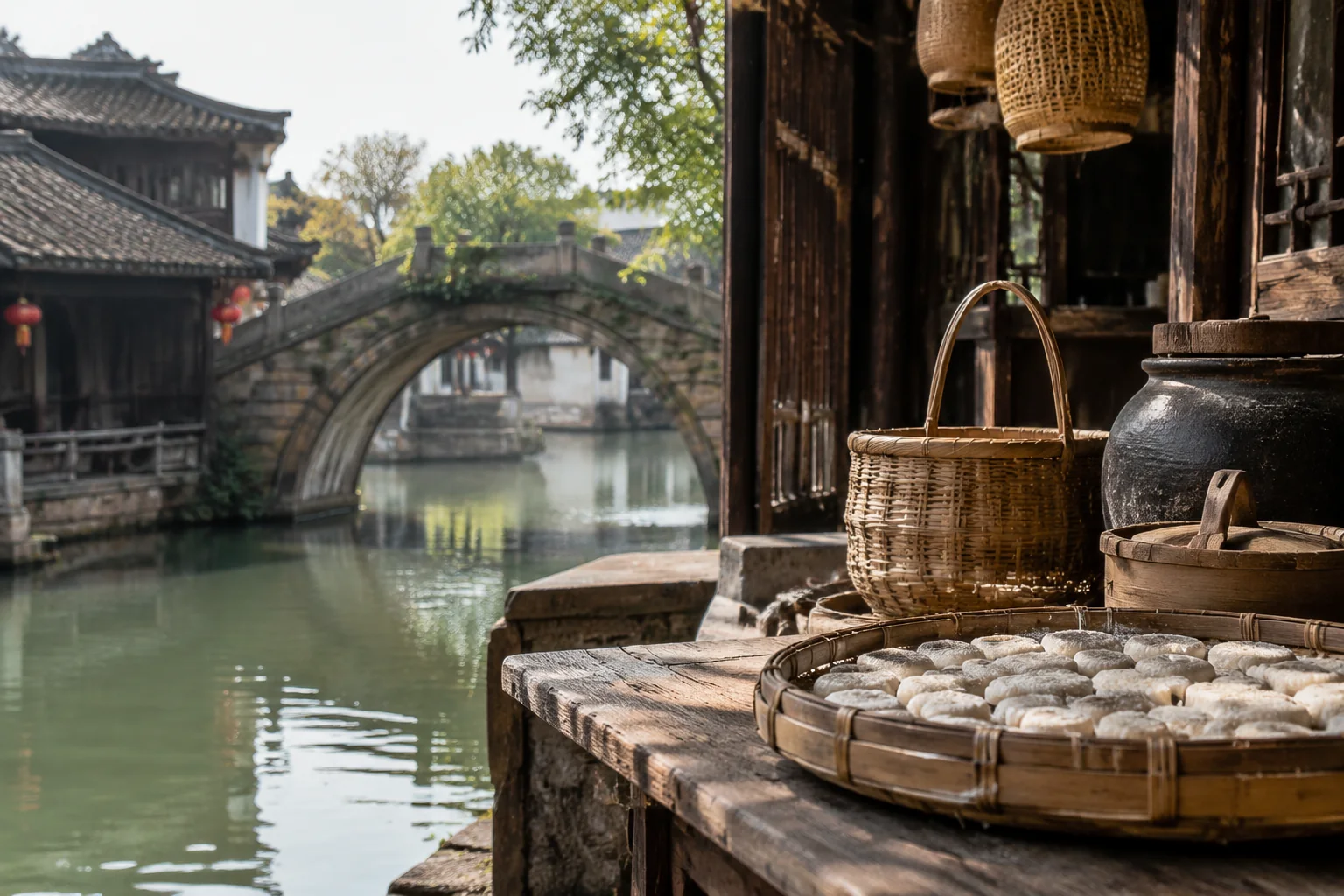
East Scenic Area (东栅, Dongzha) is presented in the reference guide as the older, more residential half of Wuzhen, and its admission is broad: a day ticket described as covering more than twenty named sights — museums, workshops, a temple, an old stage, former residences, a pawnshop, bridges and folk performances.
Breadth is both the opportunity and the trap. With that many rooms inside one compact district, the default walk becomes a zigzag: a bed museum, then a stage, then a dye workshop, then back across the lane for a writer’s house, ending in a blur.
The direct answer: treat the admission as a district pass, choose one theme, anchor it with two or three included sights, and let any fixed-time performance set the day’s skeleton. Everything below is a route framework, not a live listing — inclusions, closures and showtimes have to be confirmed at the gate.
Planning overview. This guide suits travellers giving East at least half a day and wanting to sequence it by interest. The main decision is your theme and whether the visit is a half day or a full one. The main limitation is that the underlying source is a printed guide, so treat names and times as structure rather than current fact.
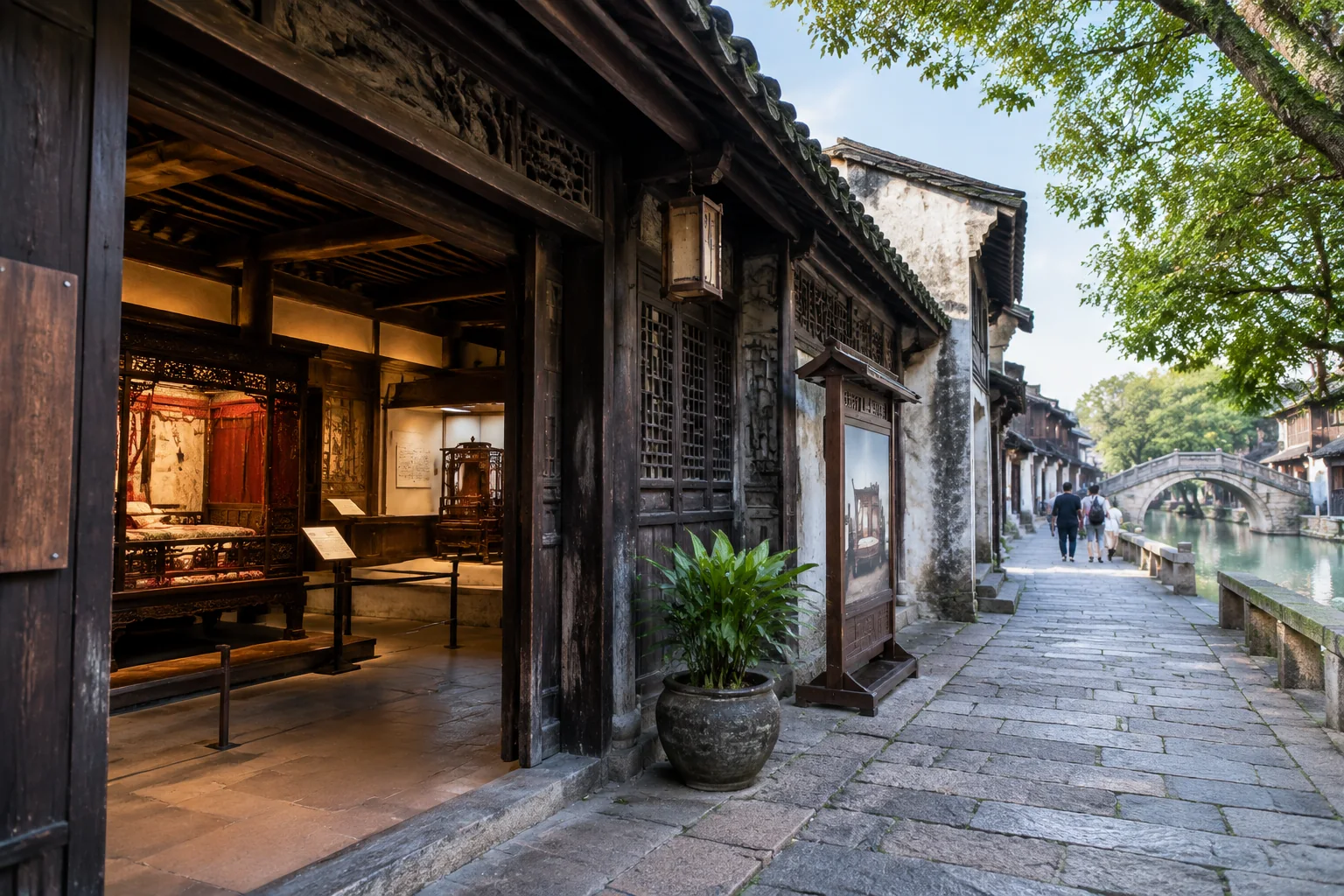
What the East Scenic Area admission is described as covering
The inclusion list reads like an inventory of town life, and the names group naturally into five clusters. Watch the naming: the same museum appears under slightly different labels in different parts of the guide (江南民俗馆 / 乌镇民俗风情馆), so match by location as well as name.
| Cluster | Named stops in the reference inclusion list | What the cluster rewards |
|---|---|---|
| Domestic life and folk custom | Jiangnan Bed Museum (江南百床馆); Jiangnan Folk Customs Museum (江南民俗馆), also listed as Wuzhen Folk Customs Museum (乌镇民俗风情馆) | Ming and Qing beds as furniture and household status; halls organised by clothing, marriage, birthday and festival custom |
| Craft and making | Indigo Print Dye Workshop (蓝印花布染坊); Traditional Workshop Area (传统作坊区); Gong Sheng Distillery (公生糟坊); Wood Carving Museum (木雕馆 / 江南木雕陈列馆) | Patterned cloth, food and drink production, carved panels, brackets and window frames |
| Literary and old-town institutions | Mao Dun’s Former Residence (茅盾故居); Hanlin House (翰林第); Fanglu Pavilion (访卢阁); Huiyuan Pawnshop (汇源当铺) | A writer’s house, a scholar’s residence, a teahouse and a pawnshop — the town’s literary and commercial layer |
| Civic and waterfront | Xiuzhen Temple (修真观); Old Stage (古戏台); Fengyuan Twin Bridge (逢源双桥, the paired Tongji and Renji bridges); Caishen Bay (财神湾) | The public face of the town, plus the orientation points most visitors pass anyway |
| Performance | Shadow puppetry (皮影戏); boxing-boat performance (拳船表演); flower-drum opera (花鼓戏); high-pole boat (高竿船) | Short, time-fixed events that decide how the rest of the day is sequenced |
The key point is that these are rooms within one admission, not separate paid attractions. Budget one ticket and one day, not a per-museum spend.
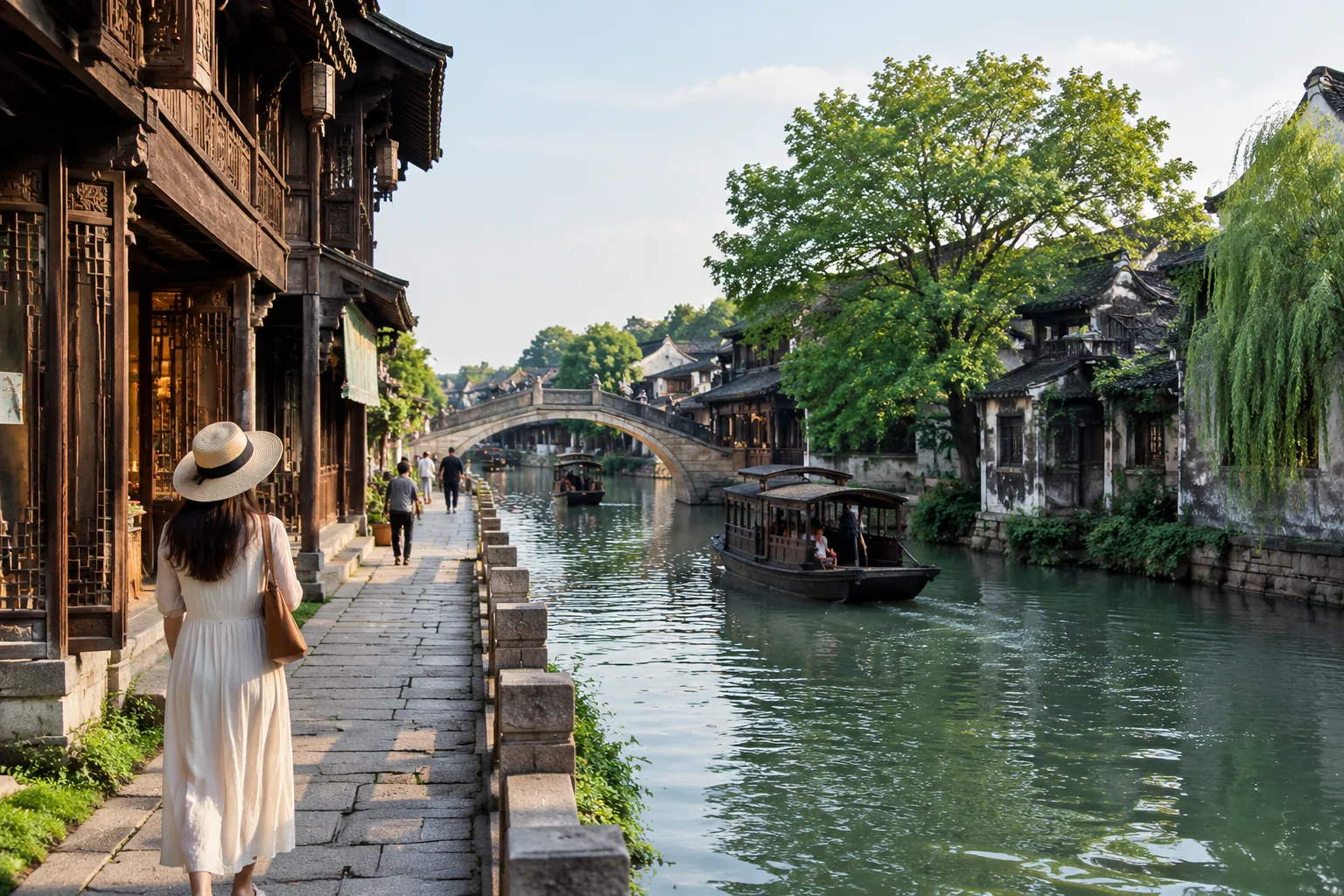
Why a theme route beats a tick-list walk
The guide’s own East route mixes registers: Jiangnan Bed Museum → Jiangnan Folk Customs Museum → Jiangnan Wood Carving Museum → Mao Dun’s Former Residence → Old Stage → shadow puppetry → Fanglu Pavilion. It is a reasonable first-visit spine, and because the district is compact — the guide treats East as a half-day area — the cost of following it is not distance but repeated switching between furniture, ritual, craft, literature and performance.
A theme route covers the same ground with one thread running through it, and it gives you a reason to read a hall properly instead of using it as a corridor between photo stops. Keep the mixed spine as a fallback for a first visit with no particular interest.
Route 1: Folk culture — beds, rituals and everyday objects
Cross Fengyuan Twin Bridge (逢源双桥) at the entrance for orientation, then go to the Jiangnan Bed Museum (江南百床馆), where the guide points to Ming and Qing examples: read them as furniture, craft and household status rather than curiosities. Continue to the folk-customs museum, whose halls cover clothing, marriage, birthday and festival custom, then to the Traditional Workshop Area (传统作坊区) for food and daily-goods workshops such as rice cake, sauce, copper, shoes and tobacco. End at Caishen Bay (财神湾) if the high-pole boat is running, or as a waterfront pause if it is not.
Every stop here answers the same question — how did a household live and provision itself — which makes the halls easier to read than when they are interrupted by a stage or a residence.
Route 2: Crafts — dye, fermentation and carving
Indigo Print Dye Workshop (蓝印花布染坊) → Traditional Workshop Area → Gong Sheng Distillery (公生糟坊) → Wood Carving Museum (木雕馆). The first two are about pattern and process, the distillery about fermentation, the carving collection about ornament and joinery.
Before committing to this route, ask which workshops are actually working that day. A craft stop with no work in progress is a ten-minute look, not a forty-minute one. Yu Liuliang Coin Museum (余榴梁钱币馆) is included, but it belongs to collecting and currency rather than making, so add it only if that interests you.
Route 3: Literary and civic history around Mao Dun’s Former Residence
Mao Dun’s Former Residence (茅盾故居) is the anchor. Build a short walk around it: the residence, then Xiuzhen Temple (修真观) and the Old Stage (古戏台), then Fanglu Pavilion (访卢阁) if it is open, with Huiyuan Pawnshop (汇源当铺) as an optional look at the town’s commercial life.
The temple and stage are not literary sights, but they are the public square the house looked onto, and they let the residence read as a place in a town rather than a museum case. One caution: Hanlin House (翰林第) appears in the East inclusion list and is named as the shadow-puppet venue, while a separate entry in the same guide describes a Xia Tongshan Hanlin Residence on the West Scenic Area side. Confirm which one your map shows before walking to it.
Route 4: Performance first, map second
Performance is the one theme where the schedule, not the map, comes first. The guide’s East calendar lists shadow puppetry at Hanlin House in short repeated slots, flower-drum opera (花鼓戏) at the Old Stage at longer intervals, and the high-pole boat (高竿船) at Caishen Bay only twice a day, suspended in special weather. The inclusion list also names a boxing-boat performance (拳船表演) with no time or location given.
Those clock times belong to the printed guide, not to today. What survives is the logic: the high-pole boat is the least flexible item, and the two theatre forms repeat often enough to absorb a delay.
- At the gate, ask for today’s performance list — name, place, time, and whether it is included in admission.
- Protect the least flexible show first, usually the high-pole boat.
- Slot shadow puppetry and flower-drum opera around it; both are described as recurring morning and afternoon.
- Fill any wait with the nearest included room rather than crossing the district.
- Keep an hour loose, because outdoor items pause in bad weather.
Comparing the four routes
| Route | Anchors | Best for | Fixed-time element to protect | Trade-off |
|---|---|---|---|---|
| Folk culture | Bed Museum, Folk Customs Museum, Traditional Workshop Area | First-timers who want the "how people lived" story | High-pole boat at Caishen Bay, if running | Least literary; workshop value depends on activity |
| Crafts | Dye workshop, Traditional Workshop Area, distillery, Wood Carving Museum | Travellers drawn to materials and process | None inherent | Falls flat if workrooms are closed |
| Literary and civic | Mao Dun’s Former Residence, Xiuzhen Temple, Old Stage, Fanglu Pavilion | Readers, and anyone wanting a shorter, quieter walk | Flower-drum opera at the Old Stage, if it fits | Depends on interiors being open; Hanlin House location needs checking |
| Performance | Shadow puppetry, flower-drum opera, high-pole boat, boxing boat | Short stays and mixed-age groups | All of them — times rule the day | Most exposed to cancellation and schedule change |
Combining themes: a practical decision sequence
- Fix the day length. Half a day is roughly six to nine included stops; a full day allows ten to twelve without rushing.
- Write down any showtime you have confirmed before planning anything else.
- Choose your primary theme and its two or three anchors.
- Add one secondary stop near where you will leave, not one that sends you back across the district.
- Plan lunch: the guide places a traditional snack street and old restaurants such as Jiujiang Lou near the Old Stage. A snack lunch costs half an hour; a sit-down meal costs an hour you may want elsewhere.
- If you continue to the West Scenic Area, treat it as a separate visit and leave a transfer buffer. The reference describes a connecting shuttle between the two areas, but current hours and frequency need checking.
Weather, families and short stays
Wet weather changes the day more than the map suggests. The high-pole boat is the item most likely to be cancelled, so shift the balance toward indoor collections and keep the performance circuit optional. Stone lanes and stepped bridges are the norm in canal towns, and the reference says nothing about shelter, drainage or handrails — plan footwear and timing accordingly.
On families, the source does not assess suitability for children. The structural point is that repeated short-format performances are easier to fit around short attention spans than a single long fixed-time event, while the museums reward a slower pace than many children want.
On limited mobility this is a genuine evidence gap rather than a detail to gloss over: no step-free routes are described, and the district includes bridges and old lanes. Ask the site directly before relying on any route described here.
For a stay of two or three hours, take the performance circuit plus one cluster — folk culture or crafts — and accept that most of the list stays unvisited.
Common planning mistakes and a pre-trip checklist
The recurring mistakes are small: treating each museum as a separate paid attraction; building the day around a printed showtime; zigzagging to complete the whole inclusion list; leaving performances until late afternoon; assuming East and West join without a buffer; assuming the ticket can be split across two days.
Before you walk in:
- Confirm which named sights today’s admission covers, and whether it is single-day and single-entry.
- Ask the last entry time and whether re-entry is allowed.
- Get a numbered map and mark your two or three anchors on it.
- Ask for today’s performance times and venues, and whether they are included.
- Ask which workshops are demonstrating.
- Note what is charged separately: the guide lists guide service and East rowing boats as add-ons rather than admission.
- Check the forecast for the outdoor performances.
Frequently asked questions
Is one East Scenic Area ticket enough for all the museums and workshops?
By the reference description, yes: the admission is presented as covering the whole list of named sights inside East Scenic Area, so museums, workshops, the temple, the stage and the residences are rooms in one visit rather than separate admissions. Two caveats — some services, such as guide service and rowing boats, are listed separately, and inclusions change. Ask at the gate instead of budgeting per museum.
How much time should I allow for the East Scenic Area?
The guide treats East as a half-day area. Six to nine included stops at a walking pace fit a morning comfortably; adding workshops, a sit-down lunch and a performance block can fill a full day. Add time if you intend to read the collections rather than pass through them.
Should I visit East or West Scenic Area first?
The guide’s own suggestion is East first: smaller, older and denser in cultural sights, and well suited to a morning. West is larger and is the half recommended for afternoon and evening. If you arrive late in the day, reverse the order rather than rushing East at closing time.
Do the performances cost extra?
The inclusion list names shadow puppetry and the boxing boat, and the performance calendar lists flower-drum opera and the high-pole boat, which suggests they fall under the day’s admission. That is not a guarantee. Confirm at the gate which performances are included today and where each takes place, since Hanlin House and Caishen Bay are separate points in the district.
What happens if it rains on the day of my visit?
Expect outdoor items to go first: the guide states the high-pole boat pauses in special weather. Reweight the day toward the museums, dye workshop, distillery and residences, and keep the Old Stage and Hanlin House in reserve if an indoor performance is running. Ask staff what has been cancelled rather than waiting at a venue.
Can I use the same ticket across two days?
The guide describes the East admission as valid for the day of purchase, so plan the theme routes as alternatives for one day rather than a two-day split. For a two-day Wuzhen stay, its own structure is East one day and West the next — but confirm current validity rules at the ticket office before building on them.
Sources and verification
This route framework was synthesized from two internal reference documents, not from a live information or booking page:
- 乌镇攻略 (Wuzhen guide), page 5 — the East Scenic Area inclusion list, the one-day East route and the two-day East/West structure.
- 乌镇攻略, page 4 — the half-day East route and the East-versus-West comparison.
- 乌镇攻略, page 9 — the East performance calendar for shadow puppetry, flower-drum opera and the high-pole boat.
- 乌镇攻略, page 11 — food notes placing snack stalls and old restaurants in the East lanes.
- 乌镇攻略, page 14 — the description of a shuttle between the two scenic areas.
- 乌镇攻略, page 8 — the entry describing a Xia Tongshan Hanlin Residence on the West Scenic Area side.
- 浙江攻略 (Zhejiang guide), page 17 — background on Wuzhen and the East/West layout.
These are internal reference documents; page numbers are given so the material can be traced, and no public links are implied. What the guide lists is background. Everything time-sensitive is unverified: current inclusions, which rooms are open, whether workshops are demonstrating, performance times and venues, ticket validity, re-entry, last entry, boat and guide charges, and shuttle arrangements. Check these with the site or its official channel before relying on them. No fact-check date is claimed here.
If you would like help turning one of these themes into a day that matches your dates and pace, send an inquiry through the form below with your travel dates, how much time you have and which theme interests you. An inquiry is a request for contact, not a booking or a confirmed quote.
Find places & plan your visit
These links open external search results. Confirm the exact place, entrance and current arrangements.
Need help planning your trip?
Tell us about your travel plans and send an inquiry.