In this guide 17 sections ▾
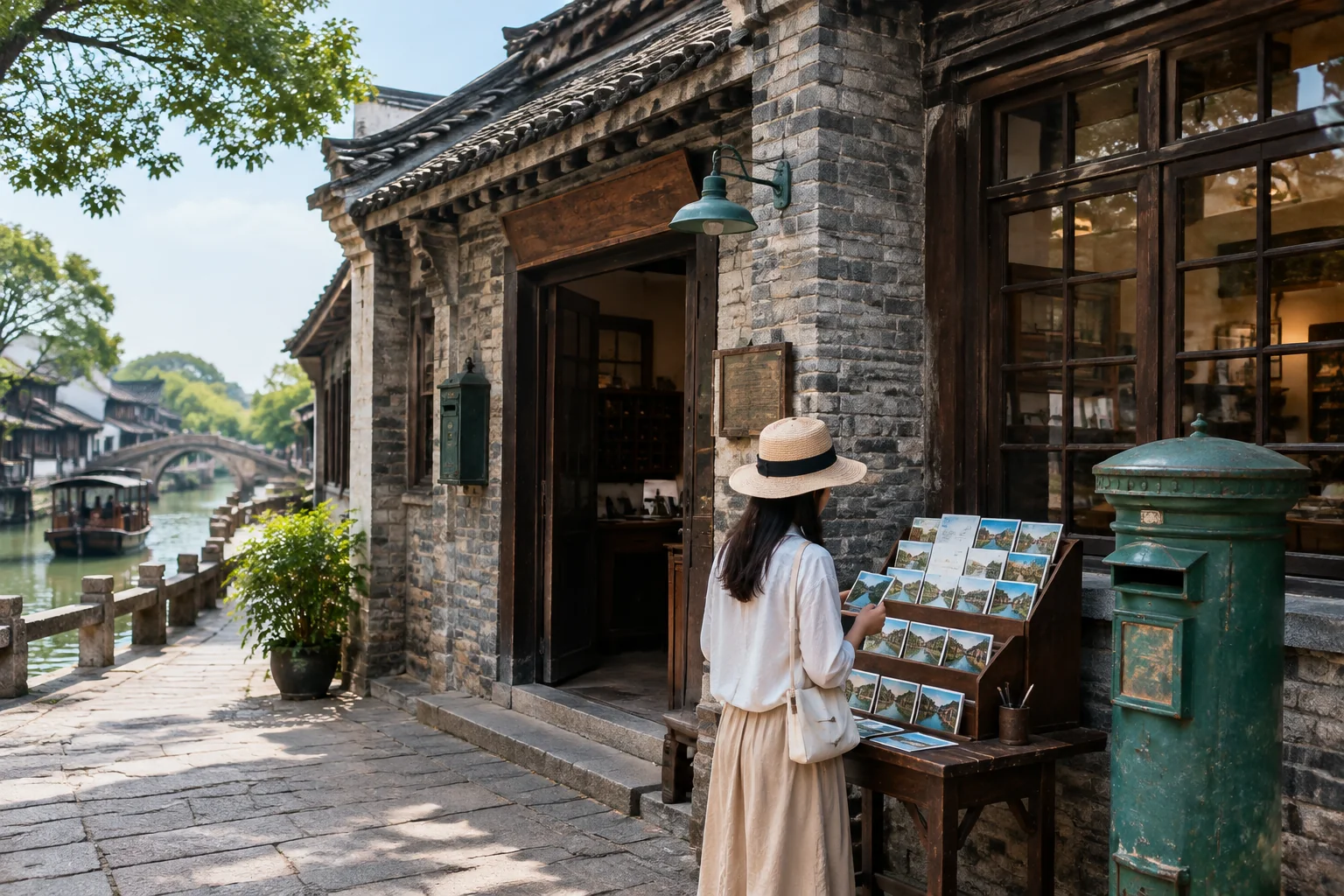
Wuzhen’s old post office is a small stop with a clear purpose: buy a postcard, write it, and send it from the West Scenic Area. It is not a major museum or a reason to reorganise a whole day. The useful way to plan it is to slot it into a West Scenic Area walk, check the current postal arrangements at the counter, and pair it with the riverside lanes that make this part of Wuzhen worth walking slowly.
This guide is for first-time visitors, short-stay travellers, families and anyone who likes a tangible souvenir more than another display case. The main decision is where to put the postcard stop in your route. The main limitation is that older guidebook details cannot be treated as today’s opening hours, postage rates or mail services.
Start With the Practical Answer
The old post office, 乌镇老邮局, is best treated as a pause rather than a sight to tick off. The historical interest is real: the reference describes a post office founded during the Qing dynasty’s Guangxu era, initially handling letters and later adding parcels and remittances. Mail was once carried on foot by postal workers, and the building itself is described as brick-and-tile rather than the timber shop-houses common in the West Scenic Area, with a Chinese-Western hybrid character.
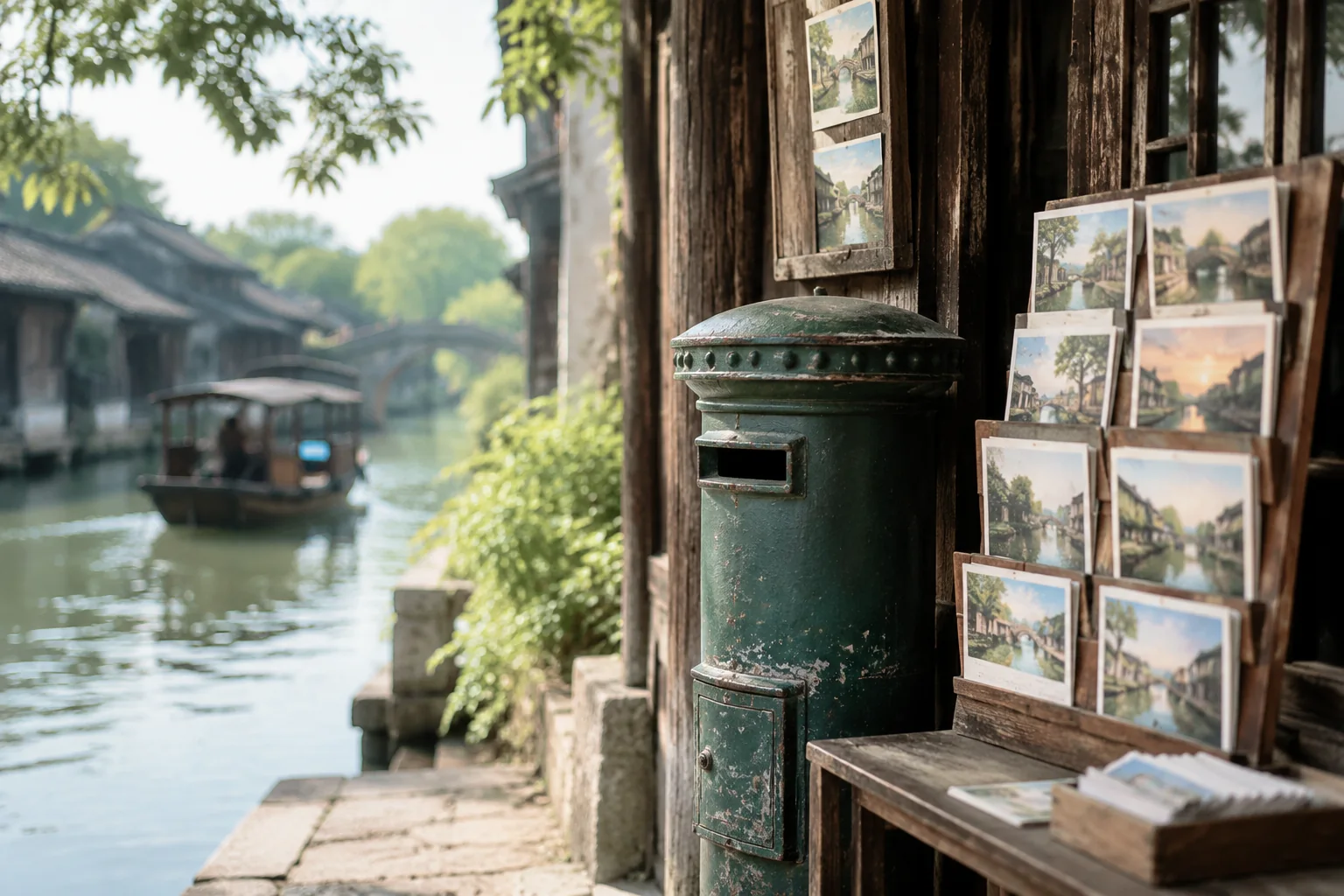
The visitor ritual is equally simple. Buy a Wuzhen postcard, write it, and ask about having it postmarked at the old post office before sending it to a friend or keeping it as a record of the trip. That is the reason to go. The building’s exterior and the postal story give the stop context, but do not expect a large postal museum.
Current details need checking on site or through current visitor information. The reference does not establish today’s counter hours, card stock, postage rates, international service, postmark policy or whether the interior is open in the same way. Do not write a card for international mail until you have asked at the counter. If the service is not available that day, the stop can still work as a short architectural and riverside pause.
Where the Old Post Office Sits in the West Scenic Area
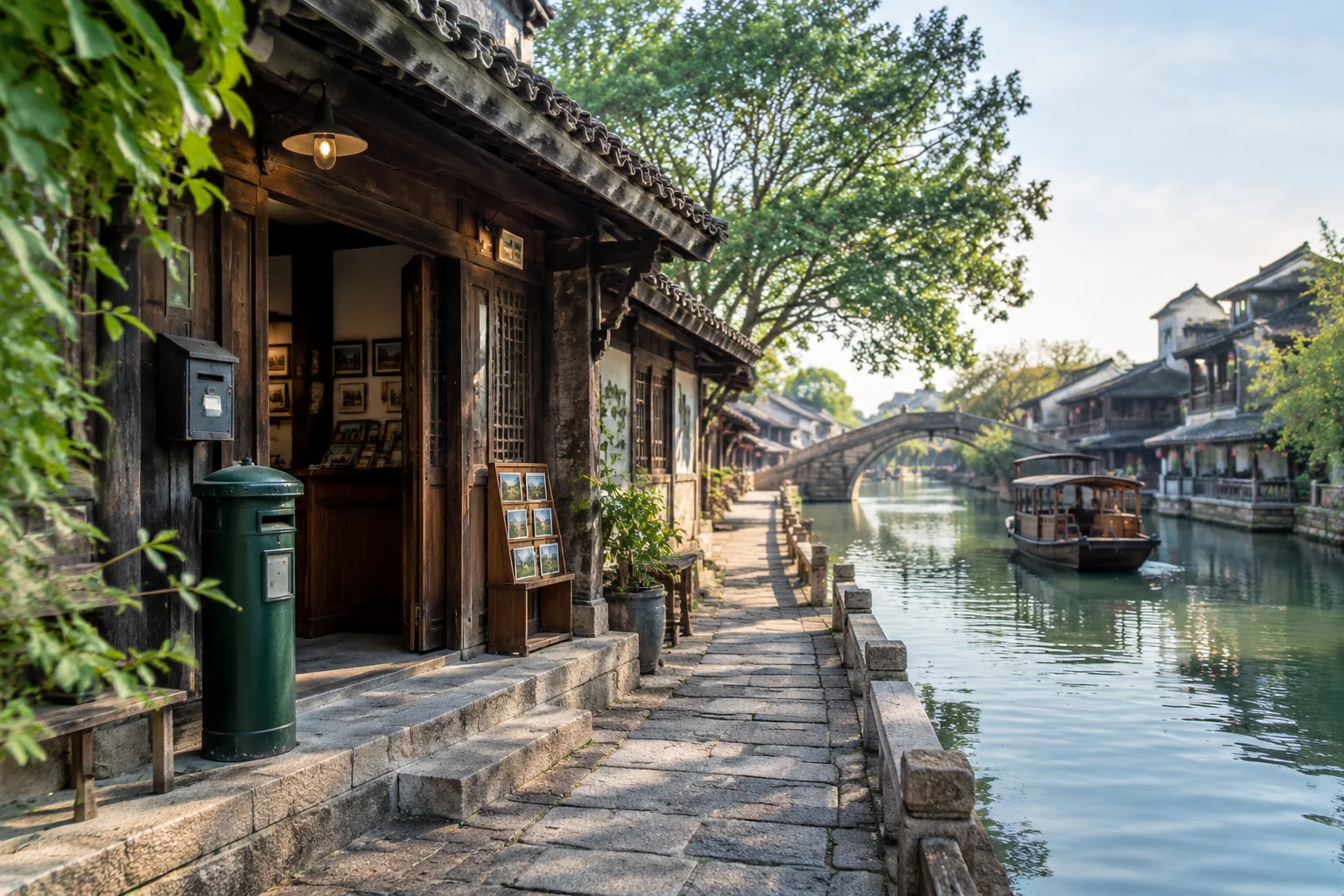
The old post office is in Wuzhen’s West Scenic Area, Xizha, on the bank of the Xishi River. Wuzhen itself lies in Tongxiang, Jiaxing, in Zhejiang. The West Scenic Area is the larger, more commercial and more leisure-oriented side of the water town in the old reference, while the East Scenic Area, Dongzha, is presented as the heritage-and-workshop side. The two are not the same visit, and the post office should not be confused with a civic post office elsewhere in Tongxiang.
The reference also lists a separate Tongxiang postal bureau for general postal business. That is not the visitor postcard stop. If you are searching on arrival, use the Chinese name 乌镇老邮局 and the West Scenic Area context rather than a generic word for post office. The old post office is also not in Dongzha. Planning it as an East Scenic Area stop will send you to the wrong side of town.
The surrounding geography matters. The old reference describes the West Scenic Area as a water-ringed district of lanes, bridges, shops and places to eat. Current entry arrangements, including any ferry crossing or visitor shuttle, should be checked at the visitor centre; do not assume an old transport pattern still applies. Once inside, orient yourself by the river. The post office is a riverbank building, so it fits naturally into a waterside walk rather than a detour through back streets.
How to Fit the Stop Into a West Scenic Area Walk
An older two-day Wuzhen itinerary gives a useful shape without being a current schedule. Its West Scenic Area day includes a ferry or entry point, a museum stop, the old post office for postcards, a pingtan performance at Wuzhen Theater, a climb or view at Bailian Temple Pagoda, lunch at Jiujiang Lou, and an afternoon around Lingshui Ju. Treat that as a flexible skeleton. Check which sights are open, which are included in your admission, and whether performances are running before you build a fixed route around them.
The practical sequence is to do the postcard stop before you are tired or pressed for time. Reach the old post office while the counter is likely to be staffed, ask about postage, and write the card there or nearby. Then continue to a river view, a teahouse-style pause or a performance if one is available. If the post office is closed, you have lost only a short pause, not the whole day.
| Option | Best for | What it involves | Main thing to verify |
|---|---|---|---|
| Quick postcard pause | Short stays, families, anyone with a fixed departure | Find the old post office, choose a card, write it, ask about postage and a postmark, then post it or keep it | Current opening, card availability, postage and whether posting is possible that day |
| Postcard plus riverside lanes | Travellers who want a slower half-day | Do the postcard first, then walk a short stretch of the Xishi River and nearby lanes, with a bridge or waterside pause | Which lanes are open and usable; do not assume a particular shop or teahouse is operating |
| Postcard inside a West Scenic Area circuit | First-time visitors with a full half-day | Use the old itinerary as a skeleton: one museum or interpretive stop, the post office, a performance or pagoda view, then a meal | Current admission inclusions, performance times and whether each sight is open |
For a short visit, choose the first or second option. A full circuit makes sense only if you have checked the current opening of the other sights and have enough buffer for queues, meals and the walk back to your entry point. Do not schedule a tight onward transfer immediately after the post office.
What to Write, Stamp and Send
A good postcard is specific. Include the date, the place, one detail you actually noticed, and a simple message. You might write about the brick facade, the river outside, the rain on the lanes or the fact that you are writing from a Qing-era post office. Avoid filling the card with a generic greeting that could have come from anywhere.
Write the destination address clearly and in the format used by the receiving postal service. Ask the counter staff what postage is required. For international mail, ask explicitly whether the old post office can send abroad and what rate applies. Do not assume that a card bought at the counter includes postage, or that a postmark is a guarantee of onward delivery. If the service is unclear, keep the card as a souvenir and ask for the safest option.
The old reference describes the pleasure of buying Wuzhen scenic postcards and having them postmarked, so it is reasonable to ask whether a postmark or cancellation is being applied that day. Policies can change. A commemorative mark, a normal cancellation and a souvenir stamp are not necessarily the same thing. Families can give children a simple task: choose one card, write three lines and keep a photograph of both sides before posting.
Protect the card from rain and damp. Keep it flat, avoid folding it, and photograph it before it goes into the postbox. If you are sending several cards, write them before reaching the counter so you do not hold up a queue while composing messages.
Pairing the Postcard Stop With Riverside Lanes
The post office is not the whole visit; the river is. Use the Xishi River as your route. A short walk along the water, a bridge crossing and a pause to look back at the lanes will do more for the day than trying to connect every shop in the West Scenic Area. The old reference describes the West Scenic Area as a place of waterways, shops and evening atmosphere, with boat rides and riverside views. Those descriptions are background, not a current activity schedule.
Evening can be atmospheric, but the post office may not be open then. Check its hours separately from the scenic area’s hours. If the post office closes earlier, write the card in the daytime and keep the evening for the lanes, bridges and waterside lights. Do not assume that a late scenic-area opening means late postal service.
Wet weather makes the post office a useful indoor pause, but do not assume seating, air-conditioning or a large dry waiting area. The sources do not verify a step-free route, lift or accessible counter. Travellers with limited mobility should ask visitor services about the approach to the building, the riverbank lanes and any queues rather than relying on general water-town descriptions.
When to Go and How Long to Allow
Go when the post office is open, not merely when the scenic area is open. Do not plan around hours or ticket prices printed in older guides. The old reference gives historic West Scenic Area information, but it is not a current schedule. Check current visitor information before setting your day, and ask at the visitor centre if the post office’s status is unclear.
Allow a flexible pause rather than a fixed slot. If the counter is quiet, the stop is brief. If there is a queue, or if you need to ask about international postage, it takes longer. The post office works best in the first half of your West Scenic Area time, when you still have patience to write and a buffer before your next stop.
A postcard does not need perfect weather, but the lanes and bridges can be wet. Carry the card in a stiff folder or a plastic sleeve, and keep a pen with you. In hot or humid conditions, treat the post office as a short breather rather than a long indoor rest. The sources do not support precise seasonal claims or precise walking times, so build in slack instead of relying on old estimates.
Common Mistakes and a Pre-Trip Checklist
The most common mistake is confusing the old post office with a working civic post office. Another is putting it in Dongzha. A third is crossing the West Scenic Area just to see one small building and then discovering that the counter is closed, the postcards are unavailable or international mail is not being handled that day. Treat it as part of a walk and keep the rest of the route flexible.
A practical checklist:
- Confirm current West Scenic Area admission and entry arrangements through current official visitor information.
- Check the old post office’s current opening and counter service before making it a priority.
- Ask whether postcards, postage and posting are available, and ask separately about international mail.
- Prepare addresses and a pen; keep a photograph of the card before posting.
- Allow a buffer and pair the stop with the Xishi River lanes rather than a tight schedule.
- For limited mobility, ask visitor services about the actual approach and any barriers on the day.
Frequently Asked Questions
Is Wuzhen’s old post office worth a stop?
Yes, if you value postcards, postal history or a small tangible ritual. It is not worth treating as a headline attraction. The building’s Qing-era history and its postcard tradition give the stop meaning, but the visit is short. Pair it with the river and nearby lanes so the journey there feels worthwhile.
Can I send a postcard abroad from the old post office?
That is not verified in the available reference. Ask at the counter before writing the card. If international service is available, confirm the postage and address format. If it is not, keep the card as a souvenir or ask staff for the safest alternative. Do not promise a friend that a card is on its way until you have confirmed the service.
Do I need a West Scenic Area ticket to visit the old post office?
The old post office is inside the managed West Scenic Area, so access is tied to whatever admission and entry system is in force. Check current admission rules before you go. Do not rely on old ticket prices or old entry descriptions. If you are staying inside the scenic area, ask your accommodation or visitor services about current re-entry procedures.
How long should I allow for the postcard stop?
Treat it as a short pause, not a half-day. Allow extra time if you plan to write several cards or ask about international postage. The post office can be fitted between a museum stop and a riverside walk. Do not put it immediately before a fixed train or coach departure.
When is the best time to visit the old post office?
Go during its confirmed opening hours, preferably earlier in your West Scenic Area visit. Evening is better for the lanes and waterside atmosphere, but the post office may close earlier. Check the current hours rather than assuming that the scenic area’s evening opening applies to the postal counter.
What should I do if the old post office is closed?
Continue your riverside walk and do not wait around on an unverified schedule. Use the building exterior as part of the lane route, and ask visitor services whether any alternative postal option is available. Do not assume another nearby shop sells postage or applies a postmark.
If you want help fitting the postcard stop into a wider Wuzhen or Hangzhou itinerary, you can send a travel inquiry using the form provided with this guide.
Sources and Verification
This article draws on internal reference documents, not live fact-checked pages.
- 《乌镇攻略》 (Wuzhen Guide), internal PDF, pages 4, 5, 7, 8 and 14. Pages 4 and 5 describe the postcard tradition and an older West Scenic Area itinerary; page 7 gives West Scenic Area context; page 8 describes the old post office, its history and its Xishi River location; page 14 lists a separate Tongxiang postal bureau and general practical information.
- 《浙江攻略》 (Zhejiang Guide), internal PDF, pages 16–18, for the regional context of Wuzhen in Tongxiang, Jiaxing, and general access background.
Source-backed background includes the post office’s Guangxu-era origin, its early letter, parcel and remittance business, foot-borne mail delivery, brick-and-tile construction, Xishi River location and the postcard-and-postmark visitor ritual. The older West Scenic Area itinerary is useful as a shape for a walk, not as a current schedule.
Current details need official confirmation: opening hours, admission and entry rules, postage rates, international mailing, postmark availability, card stock, counter staffing, accessibility and whether the interior is open. These are not verified here. No public URL, current price or fact-check date is asserted in this guide.
Find places & plan your visit
These links open external search results. Confirm the exact place, entrance and current arrangements.
Need help planning your trip?
Tell us about your travel plans and send an inquiry.